Planting trees is a visible CSR activity, but the number of saplings planted or photographs from a plantation event...

Industrial green spaces are often treated as rows of trees added around a factory boundary. In practice, effective green belt development requires much more planning.
A well-designed industrial green belt can help create a buffer between industrial operations and surrounding areas, support dust and noise interception, improve the site’s microclimate, and provide habitat value. But its effectiveness depends on where trees are planted, which species are selected, how the plantation is structured, and whether it is maintained over time.
For plant heads, EHS leaders, sustainability teams, facility managers, and CSR teams, the starting point should therefore be a site-specific industrial green belt development plan, not a generic plantation programme.
It is also important to distinguish regulatory green-belt requirements from voluntary environmental or CSR plantation.
A factory may undertake additional plantation as part of its sustainability or CSR programme, but this does not automatically replace green-belt obligations specified through applicable approvals or Environmental Clearance conditions.
Industrial green belt development refers to the planned establishment and management of vegetation around or within an industrial site to create a functional environmental and ecological buffer.
Unlike decorative landscaping, a factory green belt is planned around:
A properly planned green belt plantation can potentially help with:
However, companies should use careful language when describing these benefits.
A green belt can help intercept pollutants and provide environmental buffering, but it should not be presented as a replacement for pollution-control equipment or as a guarantee of pollution removal.
Pollution-control systems, statutory compliance measures, and green infrastructure perform different functions and should work together.
Companies planning industrial green belts should check the latest applicable requirements rather than relying on the commonly repeated assumption that every factory in India must maintain a uniform 33% green cover.
The Ministry of Environment, Forest and Climate Change issued an Office Memorandum on 29 October 2025 titled Rationalizing the requirement of green belt/green cover for Industrial Estates/Parks and individual industries based on pollution potential.
The memorandum superseded the earlier 27 October 2020 framework and introduced differentiated criteria based on industrial category, location, pollution potential, and project circumstances.
Official MoEFCC source:
https://parivesh.nic.in/publicdocument/UPLOAD_OM_NOTIFICATION/IA_DOCS/1002_31102025122841.pdf
For new greenfield industrial estates, the memorandum specifies that a minimum of 10% of the industrial-estate area should be designated as common green area, with dense plantation at 2,500 trees per hectare.
Individual industries located within industrial estates also have category-based minimum requirements.
| Industrial Estate Requirement | Minimum Green Belt / Green Area |
|---|---|
| Common green area in new greenfield industrial estates | 10% |
| Red-category member industries | 15% |
| Orange-category member industries | 10% |
| Green-category member industries | Optional under this provision |
| White-category member industries | Optional under this provision |
The memorandum also indicates that plantation should be located close to pollution sources where appropriate.
Companies may develop green cover beyond the minimum criteria depending on available land, ecological objectives, and site conditions.
For individual industrial units outside industrial estates that require Environmental Clearance, the applicable green-belt criteria should follow recommendations of the relevant sectoral Expert Appraisal Committee or State Expert Appraisal Committee and the conditions incorporated into the project’s Environmental Clearance.
The 2025 memorandum provides reference criteria that differentiate predominantly air-polluting sectors from other sectors.
| Category | Predominantly Air-Polluting Sectors | Other Sectors |
|---|---|---|
| Red | 25% for PIA ≥80 | 20% |
| Orange | 20% for PIA ≥55 | 15% |
| Green | 10% for PIA ≥25 | Optional |
| White | Optional | Optional |
These figures should not be treated as a universal plantation formula for every industrial project.
For brownfield projects involving modernisation, expansion, or changes in product mix, the Expert Appraisal Committees can determine green-belt requirements on a case-by-case basis after considering site conditions.
The memorandum specifies a minimum 40% green-belt requirement for Red and Orange category units located in Critically Polluted Areas and Severely Polluted Areas, subject to the applicable environmental-management framework.
Therefore, companies should not choose a plantation percentage simply because it is commonly quoted online.
Before finalising an industrial plantation plan, verify:
Regulatory interpretation should remain with the company’s EHS, environmental, and legal advisers.
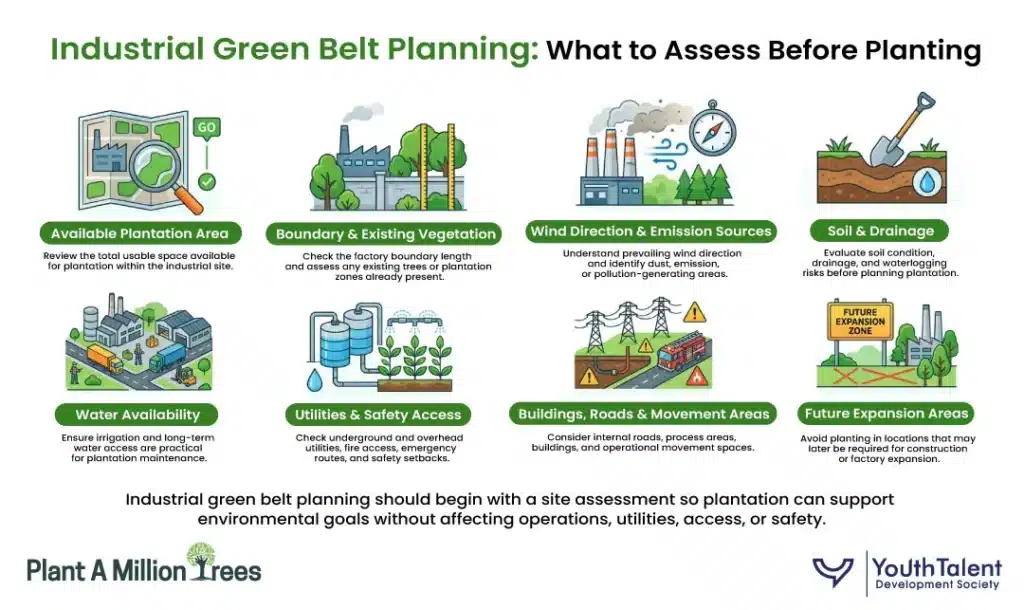
A strong site assessment should happen before the plantation design is prepared.
The objective is to understand where vegetation can realistically be established without interfering with factory operations, utilities, safety systems, emergency access, or future expansion.
The assessment should consider the following factors.
Identify the total land area as well as the portion that is genuinely suitable and available for plantation.
A site may appear to have sufficient open land, but some of that space may be required for utilities, access roads, safety zones, drainage, parking, or future construction.
Map:
Existing healthy vegetation should be considered as part of the site plan rather than automatically being replaced.
Understand the prevailing wind direction and identify:
This information can help determine where vegetation may provide greater functional value.
Review:
Poor site conditions should be addressed before plantation rather than relying on saplings to adapt after planting.
Companies preparing industrial sites can refer to PAMT’s guide on how to prepare plantation sites before monsoon in India for practical considerations around soil preparation, pit planning, water arrangements, and protection.
Identify:
Water planning should happen before plantation.
Map:
Planting should never be positioned near safety-sensitive areas simply to increase the number of trees planted.
Factories need uninterrupted operational movement.
Plantation planning should therefore consider:
Areas earmarked for future construction, utility work, or expansion should be identified before plantation begins.
The result of this assessment should be a practical industrial plantation plan showing planting zones, access requirements, protection measures, irrigation arrangements, and maintenance responsibilities.
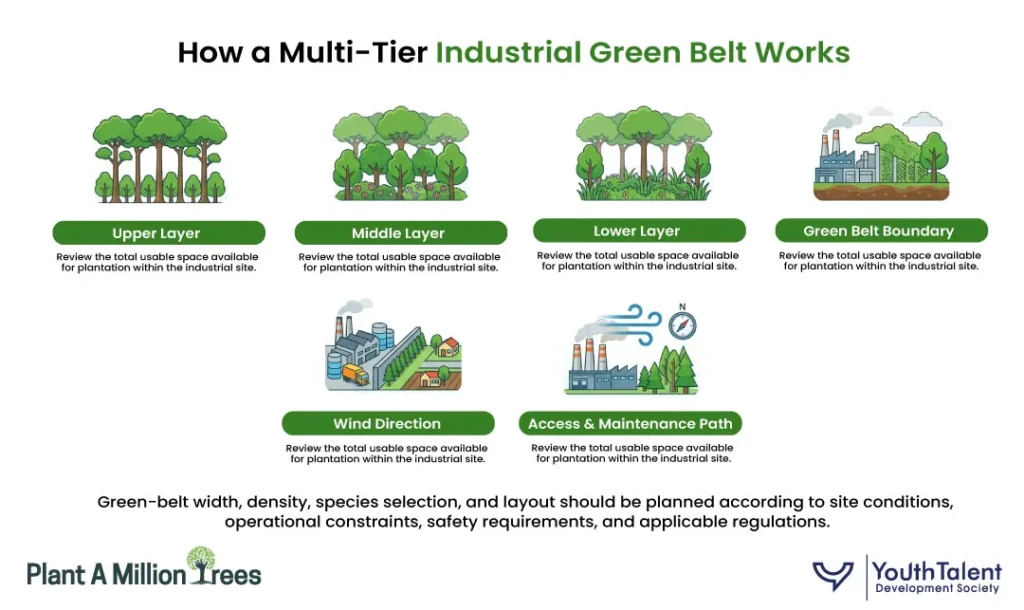
An industrial green belt does not have to consist of a single line of trees.
A multi-tier plantation can create a more structurally diverse vegetation barrier by combining vegetation at different heights.
A site-specific design may include:
Tall trees can form the upper canopy of the green belt.
Medium-height trees and shrubs can provide an intermediate vegetation layer.
Shrubs, grasses, and other lower vegetation can help create coverage closer to the soil surface.
The 29 October 2025 MoEFCC memorandum recommends a multi-tier plantation approach incorporating tall trees, medium vegetation, and ground cover where appropriate.
The actual number of rows, green-belt width, plantation density, and spacing should depend on factors such as:
Green-belt orientation should be considered as part of the site design.
The MoEFCC memorandum recommends alignment perpendicular to the predominant wind direction where appropriate to support pollutant interception.
Continuous plantation may also be useful along sensitive boundaries where site conditions permit.
However, this does not mean every factory should copy the same layout.
A narrow industrial plot, a manufacturing campus, and a large industrial estate will require different designs.
Companies planning plantation across factory campuses can also review PAMT’s guide on corporate campus tree plantation in India to compare boundary plantation, avenue plantation, biodiversity pockets, and dense plantation models.
Species selection is one of the most important decisions in industrial green belt development.
There is no universal list of trees that should be planted around every factory in India.
Species selection should consider:
The MoEFCC memorandum recommends native and pollution-tolerant species with demonstrated capacity to absorb or intercept dust, gaseous pollutants, and noise.
It also recommends a mix of evergreen and deciduous species to support year-round effectiveness.
For a broader understanding of why locally suitable species matter, read PAMT’s guide on native trees for sustainable tree plantation in India.
Companies planning seasonal plantation can also review the guide to native tree plantation for CSR projects for considerations around climate, soil, location, and plantation objectives.
The principle should remain simple:
Choose the right species for the site rather than selecting trees only because they are commonly planted.
Species should ideally be validated by a qualified local ecologist, forestry professional, horticulture expert, or another competent professional.
A species that performs well in one industrial region may be unsuitable in another because soil, rainfall, temperature, water availability, pollution exposure, and ecological conditions vary considerably across India.
Planting is only the beginning of a successful green belt plantation programme.
Before planting, soil preparation should be completed according to site conditions.
The planting sequence should also allow sufficient access for workers, equipment, irrigation, and future maintenance.
Planting pits, soil amendments, drainage improvements, and other preparation measures should be based on actual site conditions.
Poor soil preparation can affect establishment even when good-quality saplings are used.
Irrigation arrangements should be planned before saplings are installed rather than after plants begin experiencing water stress.
The system should consider both establishment-stage watering and maintenance during dry periods.
Protection measures may include:
The appropriate method depends on site conditions and operational risks.
Mulching can support soil-moisture management and help reduce weed pressure where appropriate.
Green belts require routine inspection so maintenance teams can identify:
Problems are easier to correct when they are identified early.
Some sapling mortality may occur during establishment.
If trees fail, companies should document mortality where possible, identify likely causes, correct underlying issues, and undertake replacement planting according to the maintenance plan.
The MoEFCC memorandum requires adequate provision for watering and protection of saplings and plants for at least five years, followed by subsequent sustenance.
This is why companies should think beyond plantation day.
A factory green-belt programme should have:
For detailed aftercare planning, see PAMT’s guide to post-monsoon tree plantation maintenance.
Companies can also refer to PAMT’s guide on how to improve sapling survival during monsoon plantation drives for practical considerations around establishment, protection, monitoring, and corrective action.
Companies should avoid guaranteeing a universal survival percentage.
Tree survival depends on species, soil, weather, irrigation, protection, site conditions, plantation quality, and maintenance.
Monitoring helps companies understand whether plantation is developing as intended rather than treating the number of planted saplings as the final result.
Useful monitoring indicators can include:
The 2025 MoEFCC memorandum places importance on monitoring and reporting of green-belt development.
For industrial estates, monitoring can include information such as:
Individual industrial units may also be required to report relevant green-belt information through applicable environmental reporting processes.
This makes documentation an important part of industrial green belt development.
Companies should maintain:
Documentation should be collected throughout the programme rather than reconstructed later.
For companies looking to move beyond simple tree counts, PAMT’s guide on biodiversity KPIs for CSR tree plantation explains how survival, species diversity, canopy development, and ecological indicators can be incorporated into plantation monitoring.
Not automatically.
Companies should not assume that an off-site CSR plantation can replace an on-site industrial green-belt requirement.
The 2025 MoEFCC memorandum allows industrial units to undertake additional ex-situ plantation, subject to land availability and applicable collaboration arrangements.
However, additional off-site plantation should be understood separately from the minimum green-belt requirements that may apply to industrial premises.
A company may therefore have:
Both can contribute to a broader environmental strategy, but they should not be treated as interchangeable unless the relevant regulatory authority specifically confirms otherwise.
Companies planning plantation across multiple business locations may also find PAMT’s guide on planning a multi-city CSR tree plantation programme in India useful when considering broader voluntary plantation initiatives beyond the factory green belt.
PAMT can support companies in moving from a basic tree-planting activity to a more structured industrial green belt development programme.
Depending on the project scope, support can include:
For industrial sites, the most useful approach is to begin with the actual site rather than with a predetermined number of saplings.
Available land, operational constraints, environmental objectives, water availability, safety requirements, existing vegetation, and long-term maintenance capacity should shape the plantation plan.
PAMT can support plantation planning, implementation, monitoring, and documentation.
However, interpretation of Environmental Clearance conditions, MoEFCC requirements, SPCB or PCC directions, and other statutory obligations should remain with the company’s EHS, environmental, and legal advisers.
If your company is planning a new industrial green belt or upgrading an existing plantation, begin with a site assessment.
Request an industrial green-belt site assessment and plantation proposal from Plant A Million Trees to evaluate available plantation space, site conditions, species considerations, plantation design, implementation requirements, and long-term maintenance needs.
No.
The applicable requirement can depend on the industrial category, pollution potential, project location, whether the unit is inside or outside an industrial estate, applicable Environmental Clearance conditions, and other project-specific requirements.
The 29 October 2025 MoEFCC memorandum introduced differentiated criteria rather than one universal percentage for every factory.
No.
The 33% figure has historically been prescribed for many sectors and continues to be widely referenced.
However, the October 2025 MoEFCC memorandum rationalised green-belt requirements using differentiated criteria based on factors such as project type, category, pollution potential, and location.
Companies should verify current Environmental Clearance and applicable regulatory conditions rather than automatically applying a 33% figure.
Begin with a site assessment covering:
Then develop a site-specific plantation layout, select suitable species, establish irrigation and protection systems, and prepare a long-term maintenance and monitoring plan.
There is no single best species list for every industrial site.
Companies should prioritise locally suitable native species and assess pollution tolerance where relevant.
Species selection should consider:
Local ecological, forestry, or horticultural validation is recommended.
The 29 October 2025 MoEFCC memorandum requires adequate provision for watering and protecting saplings and plants for at least five years, followed by subsequent sustenance.
Maintenance planning should therefore begin before plantation rather than after the trees are planted.
Not automatically.
Off-site plantation may form part of a company’s broader CSR, ESG, or environmental programme, but companies should not assume that it substitutes for an applicable on-site green-belt requirement.
Relevant Environmental Clearance conditions, EAC or SEAC recommendations, SPCB or PCC requirements, and other project-specific approvals should be verified.
Effective industrial green belt development is not simply about planting more trees around a factory.
It is about designing vegetation around the site’s environmental, operational, safety, regulatory, and ecological context.
A practical industrial green belt development plan should:
Most importantly, companies should distinguish regulatory green-belt obligations from voluntary corporate greening and CSR plantation.
The right plantation plan combines environmental intent with site-specific design, responsible implementation, monitoring, documentation, and long-term care.
Planning a new industrial green belt or improving an existing one? Request an industrial green-belt site assessment and plantation proposal from Plant A Million Trees to begin with a site-specific plan rather than a generic plantation target.
Planting trees is a visible CSR activity, but the number of saplings planted or photographs from a plantation event...
Corporate campuses are no longer viewed only as places where employees work or products are manufactured. Offices, factories, warehouses,...

A company with offices, factories, branches, or employee teams across India may want its environmental initiatives to reach multiple...