
Tree plantation programmes are increasingly part of corporate sustainability and rural development discussions. However, planting trees on agricultural land...

A company can select an experienced NGO, approve a plantation budget and still run into problems after the agreement is signed. The proposed plot may be available on planting day, but the NGO may lack permission to access it during summer. The company may release the second instalment when it receives event photographs, even though the proposal also calls for a verified planting register. Months later, both teams may discover that neither has budgeted for replacing failed saplings.
These issues are easier to resolve before the project starts. A CSR MoU with an NGO should connect the approved proposal to the work on the ground. It should identify the plantation site, assign responsibility for each phase, define the evidence required for payment and explain how the teams will handle delays, changes and underperformance.
The agreement also gives different teams a common reference. CSR and ESG teams can track whether the project delivers its intended outcomes. Procurement can verify deliverables, finance can review utilisation records, and the implementing agency can plan the people and resources needed for aftercare.
This article is a commercial and project review checklist. Use it to prepare for a discussion with your CSR, procurement, finance and legal teams. Have legal counsel draft or review the agreement for your project.
First, decide what the document needs to do. A memorandum of understanding (MoU) can record the terms of the collaboration. A CSR implementation agreement usually sets out how the approved project will be delivered and monitored. A grant agreement focuses on funding conditions, eligible costs, utilisation and reporting. A work order can authorise a defined package of work under an existing agreement. Schedules and annexures hold details such as the site map, itemised budget, maintenance plan and evidence requirements.
The legal effect of an MoU depends on its wording, the parties’ intention and applicable law. Ask legal counsel to identify which provisions are intended to bind the parties and whether any obligations, such as confidentiality or record retention, continue after the agreement ends.
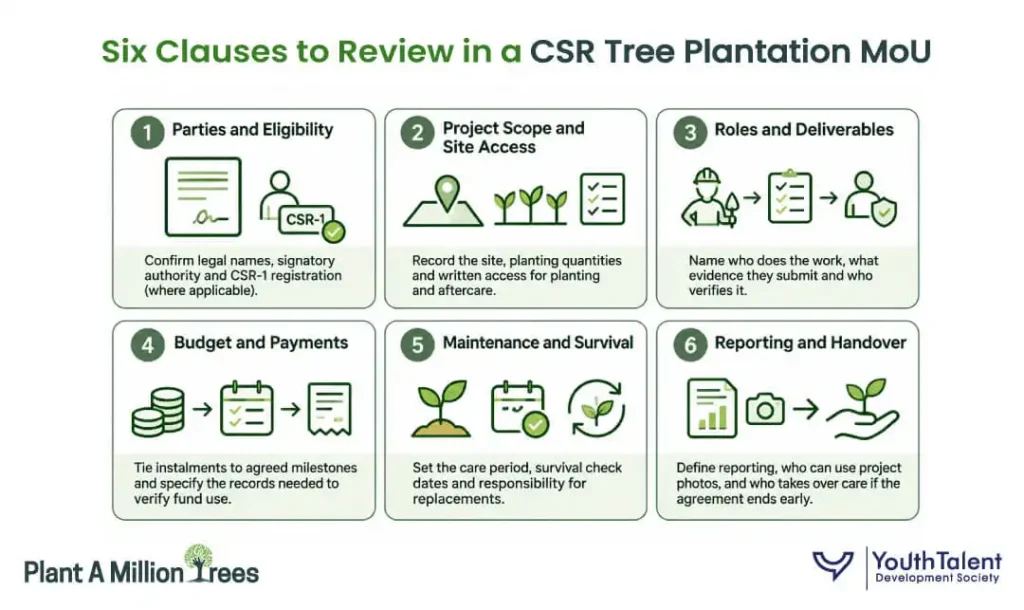
Check that the agreement uses each party’s full registered name and address. For the company, include its corporate identification details where relevant. For the NGO, check its legal form, registration number and applicable tax registrations against its records. Confirm that each signatory has the authority to sign on behalf of their organisation, and retain the supporting resolutions or authorisations where required.
The main document should also specify the effective date, project duration, formal notice contacts and how amendments are approved. List the attached schedules by name and version. If the MoU, proposal and work order describe different planting quantities or maintenance periods, the agreement should say which document takes precedence. Resolve known differences before signing so both teams work from the same scope.
Before appointing the NGO, verify that it qualifies as a CSR implementing agency under the applicable provisions of the Companies (CSR Policy) Rules, 2014, as amended. Check the NGO’s CSR-1 registration details and CSR registration number where applicable. The company should also independently confirm that the proposed activities fit its approved CSR project and relevant Schedule VII entry. Verify both the agency’s eligibility and the activity’s eligibility before signing.
During due diligence, review:
The agreement should identify the information each party relies on and require prompt disclosure of material changes. For example, name the person the NGO should notify if its registration, legal status or ability to deliver the approved work changes. Have the company’s legal and governance advisers review representations, warranties and statutory compliance clauses. Consider the project’s actual risks when agreeing on anti-bribery, fraud prevention, labour and safety requirements.
Use PAMT’s guide to selecting a CSR-1 registered NGO for tree plantation to organise the eligibility review. The CSR tree plantation vendor evaluation checklist can help the team assess field capacity, maintenance and past delivery.
Use a scope annexure to connect the plantation’s objective to the approved CSR project and relevant Schedule VII activity. Identify the location, intended beneficiaries or participating communities, planned outputs and implementation dates. For each site, include the village or city, district, state, site boundaries and a map or coordinates where available.
Record who owns or controls the land and who can authorise planting. Agree on who obtains written permission, who checks it and when the documents must be available. Where the land belongs to a municipality, school, community institution or private owner, confirm who can grant continued access for watering, survival checks and replacements. PAMT’s guide to tree plantation permissions in India covers the site questions to resolve before work begins.
The project schedule should specify:
Define how changes will be approved. If the NGO proposes a new site, for example, require a written request explaining the reason, permission status, revised quantities, cost and effect on maintenance. Identify who can approve the request and when it must go through the company’s internal CSR approval process. Update the scope and budget schedules once the change is approved.
Before finalising the annexure, check it against the CSR tree plantation proposal evaluation guide. Any deliverable the company relied on in approving the proposal should appear in the agreed scope.
An implementation agreement should identify who does each job and who confirms that it is complete. The NGO may manage field work and community coordination, while the company may approve the budget, review evidence and authorise payment. Landowners or site managers may also have responsibilities, particularly for access and handover.
The matrix below shows one way to assign responsibilities. Adapt it to the project and replace generic roles with the agreed teams or representatives.
| Activity | Responsible Party | Acceptance Evidence | Verifier |
|---|---|---|---|
| Site survey, permissions and community coordination | NGO project lead, working with the landowner or site authority | Survey, site map, written permission, maintenance access and relevant consultation records | Company CSR lead |
| Species selection, sapling procurement and planting labour | NGO field lead | Approved species list, delivery records, planting register and site photographs | Designated company project reviewer |
| Employee volunteering and safety, where included | Company event lead for employee coordination and NGO field lead for site safety | Agreed event plan, safety briefing and emergency contacts | Designated event leads |
| Irrigation, guards and routine maintenance | NGO maintenance lead | Watering and visit logs, condition of guards and records of corrective work | Designated monitoring representative |
| Survival checks and replacement | NGO monitoring lead and maintenance team | Dated survival count, replacement register and follow-up evidence | Company CSR reviewer or agreed third-party verifier |
| Project handover | NGO project lead and receiving site manager | Site records, open issues, next maintenance date and named owner | Company CSR lead |
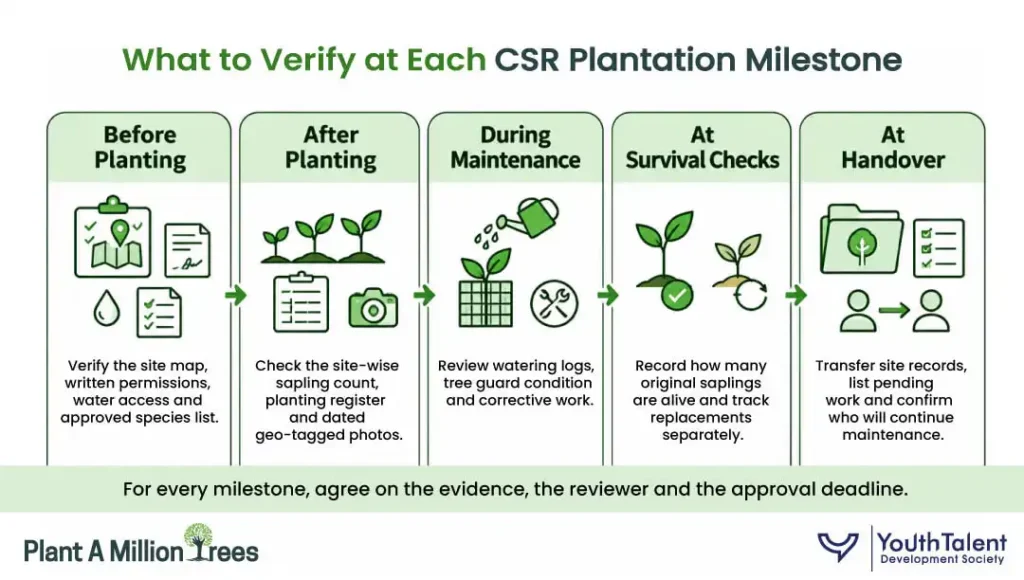
For each milestone, specify the submission deadline, review window and process for correcting incomplete work. For example, the first planting milestone can require a site-wise planting register checked against approved quantities, with an explanation for any variation. If the evidence is incomplete, the designated reviewer should record what needs correcting and set a resubmission date.
Attach an itemised budget covering the work the company has approved. Depending on the project, this may include site assessment, saplings, transport, labour, soil preparation, irrigation, guards, maintenance, replacement, monitoring and reporting. State how applicable taxes and charges are treated, and identify who can approve changes to budget lines.
Set out when payments can be released and what records support each release. An initial advance might follow signing and clearance of specified pre-planting requirements. A later instalment might depend on an approved planting register, a progress report and supporting utilisation records. Where aftercare runs beyond the planting phase, include maintenance and monitoring milestones in the payment schedule.
The National CSR eXchange FAQ on CSR fund disbursal and utilisation explains that transferring money to an implementing agency does not itself count as CSR spending. Rule 4(5) requires the company’s Board to satisfy itself that disbursed funds were used for the approved purposes and in the approved manner, with certification by the CFO or person responsible for financial management.
Agree which invoices, expense statements, utilisation certificates and other records the NGO must submit, and how advances will be reconciled. Identify who can place a payment on hold if evidence is missing or a milestone is disputed, what must be corrected and who clears the release. Specify how the company can inspect supporting records and how both parties will reconcile unused amounts at milestone review, year-end or exit, as applicable. Have finance and legal review the treatment of unspent balances and any project surplus under the applicable CSR requirements.
Set the start and end dates for maintenance, who will do the work and how it will be funded. Cover watering, weeding, mulching, protection and inspections as appropriate for the site. Name the person responsible for maintaining water access and the person who receives reports on damaged guards, dry soil or sapling loss. PAMT’s post-monsoon tree plantation maintenance guide can help teams plan for the transition into the dry season.
If the parties agree on a survival target, define the starting count, check dates, verification method and any exclusions. Decide whether the team will count every sapling or use an agreed sampling method. Record who can approve exclusions, how the NGO will document missing or inaccessible saplings, and what corrective action is due if survival falls below the agreed target.
For example, suppose 500 original saplings were verified at planting and 430 are alive at the six-month check. With no approved exclusions, original sapling survival is 86%. If the NGO then plants 50 replacements, record those separately and check them at the next visit. This preserves the original survival figure and gives the company a separate record of replacement work. Build the target around site conditions, species and available maintenance resources. See PAMT’s guide to measuring CSR plantation impact and survival.
Set replacement triggers, deadlines and cost responsibilities in the maintenance schedule. For events such as flooding, drought or fire, specify who documents the loss, how the parties agree on mitigation, and who approves revised timelines or scope. At handover, transfer site maps, maintenance logs, survival records and pending actions to the named party responsible for continued care.
Agree upfront on what the NGO will report, how frequently it will report and who will review the submission. A useful report shows planting progress, fund utilisation, maintenance visits, survival results, replacements, delays and agreed corrective actions. Use PAMT’s CSR tree plantation reporting guide to decide what to capture at each stage.
Define how the team will collect, label and store geo-tagged plantation evidence. For example, require a site identifier, coordinates, date and activity description so reviewers can connect the photographs to the relevant works and compare the same location across monitoring visits.
Review the following clauses before signing:
An early exit is easier to manage when the handover plan already answers who waters the saplings next, who holds the latest site records and who will verify outstanding work before the final financial reconciliation.
Review the agreement alongside the approved proposal, itemised budget, site permissions and implementation schedule. The CSR team should confirm the project scope and outcomes. Procurement should check that deliverables and acceptance criteria are clear. Finance should review payment and utilisation requirements, and legal counsel should confirm that the agreement reflects the intended obligations. Give the implementing agency and site team the same approved schedules so everyone works from the same dates, quantities and responsibilities.
If you are planning a CSR tree plantation project, share your preferred location, project scale, maintenance period and reporting needs with Plant A Million Trees. Request a proposal that sets out the scope, budget, deliverables, aftercare and evidence requirements before your legal team drafts or reviews the agreement.
Request a CSR Tree Plantation Proposal
Its legal effect depends on its wording, the parties’ intention and applicable law. Have legal counsel identify which obligations are binding and check whether an implementation agreement, grant agreement or work order better fits the proposed arrangement.
Common annexures include the site map and permissions, scope and species plan, itemised budget, payment milestones, responsibility matrix, maintenance schedule and reporting formats. Include a survival assessment method and handover checklist where those details need to be agreed separately.
The payment schedule should reflect project needs, internal controls and applicable CSR requirements. Where an advance is needed, specify its purpose, supporting records and reconciliation process. Link later releases to the deliverables and utilisation evidence agreed for the project.
Base both on the site, species, planting season, water availability and resources available for aftercare. Set the inspection dates and verification method, and specify when replacements are due, who pays for them and how they are recorded.
Agree on the frequency and format of updates. A typical report includes site-wise planting numbers, dated geo-tagged evidence, utilisation records, maintenance logs, survival counts, replacement activity and any issues that need a decision from the company.
Tree plantation programmes are increasingly part of corporate sustainability and rural development discussions. However, planting trees on agricultural land...
Why Tree Plantation Needs a Place in the CSR Annual Action Plan Tree plantation is a common choice for...

Companies in India are increasingly looking beyond conventional environmental activities to understand how their operations depend on nature, affect...