Tree plantation has become an important part of corporate environmental sustainability initiatives in India. Companies are funding plantation drives,...

A well-designed proposal can make a plantation project look convincing on paper. It may promise thousands of trees, employee participation, attractive plantation costs, photographs, and environmental impact. But none of these automatically tells a CSR team whether the project will succeed after the plantation day is over.
Before approving a CSR tree plantation proposal, companies need to look beyond planting numbers and presentation quality. The real questions are more practical: Where will the trees be planted? Who controls the land? Which species will be used? Who will maintain the saplings? How will survival be measured? And what evidence will the company receive?
A vague proposal can eventually lead to weak execution, poor survival tracking, unclear responsibilities, and reporting gaps. That is why CSR due diligence should happen before an NGO partnership is signed, not after problems emerge on the ground.
Here is a practical way to evaluate a plantation proposal before making that commitment.
The first stage of evaluating an NGO partnership for CSR is understanding the organization behind the proposal.
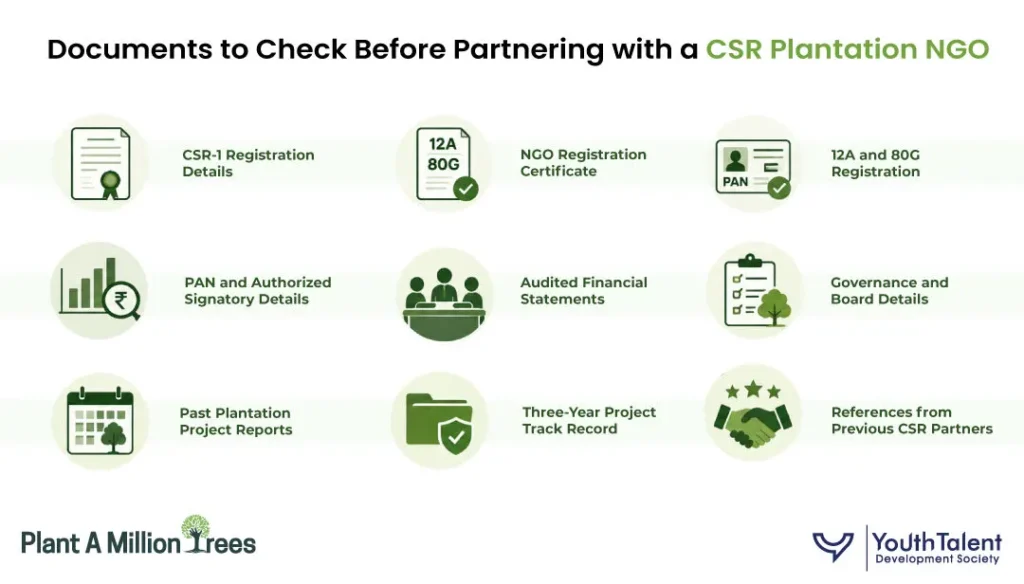
Before discussing plantation numbers or costs, companies should request basic organizational and compliance information relevant to the proposed engagement. This helps the CSR, finance, procurement, and compliance teams understand who will actually be responsible for project implementation.
One important due-diligence check is the NGO’s CSR-1 registration, where applicable to the proposed CSR implementation structure. Companies should request the relevant details and have their internal compliance or legal teams verify whether the proposed arrangement meets applicable requirements rather than relying only on a statement in a presentation.
Beyond CSR-1, the review should consider the NGO’s registration details, governance information, relevant financial documentation, and experience implementing similar projects.
Past work deserves particular attention. Ask for examples of completed plantation projects and, more importantly, evidence of what happened after those plantations.
A photograph showing 500 employees planting trees proves that an event took place. It does not prove that those trees survived.
A credible CSR implementing agency in India should be comfortable discussing maintenance, monitoring, reporting, challenges, and survival, not only plantation-day achievements.
This initial review helps companies determine whether further project evaluation is worthwhile before moving into operational details.
Once the organization itself has been reviewed, move to one of the most important parts of the CSR plantation proposal checklist: the site.
A proposal stating “plantation in Pune” or “plantation on community land” is not enough.
CSR teams should ask for clear plantation site details, including the proposed location, approximate plantation area, land ownership or control, access conditions, water availability, and the status of necessary permissions.
Useful questions include:
These questions often reveal issues that planting numbers alone hide.
For example, a proposal for 5,000 trees may appear more impactful than one for 3,000. But if the first site has limited space, unreliable water access, or unclear maintenance responsibility, the smaller and better-prepared project may create greater long-term value.
Companies should therefore evaluate the land as carefully as they evaluate the NGO.
After confirming the site, the next question is not simply “How many trees?” but “Which trees, and why?”
A reliable tree plantation NGO for CSR should be able to explain how its species plan relates to the location.
The proposal should identify the intended species or at least provide a clear process for finalizing them based on local conditions. Preference should generally be given to suitable native tree species and locally appropriate vegetation rather than selecting saplings simply because they are cheap or easily available.
Species selection should consider factors such as soil, rainfall, water availability, available growing space, local ecology, and the long-term purpose of the site.
This is particularly important because even a healthy sapling can struggle when planted in the wrong environment.
CSR managers do not need to become forestry experts to evaluate this section. They can ask straightforward questions: Why have these species been selected? Are they suitable for this particular location? What will their water requirements be? What ecological value will they provide? Are any proposed species potentially unsuitable for the local ecosystem?
A diverse, site-appropriate plantation can also contribute more meaningfully to biodiversity than a project designed around a single convenient species.
Species choice is therefore not a small technical detail. It influences survival, maintenance requirements, ecological value, and ultimately the credibility of the entire plantation project.
Plantation day lasts a few hours. The real project lasts much longer.
This is where many companies discover that proposals which looked detailed before signing become surprisingly vague.
A serious proposal should clearly explain post-plantation maintenance. Look for information on watering frequency, mulching where appropriate, protection, monitoring visits, replacement of dead saplings, pest or damage management, and the duration of maintenance support.
The company should also ask what survival rate will be monitored and how that figure will be calculated.
More importantly, understand what happens when saplings do not survive.
Does the NGO have a replacement policy? When will survival checks happen? Who bears the cost of replacement? Will replacement saplings also be monitored?
These questions change how the budget should be evaluated.
Suppose one proposal charges less per sapling but provides minimal maintenance, while another includes structured care and survival monitoring. Comparing only the initial per-tree price could make the cheaper proposal look better even when its long-term value is lower.
For CSR teams, cost per surviving tree can therefore be a more meaningful lens than simply cost per sapling planted.
If the proposal does not explain what happens during the months following plantation, ask for that information before approval. Maintenance should be part of the project design, not an optional conversation after plantation day.
A company should know before signing what evidence it will receive after implementation.
Good plantation reporting goes beyond sending a folder of employee photographs.
A proposal should explain how plantation locations, species, quantities, activities, and subsequent monitoring will be documented. Depending on the project design, this may include geo-tagged proof, site photographs, species lists, plantation dates, volunteer participation records, maintenance updates, and survival assessments.
Before-and-after documentation can be particularly useful because it helps create a clearer record of how the site develops over time.
Companies should also establish the reporting frequency. Will there be only one plantation completion report, or will maintenance and survival updates follow?
This distinction matters for internal CSR documentation and broader sustainability communication.
The same caution applies to environmental claims. If a proposal promises precise carbon sequestration or other impact numbers, CSR teams should ask how those figures are being calculated and what methodology supports them.
Transparent, conservative reporting is more credible than impressive numbers without documented assumptions.
A strong CSR tree plantation proposal should make it easy for the company to answer three questions later: What was done? Where is the evidence? What happened to the plantation afterwards?
Price comparisons can become misleading when two NGOs include different services under “cost per tree.”
One proposal may include only saplings and plantation execution. Another may cover site preparation, transportation, labour, protection, maintenance, monitoring, replacement, and reporting.
Their per-tree prices cannot be compared meaningfully without understanding what is included.
When reviewing the budget, CSR teams should check for costs related to saplings, transportation, pit preparation, labour, plantation execution, tree guards or other protection where required, watering, maintenance, monitoring, documentation, and replacement planting.
The proposal should make inclusions and exclusions clear.
Watch for unusually low prices without an explanation of how maintenance and reporting will be delivered. A low plantation-day cost can become expensive if survival is poor and the company later needs to fund replanting.
At the same time, a higher quotation should not automatically be considered better. The NGO should be able to explain what additional value the company receives.
The objective of an NGO proposal comparison should therefore be value and long-term outcome, not simply finding the lowest number in the quotation.
For companies unfamiliar with plantation implementation, reviewing every ecological, operational, and reporting detail can become difficult.
Plant A Million Trees, an initiative by Youth Talent Development Society, can support companies in structuring CSR plantation projects around practical goals and long-term outcomes.
The process can include discussions around plantation objectives, site planning, suitable species, employee engagement, execution requirements, maintenance expectations, and reporting support. This allows companies to look at the plantation as a complete project rather than treating the NGO partnership as simply a procurement of saplings.
For employee-focused projects, planning can also consider participant numbers, on-ground coordination, plantation activities, and how employee involvement connects with the larger environmental purpose.
Companies considering a plantation partnership can discuss their CSR goals, proposed scale, employee participation requirements, and reporting expectations before finalizing the project structure.
Discuss your project goals with our team and get a structured CSR plantation proposal covering planning, execution, maintenance, employee participation and reporting requirements.
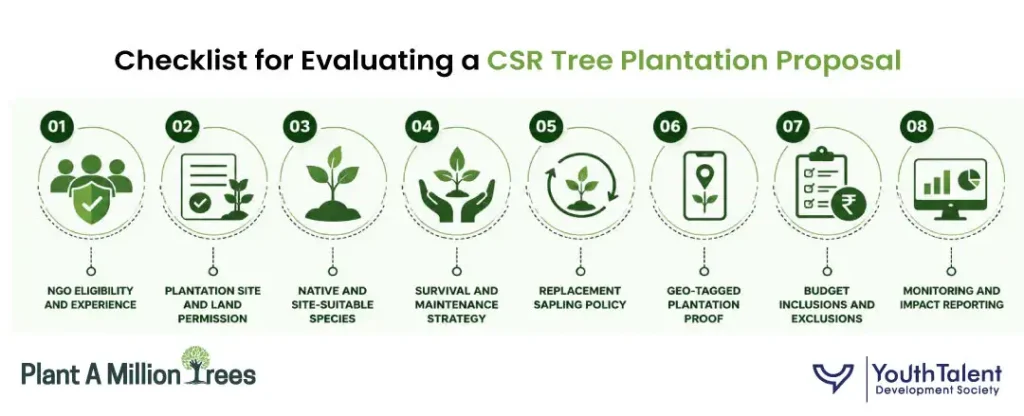
Companies should review NGO eligibility, CSR-1 registration where applicable, site and permission details, species selection, maintenance arrangements, survival monitoring, project cost, geo-tagged documentation, and reporting commitments. The proposal should explain both plantation execution and what happens afterwards.
Some of the most important questions to ask a tree plantation NGO before a CSR project concern land ownership, permissions, native species, water availability, maintenance duration, expected survival monitoring, replacement policy, geo-tagging, reporting frequency, and past project evidence.
CSR-1 can be an important compliance consideration for applicable arrangements, but companies should not use a single registration as the only selection criterion. The NGO’s project experience, site planning, execution capability, maintenance process, documentation, governance, and reporting quality should also be evaluated.
Planting numbers record an activity; survival helps indicate whether that activity is creating lasting value. Companies should therefore understand how survival will be measured, when assessments will take place, and what happens when saplings need replacement.
Knowing how to evaluate a CSR tree plantation proposal before signing an NGO partnership comes down to asking better questions before committing the budget.
Do not evaluate a project only by the number of trees promised, the per-tree price, or the quality of the presentation. Look at the NGO’s eligibility and experience, land clarity, species suitability, maintenance commitment, survival measurement, budget transparency, and quality of evidence.
A useful CSR plantation proposal checklist for companies in India should ultimately answer one question: does this proposal provide a credible path from planting trees to sustaining and proving their impact?
When those details are clear before the partnership begins, CSR teams are better positioned to build projects that are easier to execute, monitor, report, and defend internally.
For companies exploring a structured plantation initiative, the next step should be a project discussion that defines the site, goals, scale, maintenance requirements, employee participation, and reporting expectations before the proposal is approved.
Tree plantation has become an important part of corporate environmental sustainability initiatives in India. Companies are funding plantation drives,...
Industrial green spaces are often treated as rows of trees added around a factory boundary. In practice, effective green...
Planting trees is a visible CSR activity, but the number of saplings planted or photographs from a plantation event...