Industrial green spaces are often treated as rows of trees added around a factory boundary. In practice, effective green...

Tree plantation has become an important part of corporate environmental sustainability initiatives in India. Companies are funding plantation drives, biodiversity restoration, community greening, native-tree programmes, and long-term ecological projects. But the compliance question matters just as much as the environmental objective: is tree plantation eligible for CSR in India?
Tree plantation can qualify as CSR when the project is properly structured, relates to an eligible subject under Schedule VII, and is implemented in line with the applicable CSR framework. However, not every plantation event automatically becomes eligible CSR expenditure simply because trees are planted.
For CSR committees, compliance teams, CFO offices, ESG teams, and implementing agencies, tree plantation CSR eligibility depends on how the project is designed, approved, implemented, maintained, monitored, and documented. Companies should connect the activity to their CSR Policy and, where applicable, the Board-approved annual action plan rather than treating plantation as a standalone event.
This guide explains the legal basis, practical project design, implementation routes, employee-volunteering considerations, and documentation companies should review before committing CSR funds to a plantation project in India.
The legal starting point is Section 135 of the Companies Act, 2013, read with the Companies (CSR Policy) Rules, 2014 and Schedule VII of the Companies Act, 2013.
Section 135 generally applies when a company meets any of the prescribed financial thresholds during the immediately preceding financial year: net worth of Rs. 500 crore or more, turnover of Rs. 1,000 crore or more, or net profit of Rs. 5 crore or more. The Ministry of Corporate Affairs CSR FAQ provides official guidance on applicability, governance, expenditure, implementing agencies, annual action plans, and related compliance questions.
For plantation projects, the most relevant Schedule VII entry is clause (iv). It covers environmental sustainability, ecological balance, protection of flora and fauna, animal welfare, agroforestry, conservation of natural resources, and maintenance of the quality of soil, air, and water.
This creates a potential legal basis for properly structured environmental projects involving tree plantation, ecological restoration, biodiversity improvement, agroforestry, degraded-land restoration, and related interventions. MCA has also clarified that Schedule VII entries are broad-based and should be interpreted in a way that captures the essence of the listed subjects. See General Circular No. 21/2014.
That does not mean a company should label any plantation expense as CSR. The project should clearly explain the environmental need, location, intended ecological or community benefit, implementation approach, maintenance responsibilities, budget, monitoring framework, and how the activity relates to the company’s approved CSR framework.
Important: This article provides general guidance only. Companies should confirm project-specific eligibility and accounting treatment with their CSR, legal, finance, secretarial, and compliance advisers before committing CSR funds.
A plantation activity may have environmental value without automatically qualifying as CSR expenditure. The distinction lies in the purpose of the project and how it is approved, structured, implemented, and monitored.
For example, a company may organise a one-day plantation activity inside its office campus mainly as an employee-engagement or beautification exercise. That activity should not automatically be classified as CSR merely because trees were planted.
A stronger CSR project would identify an eligible environmental objective, define the site and ecological need, establish maintenance and monitoring, assign responsibilities, document expenditure, and explain how the intervention fits the company’s CSR Policy and applicable annual action plan.
Companies should also check the applicable CSR exclusions. Depending on the circumstances, activities undertaken to fulfil statutory obligations, activities designed to benefit only employees and their families, certain sponsorship or marketing-led activities, and other excluded categories should not be treated as CSR simply because they have a social or environmental element.
The practical principle is simple: a plantation project should be designed as a defined environmental intervention, not described as CSR only because it involves trees.
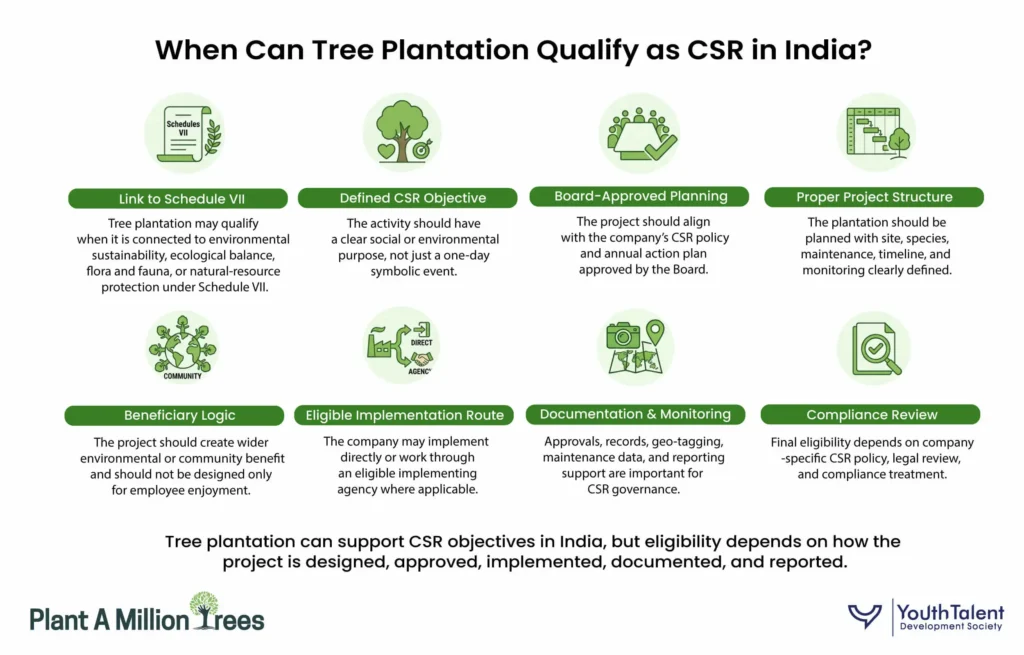
A well-developed CSR tree plantation project in India should connect the environmental objective to the activities, location, budget, implementation process, maintenance plan, and expected outcomes. Before approval, companies can also use a structured CSR tree plantation proposal evaluation process to test whether the project is operationally credible.
Start by explaining why the project is required. The objective could involve restoring degraded land, improving native vegetation, supporting biodiversity, increasing green cover, improving ecological conditions in a community, supporting watershed or soil-related outcomes, or developing a long-term plantation asset.
The proposal should describe the site’s current condition and the problem being addressed. Where practical, baseline information can include existing vegetation, land characteristics, soil condition, water availability, local biodiversity observations, and known site constraints.
A broad statement such as “plant trees to save the environment” is not enough on its own. A specific project objective gives the Board, CSR team, and implementing agency a clearer basis for planning and monitoring.
Site selection influences both eligibility assessment and long-term project performance. Companies should establish land ownership or authorised access, site suitability, soil and water conditions, drainage, existing vegetation, maintenance access, and potential risks.
Required approvals should be checked before execution. The exact process can vary depending on whether the land is public, privately owned, institution-managed, leased, or controlled by another authority.
PAMT’s guide to tree plantation permission in India explains the practical questions companies should resolve before fixing a plantation site.
Species selection should reflect local ecological conditions rather than a standard list used across every project. The plan should consider rainfall, soil, water demand, mature tree size, root behaviour, local biodiversity, maintenance requirements, and the intended plantation model.
Where appropriate, preference should be given to suitable native or locally adapted species. Companies can review PAMT’s guide to native tree plantation for CSR projects when developing a site-specific species plan.
The proposal should also define the plantation area, estimated number of saplings, species mix, spacing, planting method, and any protection or irrigation requirements.
Plantation does not end on planting day. Watering, protection, weeding, mulching where appropriate, replacement planting, periodic inspection, and corrective action may be necessary during the establishment period.
The project should identify who is responsible for maintenance, how frequently monitoring will occur, how long the maintenance commitment runs, and how these activities are budgeted.
Useful indicators can include saplings planted, survival observations, species diversity, replacement planting, maintenance visits, and site-specific growth indicators.
CSR teams should distinguish between what was done and what happened afterwards. The number of saplings planted is an output. Survival, maintenance completion, vegetation development, biodiversity indicators, or other project-specific measures can provide a stronger picture of performance over time.
Reporting expectations should be established before the project starts. PAMT’s guide to tree plantation reporting for CSR teams can help companies define what evidence and project information should be retained through implementation and maintenance.
Companies can implement eligible CSR projects directly or through an eligible implementing agency, subject to the applicable CSR framework. The appropriate route depends on the company’s internal capacity, project scale, geography, technical requirements, field execution needs, and monitoring arrangements.
Direct implementation may suit companies with an established CSR team, relevant environmental expertise, sufficient field capacity, and the ability to manage permissions, procurement, plantation execution, maintenance, documentation, and reporting.
Before choosing this route, companies should assess whether internal teams can manage the full project lifecycle rather than only plantation-day logistics.
An external implementing agency can support site identification, local coordination, ecological planning, plantation execution, employee participation, maintenance, monitoring, and reporting.
Where the CSR Rules require it, the implementing entity must satisfy the applicable eligibility conditions and complete CSR-1 registration. Companies can use PAMT’s guide on selecting a CSR-1 registered NGO for tree plantation as a starting point for compliance-focused due diligence.
CSR-1 should not be treated as proof that every proposed plantation activity qualifies as CSR or that an agency will deliver a high-quality project. The company should still review legal status, governance, relevant registrations, financial controls, past project experience, field capacity, maintenance systems, monitoring, reporting, and project-specific competence.
A structured CSR tree plantation vendor evaluation checklist can help procurement, CSR, finance, and compliance teams compare implementation partners on more than price alone.
The project agreement should clearly define scope, responsibilities, milestones, payment terms, maintenance obligations, documentation, reporting expectations, monitoring arrangements, and the treatment of unspent or unused project funds where relevant.
Employee participation can strengthen awareness, engagement, and connection with a company’s environmental programme. A corporate plantation drive may allow employees to take part in planting, site activities, awareness sessions, or approved project monitoring.
However, employee engagement and CSR accounting should be treated separately. MCA guidance makes clear that employee involvement should not simply be monetised and counted as CSR expenditure. The CSR framework also excludes activities that benefit only employees and their families.
A stronger approach is to design the initiative around an eligible environmental objective and treat employee volunteering in CSR tree plantation as one component of the wider project.
For example, employees may participate on plantation day while the larger project includes site validation, suitable species, permissions, community or ecological relevance, maintenance, survival monitoring, and structured reporting.
The proposal should clearly distinguish the plantation project’s approved expenditure from internal HR engagement costs or employee-time valuation.
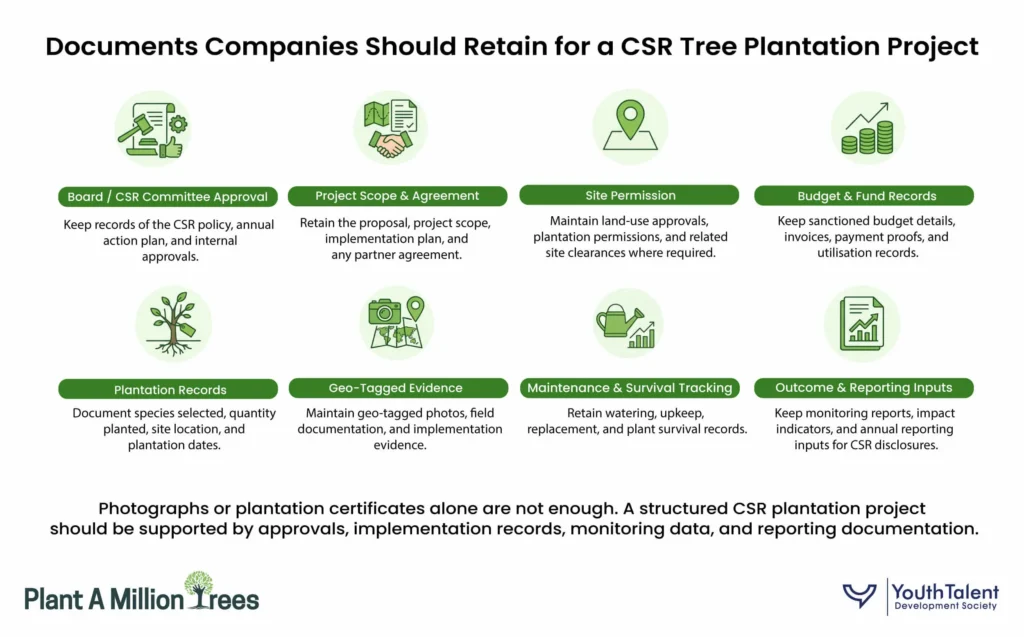
Good documentation supports governance, monitoring, financial review, annual CSR reporting, and internal accountability. Records should be maintained throughout the project lifecycle instead of being assembled only at the end.
Photographs, plantation certificates, and event reports can support the evidence trail, but they should not be treated as standalone proof of CSR eligibility or long-term environmental impact.
A well-planned plantation project requires coordination between the company’s CSR team, implementation partner, local stakeholders, site managers, and those responsible for maintenance and reporting.
Plant A Million Trees (PAMT) can support companies in translating an environmental objective into a scoped plantation project through site planning, locally suitable species selection, plantation execution, employee participation, maintenance planning, monitoring, geo-tagged documentation, and reporting support.
Companies exploring CSR tree plantation programmes for companies can discuss the proposed location, project scale, environmental objective, employee participation, maintenance period, monitoring requirements, and reporting expectations before the implementation plan is finalised.
PAMT can support project planning and execution, but the company Board and its professional advisers remain responsible for determining CSR eligibility, accounting treatment, governance, and compliance for the specific project.
Request a structured CSR tree plantation proposal covering project scope, site planning, plantation execution, employee participation, maintenance, monitoring, and reporting requirements.
Tree plantation can qualify when the project is connected to an eligible Schedule VII subject, particularly environmental sustainability and ecological balance, and is structured and implemented in accordance with the applicable CSR framework. Eligibility should be assessed on the actual project design, not simply on the fact that trees are being planted.
The location alone does not determine eligibility. A plantation on company premises requires careful assessment of the project’s purpose, beneficiaries, Schedule VII alignment, and applicable exclusions.
A project carried out merely for campus beautification, designed only for employees, or undertaken to satisfy a statutory environmental obligation should not automatically be treated as CSR. Company-specific treatment should be reviewed with legal and compliance advisers.
No. CSR-1 is an important registration requirement for applicable implementing agencies, but it does not by itself establish that every proposed activity is eligible for CSR or that the organisation can deliver the project effectively.
Companies should conduct legal, governance, financial, operational, and project-specific due diligence.
Not automatically. Employee participation can be part of a wider eligible environmental project, but employee time should not simply be monetised as CSR expenditure, and activities benefiting only employees and their families are excluded.
A stronger project includes an environmental objective, suitable site, implementation plan, maintenance, monitoring, and reporting beyond the event itself.
No. They can support project documentation, but companies should also retain approvals, project records, expenditure evidence, site permissions where applicable, species and quantity records, maintenance information, monitoring evidence, utilisation records, and reporting inputs.
A plantation project’s credibility depends on the complete evidence trail, not a single certificate or event photograph.
CSR activities under Schedule VII provide a framework through which companies can support environmental sustainability, ecological balance, biodiversity, agroforestry, and conservation of natural resources. Tree plantation can fit within this framework, but eligibility should never be assumed solely because planting has taken place.
The stronger approach is to define the environmental need, validate the site, select suitable species, establish maintenance and monitoring, choose the right implementation route, document expenditure and project evidence, and connect the initiative to the company’s CSR governance process.
For companies planning CSR tree plantation in India, this project-based approach can support better governance, stronger accountability, and more credible environmental outcomes.
Before committing CSR funds, companies should confirm project-specific treatment with their CSR, legal, finance, secretarial, and compliance advisers.
Connect your environmental objective with site planning, plantation execution, maintenance, monitoring, and reporting.
Industrial green spaces are often treated as rows of trees added around a factory boundary. In practice, effective green...
Planting trees is a visible CSR activity, but the number of saplings planted or photographs from a plantation event...
Corporate campuses are no longer viewed only as places where employees work or products are manufactured. Offices, factories, warehouses,...