Planting trees is a visible CSR activity, but the number of saplings planted or photographs from a plantation event...


Monsoon in India does more than bring rain, it brings an opportunity to restore ecosystems.
Every year, thousands of CSR plantation drives are organized across the country. Companies plant saplings to support sustainability goals, employee engagement programs, and environmental commitments. Yet, a fundamental question often goes unasked: Are we planting trees, or are we rebuilding ecosystems?
The answer lies in species selection.
The most successful plantation projects are not necessarily those that plant the highest number of saplings. They are the ones that select the right species, achieve high survival rates, and create lasting ecological value. This is why native trees for monsoon plantation India should be at the center of every CSR initiative.
Monsoon offers ideal conditions for root establishment, moisture availability, and early growth. When combined with indigenous species adapted to local environments, plantations become more resilient, biodiversity-rich, and sustainable over the long term.
This guide explores the best native trees to plant during monsoon in India for CSR projects, helping organizations move beyond plantation numbers toward meaningful environmental restoration.
Tree plantation is no longer just a CSR activity, it is increasingly becoming a long-term sustainability strategy. However, the ecological benefits of plantation depend greatly on the species selected.
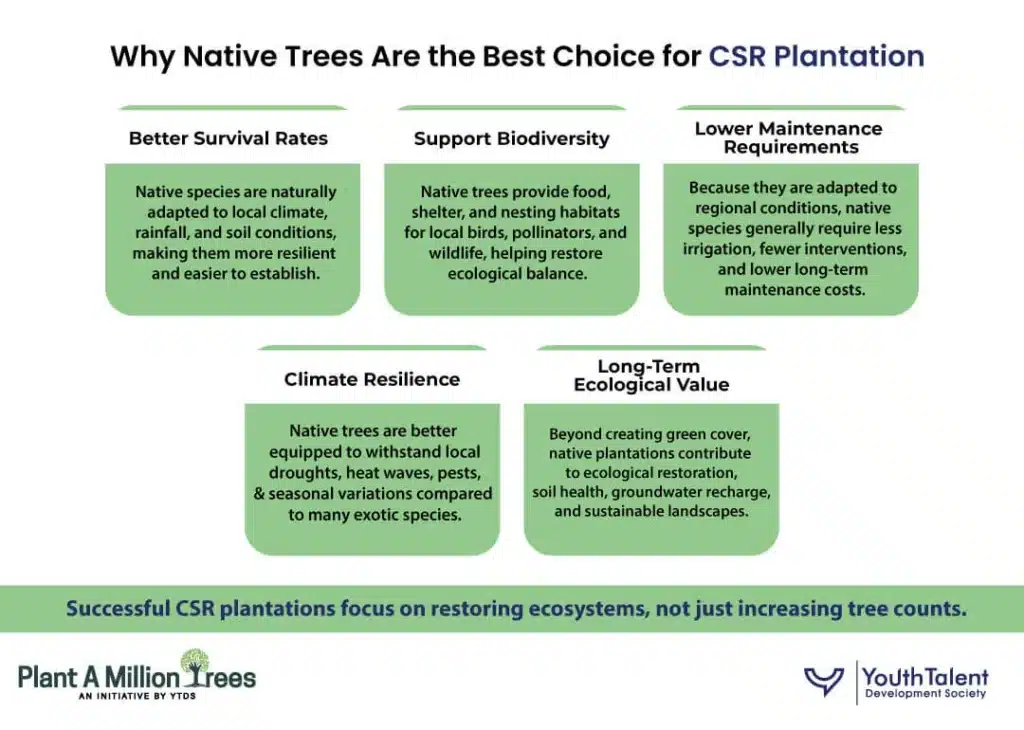
Native species have evolved over centuries alongside local soils, climate, wildlife, and rainfall patterns. As a result, they typically outperform exotic species in survival, ecosystem support, and resilience.
Many companies discover that fast-growing exotic trees may initially appear attractive because of rapid growth rates. However, they often require more maintenance, support fewer native birds and insects, and may even disrupt local ecology.
By contrast, native trees India provide several advantages:
For CSR teams seeking measurable impact, native species often deliver better environmental returns over decades rather than years.
After all, a successful plantation project should not merely create green cover, it should rebuild ecological relationships.
India’s monsoon season creates ideal conditions for sapling establishment.
Consistent rainfall reduces water stress, improves soil moisture, and allows young roots to spread more effectively. Unlike summer plantations, monsoon plantation minimizes irrigation needs during the most vulnerable stage of a sapling’s life.
This is particularly important for CSR plantation trees, where long-term maintenance budgets may be limited.
Young saplings planted during monsoon often experience:
However, rainfall alone does not guarantee success.
Many plantation projects fail because they overlook site preparation, species suitability, or aftercare. Monsoon helps, but survival depends on planning.
This is why experts increasingly emphasize one principle:
Plant during monsoon but prepare before monsoon.
A common mistake in plantation projects is selecting species based on popularity rather than suitability.
The same tree that thrives in Rajasthan may struggle in Assam. A species suitable for highways may not perform well in urban parks.
The idea of “right tree, right place” is central to sustainable forestry.
When selecting species, consider:
India’s ecological diversity ranges from arid deserts to tropical rainforests. Species should match regional rainfall and temperature patterns.
Clay, sandy, rocky, and alluvial soils support different species.
Urban sites require pollution tolerance and root management, while rural landscapes may prioritize ecological restoration.
Ask what the project seeks to achieve:
The best CSR projects align species selection with environmental objectives.
North India experiences hot summers, monsoon rainfall, and cooler winters. Species selected here must tolerate climatic variation.
These species are considered high survival trees under appropriate conditions and are frequently used in public and CSR plantations.
Southern India’s tropical climate allows diverse native species to flourish.
Many CSR projects in southern India increasingly prioritize these biodiversity-friendly trees because they provide long-term ecological benefits beyond carbon storage.
Western and central India often experience dry conditions and variable rainfall.
Heat resilience makes these trees particularly suitable for large-scale CSR initiatives in Maharashtra, Gujarat, and Madhya Pradesh.
For organizations seeking durable CSR plantation trees, species resilience often matters more than growth speed.
Eastern and Northeastern India possess some of the country’s richest biodiversity.
Plantation in these regions requires ecological sensitivity and careful species selection.
Because these regions receive heavy rainfall, species adapted to moist conditions generally perform best.
Protecting local ecology is especially important here, as inappropriate plantation can alter delicate ecosystems.
Urban India presents unique challenges: pollution, limited space, heat islands, and compacted soil.
Cities require native species that tolerate stress while supporting ecosystem services.
Suitable urban species include:
Urban plantations should focus on:
Many cities increasingly recognize that native trees India improve urban resilience far better than ornamental exotics.
Well-designed urban plantations become green infrastructure rather than decorative landscapes.
Many plantation failures begin with poor species selection.
A common mistake we see in CSR projects is prioritizing visibility over ecology. Fast-growing or ornamental species may create immediate visual impact but fail to deliver long-term benefits.
Some frequent errors include:
Monoculture plantations may appear efficient but often reduce ecosystem resilience.
Diversity improves survival.
Mixed plantations containing multiple native species create healthier and more stable ecosystems.
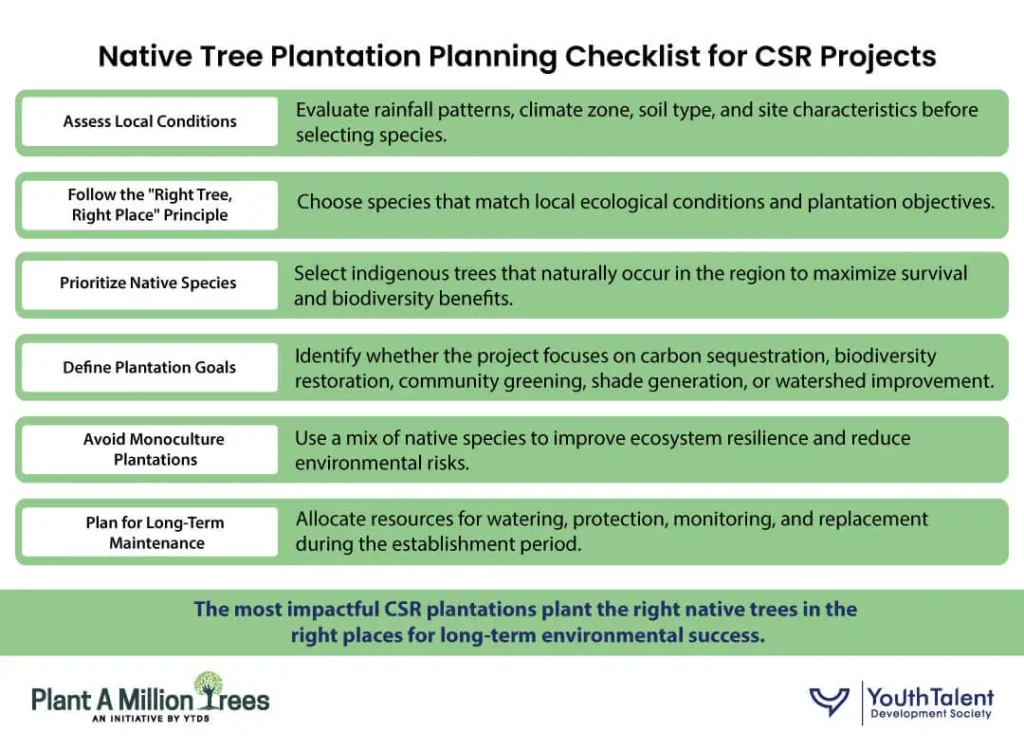
Before launching a plantation project, CSR teams should ask:
Successful plantation begins long before saplings reach the ground.
Organizations that invest in planning consistently achieve stronger environmental outcomes.
Build your plantation around the right site, locally suitable species, long-term maintenance and survival monitoring instead of selecting trees only by availability.
Share your preferred location, plantation scale and CSR objectives to discuss a structured native tree plantation approach.
Plan Your CSR Plantation ProjectNative trees are naturally adapted to local conditions, require less maintenance, and support local biodiversity more effectively.
Neem, Jamun, Arjun, Pongamia, Kadamba, Sal, and Peepal are among the best trees for monsoon planting, depending on the region.
They have evolved under local climatic conditions, making them more resilient to pests, drought, and rainfall variability.
Very important. Region-wise native trees ensure ecological compatibility and improve plantation success.
Yes. Many native species tolerate pollution while providing shade, biodiversity support, and climate resilience.
Trees that provide food, habitat, nesting sites, or pollinator support are considered biodiversity-friendly trees.
Tree plantation should not be treated as a numbers game.
The real success of a CSR project lies in survival, ecological restoration, and long-term environmental value. Native species offer a powerful pathway toward achieving these goals.
By choosing native trees for monsoon plantation India, companies can build landscapes that support biodiversity, strengthen climate resilience, and create lasting community benefits.
The future of sustainable plantation is not about planting more trees, it is about planting the right trees.
Because the best CSR plantation projects restore ecosystems, not just landscapes.
Planting trees is a visible CSR activity, but the number of saplings planted or photographs from a plantation event...
Corporate campuses are no longer viewed only as places where employees work or products are manufactured. Offices, factories, warehouses,...

A company with offices, factories, branches, or employee teams across India may want its environmental initiatives to reach multiple...