

“How much land do we need for 1,000 trees?” is one of the first practical questions CSR teams ask...

“Choosing the wrong plantation partner can waste your entire CSR budget.”
This may sound harsh, but it is one of the biggest realities in corporate plantation projects across India. Every year, companies allocate significant CSR funds toward tree plantation initiatives. The goals are often admirable: climate action, biodiversity restoration, employee engagement, and community impact.
Yet, despite good intentions, many projects fail to deliver long-term environmental outcomes. Saplings die within months; monitoring data is incomplete, and impact reports become difficult to verify.
In many cases, the problem is not the budget or the objective. It is the partner selection process.
This is why having a proper CSR tree plantation vendor checklist is essential. Selecting the right implementation partner directly influences survival rates, transparency, maintenance quality, and long-term project success.
Whether a company is working with an NGO, a private plantation agency, or a hybrid implementation model, careful vendor due diligence is critical.
This blog provides a complete guide on how to choose the right CSR tree plantation vendor in India, including evaluation criteria, red flags, and a practical decision-making framework for CSR teams.
A plantation project is only as strong as the team executing it.
Even well-funded CSR initiatives can fail if implementation partners lack expertise, transparency, or long-term commitment. Poor planning, low survival rates, weak monitoring systems, and inflated reporting often trace back to poor vendor selection.
The right partner does much more than organize plantation day activities. A reliable tree plantation partner India should support the full lifecycle of the project, from site assessment and species planning to maintenance and monitoring.
Vendor selection also affects ROI. A low-cost vendor may reduce short-term expenses but increase long-term losses due to poor survival rates. On the other hand, experienced partners may charge more initially while delivering stronger environmental impact and credibility.
From a corporate perspective, vendor selection is both a sustainability decision and a risk management decision.
Companies in India typically work with three broad categories of plantation partners.
The first category is NGOs and non-profit organizations. These groups often focus on community engagement, environmental restoration, and long-term sustainability. Many NGOs have strong grassroots networks and local knowledge.
The second category includes private plantation companies or implementation agencies. These vendors generally specialize in operational execution, logistics, and large-scale plantation projects.
The third category involves government-linked partnerships or public-private collaboration models. These may be suitable for large-scale afforestation or urban greening projects.
Each model has advantages and limitations. NGOs may offer stronger community integration, while private agencies may provide better operational scalability.
Understanding these differences is important during plantation vendor selection.

The first thing companies should evaluate is the vendor’s experience.
Ask how long the organization has been working in plantation projects. Experience matters because plantation success depends on understanding local conditions, species suitability, and maintenance challenges.
Review past projects carefully. Look for case studies, survival data, and long-term outcomes, not just plantation numbers.
A credible vendor should be able to explain:
Request evidence whenever possible. Photos alone are not enough. Look for data-backed reporting and independent validation.
A strong track record reduces risk and improves confidence in project execution.
A vendor’s ecological approach reveals whether they prioritize real impact or short-term visibility.
The first indicator is species selection. Reliable vendors prioritize native species suited to local climate and soil conditions. They understand the principle of “right tree, right place.”
Avoid partners who recommend the same species everywhere without considering ecology or regional suitability.
Ask how species are selected. Are biodiversity goals considered? Is groundwater impact evaluated? Does the project support local ecosystems?
A credible CSR NGO evaluation process should also examine whether the vendor promotes monoculture plantation or diverse ecological restoration.
Vendors focused on ecological sustainability are more likely to deliver long-term survival and environmental value.
This is one of the most important sections in the entire evaluation process.
Plantation does not end when saplings are planted. Survival depends heavily on maintenance during the first two to three years.
Ask vendors directly:
Maintenance should include watering, mulching, protection, pruning, replacement planting, and periodic inspections.
Reliable vendors track survival rates over time rather than reporting only planting numbers.
This is also where plantation audit capability becomes important. Vendors should have systems for measuring survival and documenting outcomes.
If a partner cannot clearly explain their maintenance model, that is a major warning sign.
Modern CSR projects require structured monitoring and transparent reporting.
Companies should evaluate whether vendors can provide:
Monitoring systems are essential for ESG reporting and internal accountability.
Ask whether the vendor conducts regular inspections and how often reports are shared.
Technology also matters. Vendors using geotagging, digital dashboards, or satellite-based tracking generally offer better transparency.
In the context of CSR reporting India, reporting capability is not optional,it is a core requirement.
Pricing transparency is another critical evaluation factor.
A good vendor clearly explains what is included in the project budget. This should cover saplings, site preparation, labor, protection, maintenance, and monitoring.
Be cautious of vague pricing structures or unusually low rates.
Low-cost proposals often exclude long-term maintenance, which leads to poor survival rates later.
Ask whether the quoted price includes aftercare and replacement planting. Clarify maintenance duration and reporting frequency.
Transparency in pricing reflects professionalism and reduces future disputes.

Certain warning signs should immediately raise concerns during vendor due diligence.
Be cautious if a vendor:
Another major red flag is resistance to audits or third-party verification.
Reliable partners welcome transparency. Weak vendors avoid accountability.
Recognizing these signs early helps companies avoid costly mistakes.
A structured CSR partner checklist helps companies make objective decisions.
Before finalizing a plantation partner, confirm the following:
Using a checklist-based approach reduces subjectivity and improves partner selection quality.
Many companies today seek implementation partners who combine operational capability with sustainability expertise.
Organizations such as the Youth Talent Development Society (YTDS) emphasize long-term ecological impact rather than one-day plantation events. Their approach focuses on planning, native species selection, maintenance, monitoring, and measurable outcomes.
This kind of structured partnership helps companies align CSR plantation with broader ESG and sustainability goals.
The key is to choose partners who prioritize survival, transparency, and long-term environmental value.
Successful plantation projects are rarely built through transactional vendor relationships.
Long-term partnerships improve coordination, accountability, and ecological outcomes. Vendors who work with companies across multiple plantation cycles develop deeper understanding of organizational goals and local conditions.
This continuity improves planning quality and survival rates over time.
In the broader context of plantation vendor selection, companies should think beyond short-term execution and focus on strategic sustainability partnerships.
Discuss your plantation requirements with a team focused on long-term survival, transparent execution, maintenance, monitoring and structured CSR reporting.
Share your preferred location, project scale and reporting requirements to discuss an appropriate plantation approach for your organization.
Discuss Your CSR Plantation ProjectIt is a structured framework used by companies to evaluate plantation implementation partners based on experience, survival rates, monitoring, and transparency.
Because the vendor directly influences survival rates, reporting quality, and long-term impact.
Questions about survival rates, maintenance, reporting systems, species selection, and past projects.
Warning signs include no survival data, unrealistically low pricing, and lack of monitoring systems.
Not necessarily. Extremely low-cost projects often compromise survival and long-term impact.
A successful plantation project begins long before the first sapling is planted, it begins with choosing the right partner.
Using a structured CSR tree plantation vendor checklist helps companies reduce risk, improve survival rates, and ensure genuine environmental impact.
In today’s ESG-driven landscape, partner selection is not just an operational decision. It is a credibility decision.
The takeaway is simple:
The success of your plantation begins with your partner.
“How much land do we need for 1,000 trees?” is one of the first practical questions CSR teams ask...
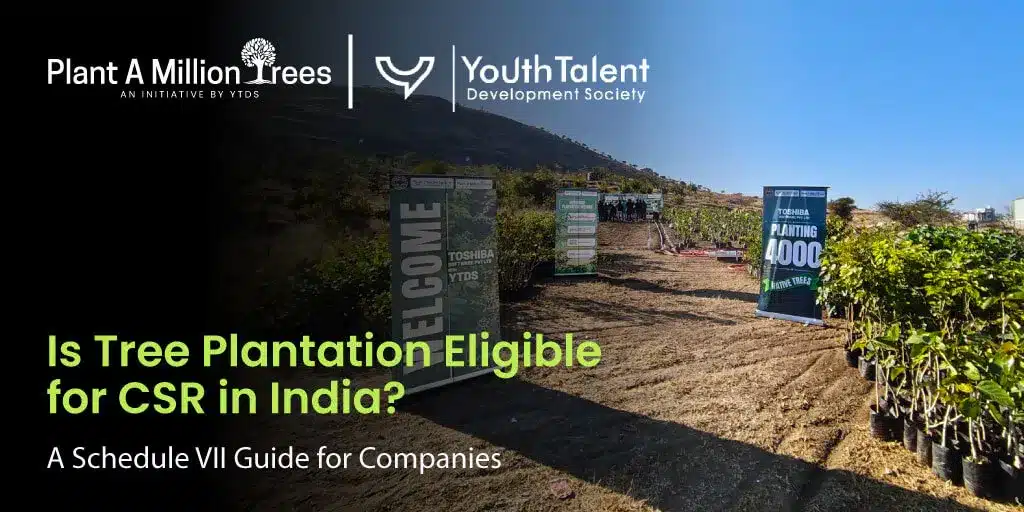
Tree plantation has become an important part of corporate environmental sustainability initiatives in India. Companies are funding plantation drives,...
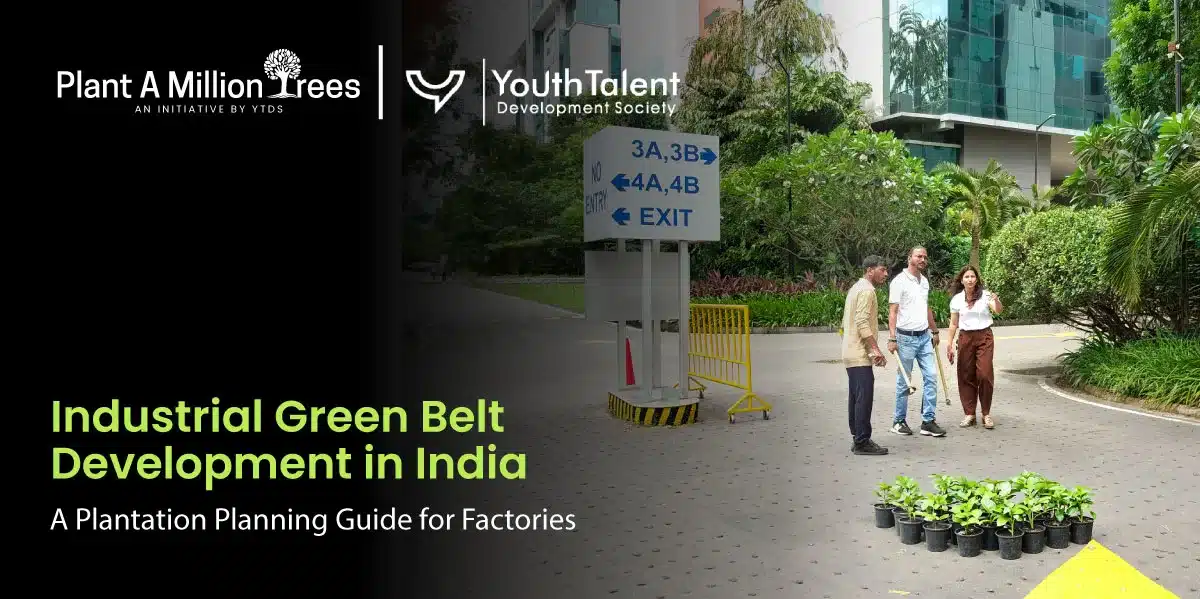
Industrial green spaces are often treated as rows of trees added around a factory boundary. In practice, effective green...