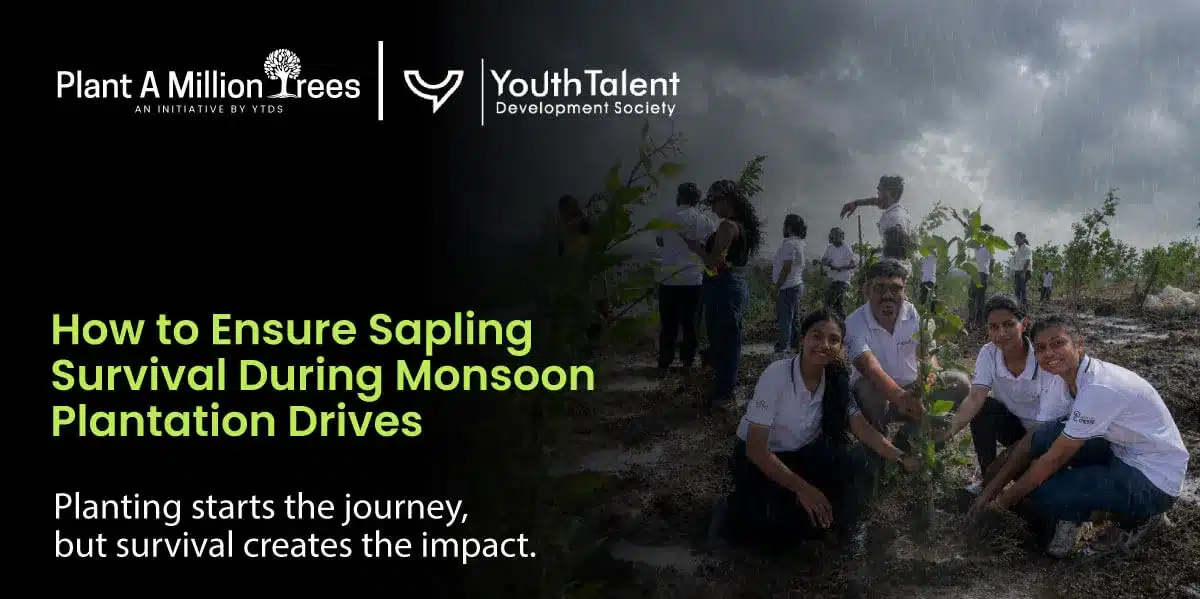
Tree plantation becomes far more valuable when it is connected to measurable sustainability goals rather than treated as a...


Millions of saplings are planted across India every year during the monsoon season. Governments launch afforestation campaigns, companies organize CSR plantation drives, educational institutions conduct environmental initiatives, and communities come together to create greener landscapes.
Yet, despite these efforts, survival remains the real challenge.
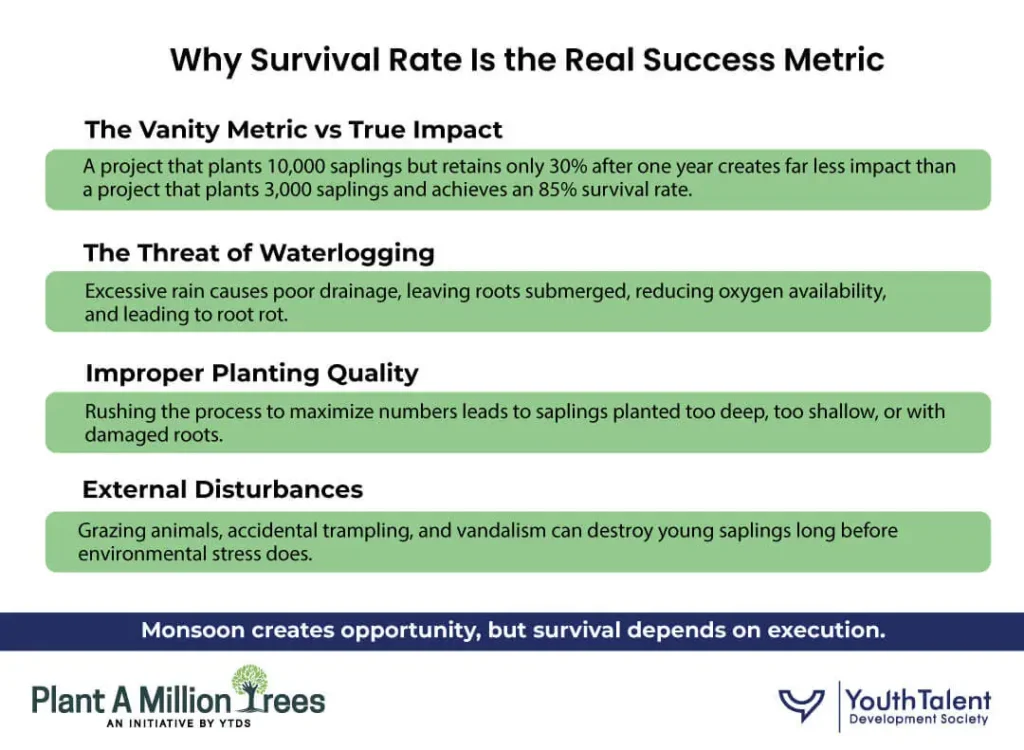
A plantation drive is often judged by the number of saplings planted, but the true measure of success is how many survive and continue growing years later. A project that plants 10,000 saplings but retains only 30% after one year creates far less impact than a project that plants 3,000 saplings and achieves an 85% survival rate.
This is why sapling survival during monsoon should be the primary focus of every plantation initiative. While the rainy season provides favorable conditions, rainfall alone does not guarantee success. Poor site preparation, unsuitable species selection, waterlogging, grazing, and lack of maintenance can quickly turn a promising plantation into a failed one.
For CSR teams, NGOs, government agencies, and community groups, improving survival rates is not just an environmental goal, it is also a matter of accountability, cost efficiency, and long-term ecological impact.
This guide explains how to improve sapling survival during monsoon plantation drives, covering everything from sapling selection and planting techniques to aftercare, monitoring, and protection measures.
Plantation projects are often celebrated on the day of planting. Photographs are taken, reports are published, and participation numbers are shared. However, experienced environmental practitioners know that plantation day is only the beginning.
The real story unfolds months later.
A surviving tree contributes to carbon sequestration, biodiversity restoration, soil improvement, and groundwater recharge. A dead sapling contributes none of these benefits.
From an environmental perspective, survival determines impact. From a CSR perspective, survival determines whether investments translate into measurable outcomes. From a financial perspective, low survival rates mean resources were spent without creating lasting value.
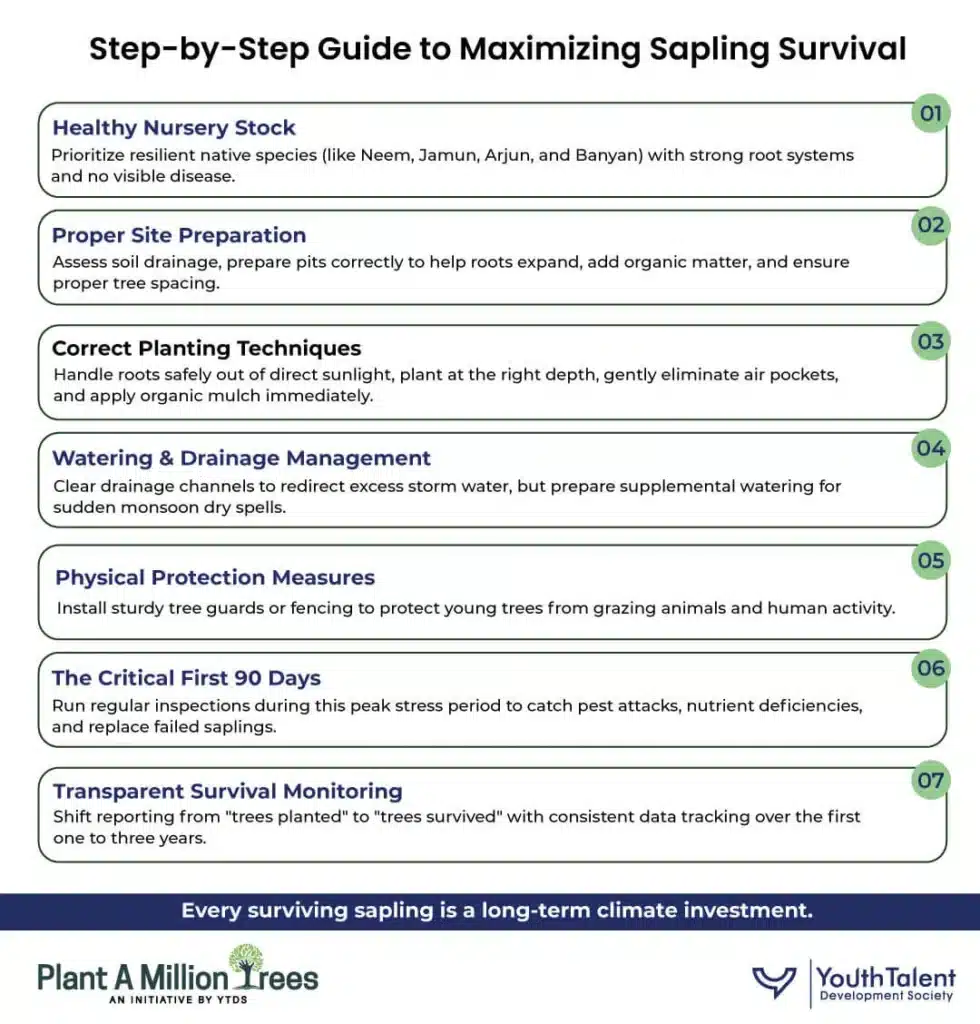
Many organizations are now shifting from reporting “trees planted” to reporting “trees survived.” This shift reflects a growing understanding that plantation effectiveness depends on outcomes rather than activity counts.
A strong tree survival rate India benchmark is increasingly becoming a key indicator for responsible plantation programs.
One of the most common misconceptions in plantation work is that monsoon automatically guarantees success.
Rainfall certainly helps, but it does not solve every problem.
Many companies discover that saplings can die even during periods of abundant rainfall. In some cases, excessive rain creates problems of its own.
Waterlogging is a common example. When drainage is poor, roots remain submerged for long periods, reducing oxygen availability and causing root rot. Young saplings are particularly vulnerable to this condition.
Another issue is poor planting quality. A sapling planted too deep, too shallow, or with damaged roots may struggle regardless of rainfall.
Inadequate species selection is another major factor. Trees that are unsuitable for local soil, climate, or site conditions often show weak growth and low survival.
Finally, many plantation projects fail because maintenance stops immediately after planting. Rain may support initial establishment, but young trees still require monitoring, protection, and care.
The lesson is simple: monsoon creates opportunity, but survival depends on execution.
Survival begins long before plantation day.
The quality of saplings selected from the nursery often determines whether a plantation succeeds or struggles.
Healthy saplings generally have strong root systems, upright stems, healthy leaves, and no visible signs of disease or pest damage.
A common mistake we see in large-scale plantation drives is the purchase of saplings based solely on price. Cheap nursery stock may reduce upfront costs, but weak plants often result in higher mortality rates later.
Native species should usually be prioritized because they are naturally adapted to local environmental conditions. They typically require less maintenance, support biodiversity, and show better long-term performance.
Species such as Neem, Jamun, Arjun, Pongamia, Banyan, and Peepal are frequently chosen in many regions of India because of their ecological suitability and resilience.
Another important consideration is age and size. Extremely small saplings may be vulnerable, while oversized saplings may experience transplant shock. Choosing healthy, well-developed nursery stock is often more important than choosing the largest available plant.
Many plantation failures can be traced back to inadequate site preparation.
A sapling’s future is heavily influenced by the condition of the soil it enters.
Before plantation begins, the site should be assessed for soil quality, drainage, slope, and water availability. Areas prone to flooding or prolonged waterlogging require special attention.
Pit preparation is particularly important. Well-prepared pits allow roots to expand more easily and access nutrients and moisture.
Adding organic matter such as compost or well-decomposed manure can significantly improve soil structure and fertility.
Spacing is another critical factor. Overcrowded plantations may initially appear dense and impressive, but competition for water, nutrients, and sunlight often reduces long-term survival.
Experienced plantation managers understand that preparation is not a preliminary task, it is the foundation of survival.
Even the healthiest sapling can fail if planted incorrectly.
One of the most frequent mistakes during large plantation drives is rushing the planting process to maximize numbers.
Proper root handling is essential. Roots should not remain exposed to direct sunlight for long periods. Damaged roots reduce the plant’s ability to absorb water and nutrients.
Planting depth also matters. A sapling buried too deeply may struggle to access oxygen, while one planted too shallowly may become unstable.
The soil around the root zone should be gently compacted to eliminate air pockets without excessively compressing the soil.
Mulching immediately after planting can greatly improve survival. Organic mulch helps retain moisture, suppress weeds, and moderate soil temperature fluctuations.
In windy or exposed locations, staking may provide temporary support until roots establish themselves.
These seemingly small details often determine whether a sapling survives its first year.
Many people assume that watering is unnecessary during the rainy season.
In reality, successful monsoon tree care requires balancing water availability with proper drainage.
Heavy rainfall can create waterlogged conditions that are just as harmful as drought.
Regular site inspections are important, particularly after intense rainfall events. If standing water remains around saplings for extended periods, corrective action may be required.
Drainage channels can help redirect excess water and protect vulnerable areas.
At the same time, monsoon rainfall is not always consistent. Dry spells can occur even during the rainy season. Newly planted saplings may require supplemental watering during these periods.
The key is observation rather than assumption. Effective plantation teams monitor conditions continuously and respond accordingly.
One of the biggest threats to young trees often comes not from nature, but from external disturbances.
Grazing animals, accidental trampling, vandalism, and human activity can destroy saplings long before environmental stress becomes a concern.
This is where sapling protection becomes essential.
Tree guards remain one of the most effective protection measures, particularly in urban and peri-urban environments. Depending on budget and site conditions, they may be made from bamboo, metal, recycled materials, or other locally available resources.
In larger rural plantations, fencing may be more practical than individual guards.
Community engagement also plays a major role. Local residents who understand the purpose and benefits of plantation projects are more likely to help protect them.
Protection is not merely a physical intervention, it is a long-term survival strategy.
The first three months after plantation often determine the future success of a project.
This period is when saplings experience the greatest adjustment stress and are most vulnerable to environmental challenges.
Regular inspections should be scheduled throughout this phase. Monitoring allows teams to identify problems before they become irreversible.
Common issues include:
Dead saplings should be replaced promptly whenever possible.
A structured post-plantation care program during the first 90 days significantly improves survival outcomes.
Many successful plantation projects attribute their high survival rates not to plantation day excellence but to disciplined maintenance during this early period.
When survival rates decline, the causes are often predictable.
Poor species selection remains one of the leading reasons for plantation failure. Trees unsuited to local conditions struggle to establish themselves regardless of maintenance efforts.
Improper planting methods also contribute significantly to mortality.
Inadequate drainage is another major factor, especially during heavy monsoon periods.
Neglect is perhaps the most common issue. Many plantation drives receive attention during execution but little follow-up afterward.
Other common causes include:
Understanding these risks allows plantation managers to address them proactively.
Before concluding a plantation project, ask the following questions:
While conditions vary, survival rates above 75-80% after the first year are generally considered strong outcomes for plantation projects.
Common reasons include waterlogging, poor planting techniques, unsuitable species, root damage, and lack of monitoring.
Yes. Mulching helps regulate soil moisture, suppress weeds, and improve root-zone conditions even during the rainy season.
Regular inspections should occur throughout the first 90 days and continue periodically for at least one to three years.
Not always, but tree guards are highly recommended in areas where grazing animals, vandalism, or accidental damage are likely.
Plantation success is not measured by the number of saplings planted, it is measured by the number that survive and thrive.
Improving sapling survival during monsoon requires much more than taking advantage of rainfall. It requires thoughtful species selection, careful site preparation, proper planting techniques, effective monsoon tree care, and long-term commitment to maintenance.
Organizations that focus on survival create lasting environmental value, stronger biodiversity outcomes, and more credible CSR impact.
The most important takeaway is simple:
Every surviving sapling is a long-term climate investment. Planting starts the journey, but survival creates the impact.
Tree plantation becomes far more valuable when it is connected to measurable sustainability goals rather than treated as a...

Tree plantation has become one of the most visible CSR initiatives undertaken by companies across India. Every monsoon, organizations...

A successful CSR tree plantation project begins long before the first sapling is planted, it begins with choosing the...