
A company with offices, factories, branches, or employee teams across India may want its environmental initiatives to reach multiple...


Tree plantation becomes far more valuable when it is connected to measurable sustainability goals rather than treated as a one-day CSR activity.
For companies in India, a well-planned ESG tree plantation project can contribute to environmental restoration while also supporting employee participation, community engagement, transparent reporting, and long-term climate action. The difference lies in how the project is designed.
Planting trees is only the beginning. Companies need to ask what environmental impact the plantation will create, how communities will benefit, how survival will be monitored, and how results will be documented.
When these elements come together, tree plantation can move from a symbolic green initiative to a meaningful part of a company’s broader ESG and sustainability strategy.
At its simplest, ESG tree plantation means planning and managing a plantation project in a way that creates measurable value across Environmental, Social, and Governance priorities.
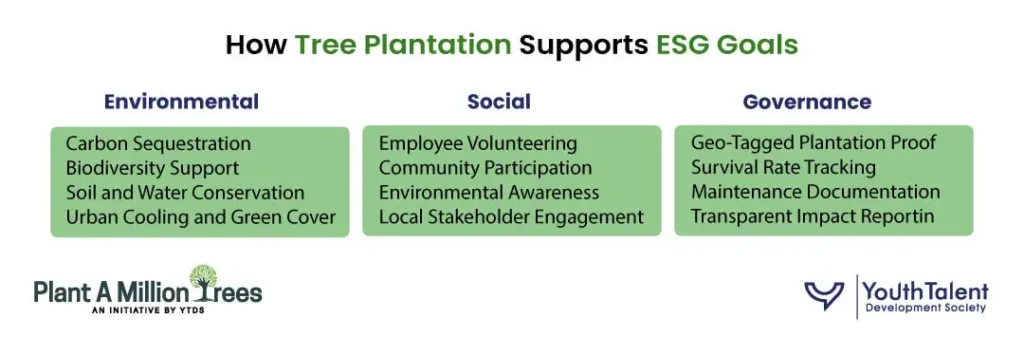
The environmental connection is easy to understand. Trees can contribute to carbon sequestration, biodiversity restoration, soil conservation, local cooling, and improved green cover.
But a well-designed plantation project can go further.
The Social aspect may include involving employees as volunteers, engaging local communities, creating environmental awareness, or supporting schools and institutions through greening initiatives.
The Governance aspect focuses on how responsibly the project is executed. Companies should know where trees were planted, which species were selected, how many survived, who is maintaining them, and how the impact is being monitored and reported.
This is what separates an ESG-aligned plantation project from a simple plantation event.
For companies exploring ESG tree plantation India initiatives, the objective should therefore not be to plant the highest possible number of saplings. It should be to create a project where environmental outcomes, social participation, and transparent implementation work together.
The most direct contribution of tree plantation to ESG comes under the Environmental pillar. However, companies should avoid reducing this contribution to a single claim such as “trees absorb carbon.”
The actual environmental impact can be much broader.
As trees grow, they absorb carbon dioxide through photosynthesis and store carbon in their trunks, branches, roots, and surrounding biomass. Over time, healthy plantation can therefore contribute to carbon sequestration.
However, companies should be careful when making carbon-related claims. A newly planted sapling does not immediately offset a fixed quantity of corporate emissions. Carbon absorption varies according to species, age, climate, soil conditions, survival rates, and growth.
If carbon impact is part of the project’s objectives, it should be measured using an appropriate methodology rather than estimated through unrealistic “one tree equals X kilograms of CO₂” assumptions.
Plantation projects designed around native and locally suitable species can create habitats for birds, insects, pollinators, and other wildlife.
This is where species diversity matters.
A plantation containing a thoughtful mix of native trees may create greater ecological value than a large monoculture plantation. Companies interested in biodiversity should therefore consider the surrounding ecosystem when selecting species.
Tree roots can help stabilize soil and reduce erosion. Organic matter from leaves can gradually support soil health, while appropriate plantation designs may improve rainwater infiltration.
These benefits depend heavily on location and project design, which is why site assessment should happen before planting.
In cities and industrial areas, strategically planted trees can provide shade, contribute to greener surroundings, and help reduce localized heat.
For companies operating large campuses, manufacturing facilities, educational institutions, or urban properties, plantation can therefore complement broader corporate sustainability initiatives focused on improving the local environment.
The important principle is to define the environmental objective first and design the plantation around it, not plant first and decide what impact to claim later.
A plantation project becomes more meaningful when the people connected to the organization become part of its journey.
Employee volunteering is one of the most visible examples. Instead of discussing sustainability only through presentations and awareness sessions, employees get an opportunity to participate directly in an environmental initiative.
But meaningful participation requires more than inviting employees to plant a sapling and take photographs.
Companies can use plantation projects to educate employees about native biodiversity, climate action, local ecosystems, and long-term environmental responsibility. Employees can also participate in follow-up visits to understand how the trees they planted are progressing.
Community involvement can create another layer of social value.
Local residents, schools, volunteers, and community organizations often understand the landscape better than external project teams. Their involvement can help identify suitable locations, understand local environmental challenges, and support long-term protection.
Consider a company planting trees near a village. The project may have greater long-term value if local stakeholders are involved in species selection and maintenance rather than simply being informed that a plantation will take place.
This approach turns ESG plantation into a collaborative project.
For companies asking how tree plantation supports ESG goals for companies in India, this social dimension is important. A successful project should create environmental assets while also encouraging participation, awareness, and shared responsibility.
Governance may be the least visible part of a plantation project, but it is often what determines its credibility.
A company may announce that it planted 10,000 trees. From a governance perspective, however, several questions immediately follow.
Where were they planted? Which species were used? How many survived? Who maintains the site? Is there verified documentation? When will the next monitoring visit take place?
A credible ESG tree plantation project should be able to answer these questions.
Geo-tagged plantation records can help verify the location of project sites. Plantation reports can document species and quantities. Survival assessments can show how the project is performing over time. Maintenance records can establish whether aftercare commitments are being fulfilled.
These records are particularly valuable when companies prepare ESG reporting and sustainability disclosures.
Instead of reporting only activity-based metrics such as “number of saplings planted,” companies can gradually present outcome-oriented information, including survival rates, maintenance progress, biodiversity indicators, employee participation, and community involvement.
Good governance also means acknowledging limitations. If survival is lower than expected, transparent reporting should explain the challenge and describe corrective action.
The goal should not be to create a perfect-looking report. It should be to create an accountable project.
A regular corporate plantation event and an ESG-aligned plantation project may look similar on day one. Employees arrive, saplings are planted, photographs are taken, and the event is documented.
The difference becomes visible six months later.
In a one-day drive, the company’s involvement may end when the event concludes.
In an ESG-aligned project, the next phase has only begun.
The plantation is monitored. Survival is assessed. Dead saplings may be replaced. Maintenance is documented. Geo-tagged photographs are updated, and progress becomes part of future sustainability reporting.
This long-term perspective matters because environmental value develops over years.
A sapling planted today will not immediately become a mature carbon sink or biodiversity habitat. Its value grows as the tree survives and develops.
Companies should therefore measure plantation success through outcomes rather than event-day numbers.
For companies planning an ESG-aligned plantation project, the process should begin before selecting the number of saplings.
1. Define the sustainability objective. Decide whether the project primarily aims to support biodiversity, urban greening, ecological restoration, employee engagement, community participation, or another measurable goal.
2. Select the site carefully. Assess land availability, soil conditions, water access, long-term protection, and maintenance feasibility.
3. Choose native and suitable species. The “right tree, right place” principle should guide species selection. A locally suitable mix generally creates better long-term outcomes than choosing species solely because they grow quickly.
4. Create a realistic maintenance plan. Determine who will water, protect, monitor, and maintain the trees after plantation. Budget for aftercare from the beginning.
5. Involve employees and communities meaningfully. Participation should include environmental education and long-term engagement wherever possible.
6. Establish reporting requirements before execution. Decide what information will be collected, including GPS locations, species records, photographs, volunteer participation, and plantation quantities.
7. Monitor survival and impact. Schedule follow-up assessments rather than waiting until the annual report is due.
This approach connects plantation activity directly with broader ESG sustainability goals and creates a clearer pathway from intention to measurable impact.
Measuring ESG impact does not require companies to create an unnecessarily complicated reporting system. A focused set of relevant indicators is often more useful than dozens of metrics with little practical value.
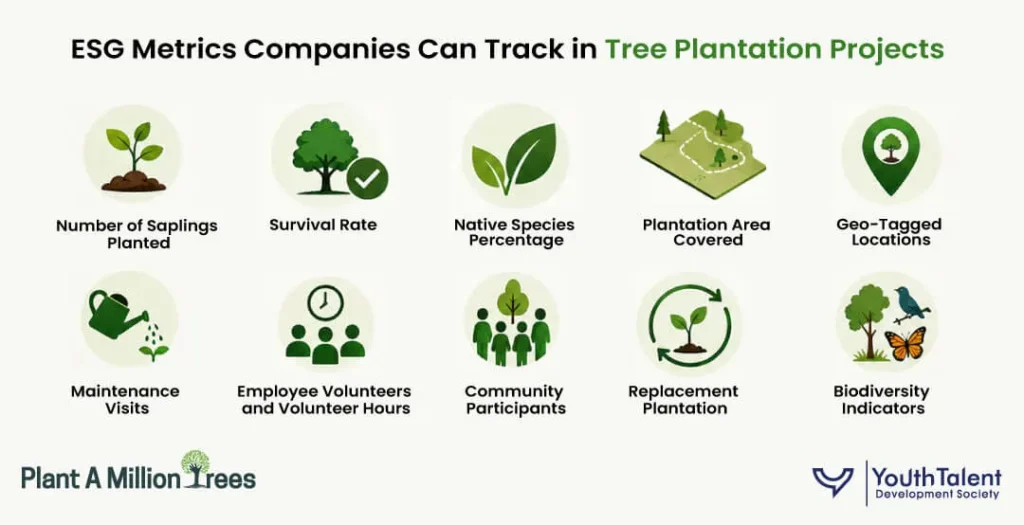
Start with the number of saplings planted, but do not stop there.
The survival rate is one of the most important indicators because it shows how many trees remain alive after defined monitoring periods.
Companies can also track the proportion of native species, total plantation area, geo-tagged locations, maintenance visits, replacement plantation, and tree growth indicators where appropriate.
For the social dimension, useful metrics may include employee volunteers involved, volunteer hours, community participants, schools or institutions engaged, and environmental awareness activities conducted.
Biodiversity-focused projects may gradually monitor visible indicators such as the return or presence of birds, butterflies, pollinators, or other locally relevant species. These observations should be reported carefully and without overstating causation.
Together, these metrics give companies a more complete picture of the ESG benefits of corporate tree plantation projects.
One of the most common mistakes is treating plantation as a photo opportunity. Visibility is useful, but photographs cannot substitute for survival and impact.
Another mistake is selecting species without considering local ecology. Planting the wrong trees can increase maintenance requirements and reduce survival.
Companies also sometimes commit to ambitious plantation numbers without allocating sufficient resources for maintenance. A smaller, well-maintained project can create greater long-term value than a large plantation with poor survival.
Weak documentation creates another problem. Without geo-tagged records, species information, monitoring data, and maintenance reports, companies may struggle to demonstrate credible outcomes.
Finally, businesses should avoid making vague or exaggerated ESG claims. Plantation can contribute to climate action and environmental restoration, but those contributions should be reported proportionately and supported by evidence.
Plant A Million Trees, an initiative by Youth Talent Development Society, can support companies in developing structured plantation projects that connect environmental action with long-term impact.
The approach can include plantation planning, native species selection, employee engagement, on-ground execution, geo-tagged documentation, maintenance tracking, and reporting support.
For companies, this creates an opportunity to move beyond organizing a one-day plantation activity and instead build a project focused on transparency, survival, and measurable outcomes.
The objective is not simply to increase plantation numbers. It is to help create environmental initiatives that companies can responsibly track, communicate, and sustain over time.
ESG tree plantation refers to plantation projects designed to support Environmental, Social, and Governance outcomes through ecological impact, stakeholder participation, transparent documentation, monitoring, and reporting.
Tree plantation can support environmental restoration, carbon sequestration, biodiversity, employee engagement, community participation, and climate action when projects are appropriately designed and maintained.
Companies can track saplings planted, survival rates, native species, plantation area, geo-tagged locations, maintenance visits, employee participation, community engagement, and relevant environmental indicators.
No. Carbon offset claims require appropriate measurement, methodologies, monitoring, and verification. Companies should avoid assuming that every planted tree represents a fixed amount of carbon offset.
Environmental benefits develop as trees survive and mature. Monitoring helps companies understand survival, identify maintenance needs, improve future projects, and provide credible information for ESG and sustainability reporting.
Tree plantation can be a valuable component of corporate sustainability, but its real impact depends on what happens before and after plantation day.
Companies that connect ESG tree plantation with clear sustainability goals, suitable native species, meaningful stakeholder participation, transparent documentation, and long-term monitoring can create outcomes that extend far beyond the number of saplings planted.
The shift is ultimately from activity to accountability, and from short-term visibility to lasting environmental value.
A well-planned ESG tree plantation project helps companies turn sustainability goals into visible, measurable action.
A company with offices, factories, branches, or employee teams across India may want its environmental initiatives to reach multiple...

Plantation day often gets the most attention in a CSR project. Employees gather, saplings are planted, photographs are taken,...

For companies planning CSR tree plantation India projects, the key question in 2026 is no longer simply how many...