

A company with offices, factories, branches, or employee teams across India may want its environmental initiatives to reach multiple...

Corporate campuses are no longer viewed only as places where employees work or products are manufactured. Offices, factories, warehouses, institutions, and business parks often have outdoor areas that can be planned as functional green spaces.
When approached systematically, plantation can contribute to corporate greening, employee engagement, site improvement, biodiversity, and broader environmental objectives.
However, corporate campus tree plantation should not be treated simply as decorative landscaping. A successful project requires careful site assessment, appropriate species selection, irrigation, protection, maintenance, and long-term monitoring.
For companies planning corporate campus tree plantation in India for offices and factories, the first step is understanding what the site actually needs. An office may benefit from shaded employee areas and avenue planting, while a factory may require a more structured greenbelt approach. A business park may need a combination of boundary planting, common green areas, biodiversity pockets, and pedestrian-friendly spaces.
The right approach depends on the function of the property, available land, existing infrastructure, local conditions, and the company’s long-term objectives.
Before selecting trees or deciding how many saplings to plant, companies should clarify why they are planning the project.
The objective could include:
The objective influences almost every later decision, including site selection, plantation model, species selection, maintenance, monitoring, and measurement.
Companies should also distinguish voluntary corporate greening or CSR plantation from any site-specific statutory, consent-related, or environmental requirement.
A company should not assume that a voluntary plantation initiative automatically replaces or satisfies applicable environmental compliance requirements. Factories and regulated projects may have specific conditions that need to be reviewed with the company’s environmental, EHS, legal, or compliance teams.
The plantation plan should therefore support the company’s broader environmental management approach rather than being presented as a substitute for regulatory obligations.
Companies considering a larger environmental initiative can also review how to evaluate a CSR tree plantation proposal before finalising the implementation structure.
Different types of corporate properties require different plantation priorities. The same model should not simply be copied from one location to another.
An office campus may focus on employee comfort, shade, pedestrian movement, biodiversity, and usable outdoor spaces.
Potential approaches include:
For an office, the location of trees matters as much as the number planted.
Trees should be positioned with consideration for buildings, utilities, walkways, access routes, visibility, parking areas, and potential future development.
A factory site may have different priorities. Plantation can form part of a broader industrial greenbelt or site-greening strategy.
Companies may need to consider:
Species selection may also need to account for local environmental conditions and tolerance to site-specific stresses.
Any regulatory or consent-related greenbelt requirement should be reviewed separately with the appropriate technical and compliance teams.
A business park often contains shared spaces used by multiple companies, employees, service teams, and visitors.
Business park plantation can combine avenue planting, common green spaces, boundary areas, shaded pedestrian zones, and biodiversity pockets.
Because multiple stakeholders may use or manage the property, one important question should be resolved before planting begins:
Who will maintain the trees after plantation?
Clear ownership of irrigation, protection, replacement, monitoring, and long-term maintenance can prevent plantation areas from being neglected once the initial project is completed.
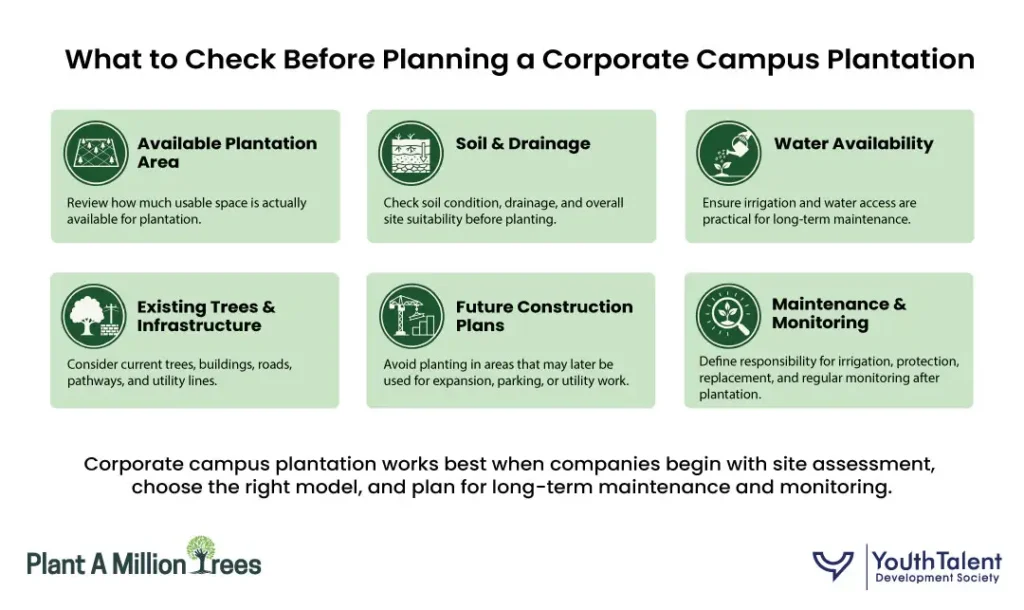
The most important part of corporate campus tree plantation planning often happens before the first sapling is planted.
A site assessment should examine both the physical characteristics of the campus and its future requirements.
Companies should review:
Planting trees without considering underground utilities, drainage systems, roads, buildings, or future construction can create problems later.
Existing trees should also be mapped before deciding where additional plantation is required.
Mature trees may already provide shade, biodiversity value, ecological functions, and visual benefits. The objective should be to complement the existing landscape rather than unnecessarily replacing or disturbing established vegetation.
Future development is another important consideration.
A part of the campus that is vacant today may later be required for a building, parking area, utility installation, road expansion, or operational facility. Plantation planning should take these possibilities into account.
The site assessment therefore becomes the foundation of a practical corporate campus plantation plan.
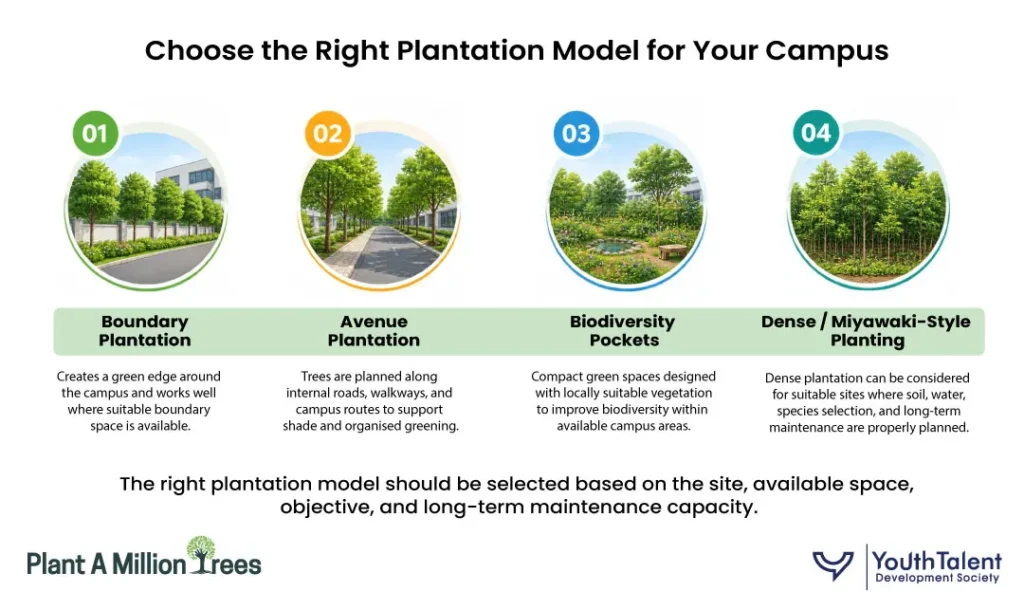
There is no single plantation model suitable for every corporate property.
The appropriate approach depends on the available space, site function, environmental objective, water availability, employee use, infrastructure, and long-term maintenance capacity.
Boundary plantation can create a green edge around the campus where sufficient space is available.
The design should consider access, security, mature tree size, maintenance requirements, surrounding infrastructure, and the intended purpose of the boundary area.
Avenue plantation involves planting trees along internal roads, walkways, pathways, or other campus routes.
Tree selection and positioning should consider:
For office campuses, avenue plantation can also contribute to shaded walking areas and more comfortable outdoor movement.
Companies with smaller or fragmented spaces may consider compact biodiversity-focused areas instead of attempting to plant trees throughout the entire campus.
These spaces can include a mix of locally suitable vegetation and trees selected according to site conditions.
Where biodiversity is one of the project objectives, companies can also track practical biodiversity KPIs for CSR tree plantation rather than measuring success only by the total number of saplings planted.
Dense plantation models may be considered where the site, objectives, soil conditions, water availability, and maintenance capacity make them appropriate.
However, companies should not assume that dense planting is automatically the best solution for every office, factory, or business park.
The methodology should be selected according to:
Companies evaluating this approach can review where the Miyawaki method in India works, where it may not be suitable, and what conditions need to be considered before implementation.
The key principle is simple:
Choose the plantation model based on the site, not because a particular model is currently popular.
The right plantation model depends on the available space, site objective, infrastructure, and long-term maintenance capacity.
| Plantation Model | Space Requirement | Primary Purpose | Maintenance Considerations | Best-Fit Use Cases |
|---|---|---|---|---|
| Boundary Plantation | Continuous or suitable space along the campus boundary | Create a green edge and utilise suitable peripheral areas | Requires access for irrigation, protection, monitoring, and mature-tree management | Factories, office campuses, warehouses, and business parks with available boundary space |
| Avenue Plantation | Linear space along internal roads, walkways, or pathways | Support shade, pedestrian comfort, and organised campus greening | Tree placement should account for canopy size, roots, visibility, utilities, and pedestrian movement | Office campuses, institutions, business parks, and suitable internal factory roads |
| Biodiversity Pockets | Flexible; can work within smaller or fragmented available areas | Create locally suitable green spaces with biodiversity value | Requires suitable species selection, irrigation planning, monitoring, and ongoing vegetation management | Offices and business parks where plantation space is limited or distributed across the site |
| Dense / Miyawaki-Style Planting | A dedicated compact area with suitable site conditions | Develop a dense plantation where the ecological objective and site conditions support the model | Requires careful soil, water, species, density, and long-term maintenance planning | Selected corporate sites where available area, water, species suitability, and maintenance capacity support dense planting |
On mobile, swipe horizontally to view the complete table.
Species selection is one of the most important decisions in a campus plantation project.
Companies should avoid using one universal list of trees for every office, factory, or business park in India.
Climate, soil, rainfall, available space, water availability, surrounding ecology, and site function can differ considerably between locations.
Native trees or locally suitable species should be considered wherever appropriate.
Important factors include:
For factory sites, tolerance to dust or other site-specific conditions may be relevant when selecting species.
However, species should still be assessed locally rather than assuming that a particular tree is suitable for every industrial location.
Companies should also consider the eventual size of the tree.
A small sapling may initially appear suitable beside a building or pathway, but its mature canopy or root system may later interfere with structures, roads, utilities, drainage, visibility, or pedestrian movement.
This is why species and placement should be considered together.
Local forestry, horticulture, or ecological expertise can help companies make site-specific decisions where required.
Plantation day is only the beginning of a corporate campus tree project.
Before planting starts, the company should establish who will be responsible for maintenance.
Someone should be accountable for watering, mulching, protection, replacement, monitoring, and record keeping.
A maintenance plan may cover:
Watering requirements should be determined according to species, season, rainfall, soil, local climate, sapling age, and actual site conditions instead of applying one fixed schedule to every plantation.
Companies should also plan for seasonal changes.
For example, the maintenance requirements of a plantation may change significantly after the monsoon. A structured post-plantation maintenance approach can help teams identify stressed saplings, drainage issues, weed growth, protection failures, irrigation needs, and replacement requirements before the dry season.
Corporate campuses also create opportunities for employee involvement.
Employee participation can include:
However, employee participation should support the project rather than replace professional groundskeeping or technical maintenance.
Specialised pruning, pest or disease management, tree safety assessments, or work around infrastructure should be handled by appropriately qualified personnel where required.
Companies planning a larger employee activity can use an employee volunteering CSR tree plantation framework to plan participation, safety, site coordination, documentation, and long-term employee engagement.
The objective should be to connect employees with the environmental project while maintaining clear responsibility for long-term tree care.
A company should decide what it wants to measure before plantation begins.
Simply counting the number of trees planted provides only a partial picture of project progress.
Companies can maintain records covering:
Geo-tagging can connect plantation photographs and records with specific campus locations, making documentation easier to organise and verify.
Companies that need more structured evidence can consider geo-tagged tree plantation records as part of their monitoring and reporting process.
Geo-tagging does not replace site monitoring, but it can make plantation documentation more organised and transparent.
Survival tracking is particularly useful because a plantation programme continues long after the plantation event.
If some saplings fail, the company can document the issue, investigate possible causes, and determine whether replacement planting or another corrective action is appropriate.
Over time, records relating to survival, growth, canopy development, maintenance, and site conditions can provide a clearer picture of how the campus green space is developing.
Where relevant to the company’s reporting framework, this information may also contribute to internal sustainability documentation or ESG reporting.
The important distinction is between recording what was planted and understanding what continued to survive and develop.
Plant A Million Trees (PAMT) can support companies exploring structured campus plantation projects, depending on project scope and location.
Potential support can be discussed around:
For an organisation planning corporate campus tree plantation, the initial discussion can focus on practical details such as campus location, available plantation area, existing vegetation, project objectives, employee participation, water availability, site conditions, and long-term maintenance expectations.
The aim should be to develop a plantation plan suited to the actual property rather than offering the same fixed solution for every office or factory.
Companies should continue to keep regulatory, consent-related, and environmental compliance decisions with their relevant internal teams and qualified advisers, since project-specific requirements can vary depending on the nature and location of the facility.
For companies looking for structured implementation support, PAMT’s CSR tree plantation programmes for companies can connect site planning with plantation execution, employee participation, maintenance, monitoring, and reporting based on the agreed project scope.
There is no single space requirement suitable for every project.
The appropriate plantation model depends on available land, existing infrastructure, tree species, site objectives, mature tree size, water availability, and maintenance capacity.
A site assessment should be completed before determining plantation density or layout.
Office campuses can consider options such as avenue plantation, boundary plantation, shaded employee areas, biodiversity pockets, or other site-specific green spaces.
The appropriate choice depends on available space, employee use, utilities, pathways, buildings, water availability, and future development plans.
A factory may have site-specific environmental, EHS, consent-related, operational, or safety requirements.
Companies should review applicable requirements with their environmental and compliance teams.
Plantation planning should also consider internal movement, utilities, drainage, access, safety, maintenance, and the function of the proposed plantation area.
Species should be selected according to local climate, soil, water availability, mature size, root characteristics, canopy spread, biodiversity value, safety considerations, and the purpose of the plantation.
Native or locally suitable species should be considered where appropriate rather than relying on a universal species list for all locations in India.
Companies should assign clear responsibility for irrigation, mulching, protection, monitoring, replacement, and other maintenance activities.
The maintenance plan should extend beyond plantation day and should be supported by appropriate records and periodic site monitoring.
Corporate campus tree plantation works best when it is treated as a long-term site-planning exercise rather than a one-day activity.
For offices, factories, institutions, warehouses, and business parks, the process should begin with a site assessment, followed by selection of an appropriate plantation model, locally suitable species, irrigation, protection, maintenance, and monitoring.
Every corporate property is different.
An office may prioritise employee-friendly shaded areas and walking spaces. A factory may require a carefully planned boundary or greenbelt approach. A business park may benefit from shared avenues, biodiversity areas, and coordinated maintenance.
The next step is therefore not simply deciding how many trees to plant.
Companies should first assess the campus location, available plantation area, existing trees, soil and drainage conditions, water availability, infrastructure, project objectives, employee participation requirements, and long-term maintenance responsibilities.
Planning a plantation project for your office, factory, institution, or business park?
Share your campus location, available plantation area, project objectives, employee participation requirements, and maintenance expectations with the Plant A Million Trees (PAMT) team to discuss a site-specific plantation approach.
The strongest campus plantation plan is not simply the one that plants the most trees. It is the one designed around the site and capable of being maintained, monitored, and improved over the long term.
A company with offices, factories, branches, or employee teams across India may want its environmental initiatives to reach multiple...

Plantation day often gets the most attention in a CSR project. Employees gather, saplings are planted, photographs are taken,...

For companies planning CSR tree plantation India projects, the key question in 2026 is no longer simply how many...