
Companies in India are increasingly looking beyond conventional environmental activities to understand how their operations depend on nature, affect...

Tree plantation is a common choice for companies looking to support environmental sustainability through Corporate Social Responsibility (CSR). However, a plantation idea needs to be translated into an approved project with defined objectives, a budget, an implementation schedule, maintenance responsibilities and a monitoring mechanism.
The CSR annual action plan provides the structure for those decisions. It connects the company’s CSR Policy with the projects it intends to undertake and establishes how implementation and expenditure will be reviewed.
For CSR committees, company secretaries, CFO teams, ESG professionals and programme managers, the starting point is a proposal that can be assessed before commitments are made. Preparing it before the financial year begins can improve coordination, while properly approved changes remain possible during the year.
Simply mentioning tree plantation in a plan does not make every related expense eligible CSR expenditure. Companies should assess the project against Schedule VII and the applicable CSR provisions. PAMT’s guide to tree plantation CSR eligibility in India explains this distinction.
This guide sets out the five Rule 5(2) planning requirements and shows how to translate them into a plantation project with a clear scope, realistic schedule and evidence for review.
These documents are connected, but they serve different purposes. A detailed NGO proposal does not replace the company’s approved annual action plan, and a plantation completion report does not replace its annual CSR disclosure.
| Document | Purpose | What It Contains | Plantation Example |
|---|---|---|---|
| CSR Policy | Establishes the company’s standing CSR approach | Direction and guiding principles for selecting, implementing and monitoring activities | Environmental sustainability as a focus area |
| CSR Annual Action Plan | Sets out projects and implementation arrangements for the financial year | Project list, execution route, fund use, schedule, monitoring and assessment details | An approved native-tree project with allocations and review arrangements |
| Project Proposal | Supplies the detail needed to evaluate and deliver a particular project | Need, site, permissions, species, costs, responsibilities, maintenance and evidence | A site-specific implementation and aftercare proposal |
| Annual CSR Report | Discloses the company’s CSR activities for the year | Particulars required under the applicable reporting rules and format | Relevant project, expenditure and implementation disclosures |
The annual action plan can reference supporting project documents so that operational detail remains accessible without overloading the main plan. Teams should ensure that approved scope, financial allocations and reporting records remain consistent across documents.
For example, if the proposal includes two years of maintenance, the plan and agreement should explain how that commitment will be funded and reviewed. Later reporting should reflect actual utilisation and progress rather than repeat the original proposal unchanged.
PAMT’s guide to tree plantation reporting for CSR teams can help identify project records to retain for corporate reporting.
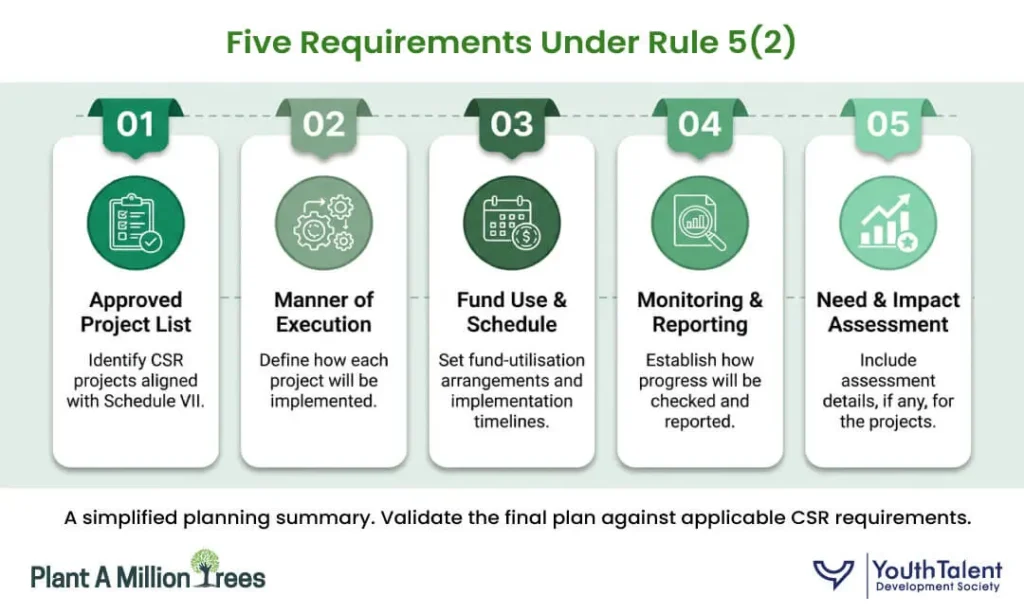
Rule 5(2), as substituted by the Companies (CSR Policy) Amendment Rules, 2021, sets out five required planning elements. The points below paraphrase those elements; the plantation examples are practical suggestions for applying them.
Identify the projects approved in areas or subjects specified in Schedule VII. For plantation, give each project a clear name and environmental purpose. A site-specific native-tree restoration project is easier to assess than an unexplained entry saying “plantation drive”.
State how the project will be implemented under the applicable Rule 4(1) route. Identify whether the company will execute it directly or engage an eligible implementing agency, and explain who will deliver the fieldwork and aftercare.
Explain how funds will be used and when activities will occur. Link site preparation, procurement, planting, maintenance and reporting to allocations, milestones and evidence. Where relevant, show the financial-year split.
Describe how progress will be checked and reported. The supporting plantation plan can specify inspection responsibilities, survival checks, maintenance records, expenditure updates and the route for escalating delays or site problems.
Record relevant need and impact assessment details. For plantation, the supporting proposal should explain the environmental need and why the site and intervention are suitable. Routine inspections and mandatory independent impact assessment serve different purposes and should be planned separately.
Use these five fields as the minimum organising structure, then attach the detail needed for informed approval. The company’s legal or compliance advisers should validate the final plan against the current rules and its specific circumstances.
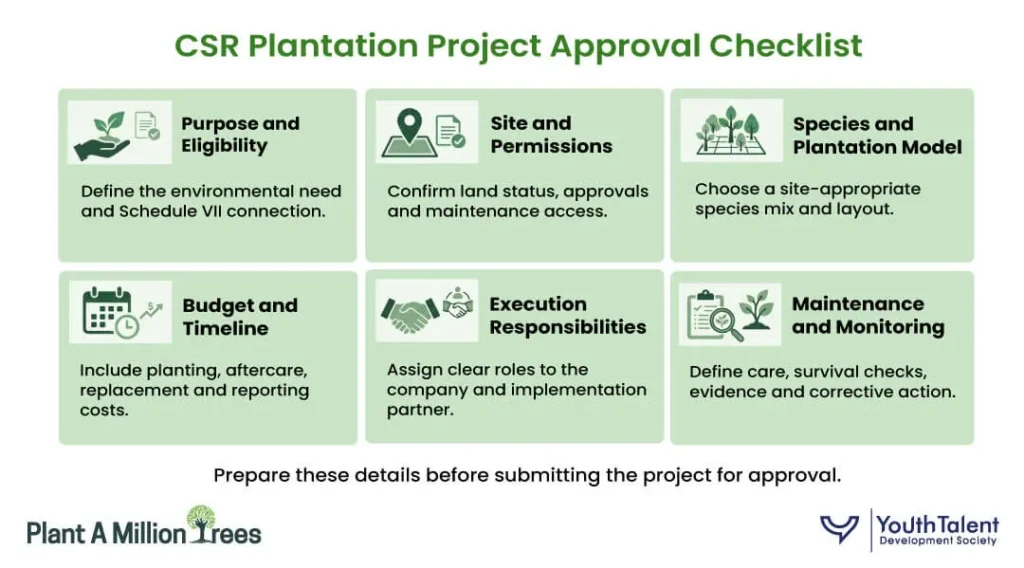
A strong CSR plantation proposal explains what the company intends to achieve and whether the selected site can support that objective. A one-day event description does not provide enough information to evaluate a project with maintenance obligations.
Before approval, complete the following project-definition checklist:
Check tree plantation permission requirements before finalising the site. Species planning should also draw on site conditions; PAMT’s native tree plantation guide for CSR projects provides a starting point.
Use the CSR plantation proposal evaluation guide to review whether the supporting documents explain both implementation and what happens after planting day.
A company with the necessary internal expertise and field capacity may implement the plantation project directly. Its teams then need arrangements for permissions, procurement, site work, maintenance, monitoring and documentation.
Alternatively, the company may work through an eligible implementing agency. Before appointment, verify the agency’s applicable Rule 4 eligibility, required registrations, financial controls, relevant experience and ability to maintain the site throughout the proposed period.
PAMT’s guide to selecting a CSR-1 registered NGO for tree plantation can support this review. CSR-1 registration alone does not establish that every proposed activity is eligible CSR expenditure or demonstrate the agency’s delivery quality.
A written agreement should allocate responsibilities clearly. Identify who secures permission, approves species, procures saplings, supervises planting, maintains the site, checks survival and submits reports. Also define payment conditions, evidence requirements, replacement obligations and the process for handling unused funds or changes.
For example, the NGO may submit monthly field updates while the company’s programme manager checks delivery against the agreement. Finance reviews utilisation evidence, and the responsible governance bodies consider material changes through the approval process.
The company’s oversight continues after an agency is appointed. A CSR tree plantation vendor evaluation checklist helps teams review operational capability alongside compliance documents and price.
A plantation budget should cover the complete implementation cycle. Relevant heads can include site preparation, saplings, transport, labour, guards, irrigation, project-related event logistics, maintenance, replacement, monitoring and reporting. Each cost still needs a project-specific eligibility review.
The table below illustrates a ₹10 lakh project beginning in FY 2027–28, with maintenance continuing into FY 2028–29. It is a planning example, not a PAMT quotation, statutory allocation or determination of ongoing-project status. Timing must reflect local site conditions and an appropriate planting window.
| Activity | FY 2027–28 | FY 2028–29 | Milestone and Evidence |
|---|---|---|---|
| Site preparation and baseline | ₹1,00,000 | — | April–May: site readiness, permissions and baseline records |
| Saplings, transport and planting | ₹3,00,000 | — | Suitable planting window: species and quantity records |
| Guards and irrigation arrangements | ₹1,50,000 | — | Installation and inspection records |
| Maintenance and replacement | ₹1,75,000 | ₹1,75,000 | Agreed care cycles and replacement logs |
| Monitoring and reporting | ₹50,000 | ₹50,000 | Periodic reports and utilisation records |
| Total | ₹7,75,000 | ₹2,25,000 | Total planned project budget: ₹10,00,000 |
Assign an owner to each milestone and specify what evidence supports each fund release. Advance payments may be operationally necessary, but payment and recognised CSR utilisation should be tracked separately.
The MCA CSR FAQ, question 7.4 explains that transferring funds to an agency alone does not establish CSR spending. Utilisation must be established, with Board oversight and certification by the CFO or person responsible for financial management under Rule 4(5).
Confirm whether multi-year work meets the applicable ongoing-project conditions and assess any unspent-fund obligations separately. Maintenance continuing beyond March does not remove that review. PAMT’s CSR tree plantation cost guide can support preparation of a detailed quotation.
Monitoring should help the company act when delivery falls behind the approved plan. Define what will be measured, who will collect the information and who can require corrective action.
The following is an illustrative operating schedule. Frequencies, deadlines and thresholds should be agreed for the site; they are not statutory monitoring standards or automatic PAMT commitments.
| Monitoring Item | Illustrative Frequency | Responsible Role | Trigger and Response |
|---|---|---|---|
| Planting and species records | At planting and after replacements | Field team | Reconcile quantity or species differences before accepting the milestone |
| Watering and maintenance logs | Monthly summary; care as required | Maintenance lead | Escalate missed care or water shortages promptly |
| Survival checks | At 3, 6 and 12 months, then as agreed | Monitoring lead | Investigate results below the agreed site target; document corrective action |
| Budget and utilisation | At fund-release milestones and quarterly review | Project manager and finance | Resolve unsupported utilisation or cost variance before further release |
| Consolidated progress | Quarterly and at closeout | Company programme owner | Refer material scope or timeline changes for formal review |
Use a consistent survival method. Record original planting, surviving original saplings and replacements separately so replacement planting does not conceal losses. State whether checks use a full count or a sample, along with the inspection date and coverage.
Link photographs to site and activity records. Geo-tagged plantation evidence supports traceability, while selected biodiversity KPIs can help track site-specific changes. Neither photographs nor planting counts alone prove long-term ecological outcomes.
Independent impact assessment is distinct from routine monitoring. MCA’s February 2026 explanation of Rule 8 describes the ₹10 crore average CSR-obligation threshold over the preceding three financial years, along with project outlay of at least ₹1 crore and completion at least one year before the assessment.
Where applicable, an independent agency is required. Review project-specific applicability with advisers and use PAMT’s plantation impact-assessment guide for further planning context.
The CSR Committee formulates and recommends the annual action plan to the Board for approval. The National CSR Exchange FAQ clarifies that, where Section 135(9) applies and a Committee is not required, the Board performs its functions itself. Companies should verify their applicable governance position.
Rule 5(2) permits Board alterations during the financial year on the CSR Committee’s recommendation and reasonable justification, subject to the applicable governance arrangements. Operational teams should therefore use a documented process for changes requiring amendment of the approved plan.
For example, if permission for the original site is withdrawn, the project team should record the issue and assess the proposed alternative’s suitability, permissions, costs and timetable. Procurement or field teams should not quietly substitute another site where that changes the approved project.
A practical change record should capture the reason, revised scope, budget and schedule, effects on maintenance and outcomes, and the recommendation and approval records. Update the agreement and working documents after the appropriate approval.
Appoint a programme owner to maintain the current version of the plan. A quarterly internal review can help teams reconcile progress, utilisation and outstanding risks; this is a suggested management cadence rather than a universal statutory meeting requirement.
PAMT can help companies translate an environmental objective into a structured plantation proposal for internal consideration. Depending on the agreed scope, support can include site assessment, species planning, implementation coordination, maintenance arrangements, survival monitoring and reporting documentation.
Share the proposed location, plantation scale, financial year, budget range and maintenance expectations. The proposal should then explain the site, objectives, execution responsibilities, costs, implementation milestones and evidence the company can expect to receive. Confirm the final scope and reporting commitments in the agreement.
Request a structured CSR tree plantation proposal with a project scope, budget, implementation schedule, maintenance plan and monitoring and reporting arrangements.
The company’s responsible teams and professional advisers should validate the final annual action plan, project eligibility, accounting treatment and approvals against the current CSR framework.
Rule 5(2) specifies required content rather than a single table layout. Companies can organise those fields in a suitable format and reference supporting proposals, budgets and schedules. Advisers should confirm that the final document meets applicable requirements.
The Board approves the plan through the applicable governance process. Mid-year alterations require reasonable justification and the CSR Committee’s recommendation where a Committee is required. Document the reasons and approval, then update the implementation records.
Direct implementation is possible. If an agency is engaged, verify its applicable legal eligibility and registration requirements, then assess its field capacity and maintenance arrangements. Naming the activity in the plan does not establish project eligibility by itself.
No. The Rule 8(3) conditions determine mandatory independent assessment. Routine survival checks, maintenance records and progress reporting should still be defined for project oversight even where that independent assessment requirement does not apply.
Companies in India are increasingly looking beyond conventional environmental activities to understand how their operations depend on nature, affect...

“How much land do we need for 1,000 trees?” is one of the first practical questions CSR teams ask...
Tree plantation has become an important part of corporate environmental sustainability initiatives in India. Companies are funding plantation drives,...