
Planting trees is easy to count. Measuring what those trees actually contribute to an ecosystem is much harder. A...

For companies planning CSR tree plantation India projects, the key question in 2026 is no longer simply how many saplings can be planted. Companies also need to understand whether a plantation is being undertaken as a normal CSR activity, as a green credit tree plantation project, as a carbon project, or for broader ESG objectives. These are not interchangeable.
The Green Credit Programme India was introduced to incentivise voluntary environmental actions. The Indian Council of Forestry Research and Education (ICFRE) is the programme administrator and is responsible for developing methodologies, registration processes, monitoring and verification mechanisms.
The tree-plantation framework has also evolved since the programme was introduced. The modality for tree plantation and eco-restoration of degraded forest land was notified in February 2024 and subsequently revised on 29 August 2025. In an official parliamentary response dated 3 August 2026, the Ministry of Environment, Forest and Climate Change again confirmed the revised framework, including the five-year restoration requirement and minimum canopy-density condition.
For green credits for companies, this distinction is important because Green Credits and carbon credits measure different environmental outcomes and operate through separate frameworks. A company can undertake a valuable plantation without automatically generating either type of credit.
The practical starting point is therefore simple: define the environmental, CSR or ESG objective first, and then determine which framework, documentation and verification process applies.
The Green Credit Programme is a government framework designed to encourage voluntary environmental actions through a system of measurable and verified environmental activities. The Green Credit Rules, 2023 were notified under the Environment (Protection) Act, 1986, while ICFRE was designated as the Administrator. The programme uses digital infrastructure for registration, monitoring and verification.
At the policy level, the Green Credit Programme operates under the Ministry of Environment, Forest and Climate Change and also supports the objectives of Mission LiFE, which encourages environmentally responsible behaviour and sustainable lifestyles. For companies, however, participation should remain focused on the specific eligibility, restoration, monitoring and verification requirements applicable to the chosen Green Credit activity.
For green credit tree plantation, the focus is on ecological restoration rather than simply conducting a plantation event. The programme includes mechanisms for identifying suitable degraded forest land and enabling participating entities to undertake restoration through the prescribed process.
For the tree-plantation activity currently operationalised under the programme, eligible land generally consists of degraded forest land under the control and management of State or UT Forest Departments and uploaded through the Green Credit Programme process.
This makes Green Credit participation different from a conventional corporate plantation drive. An employee plantation activity, office-campus plantation or NGO-supported CSR plantation may have environmental value, but that does not automatically make it eligible for Green Credits.
Companies should therefore establish whether they are seeking:
The answer will determine how the project should be designed and reported.
One of the biggest changes in the Green Credit framework is the move away from treating the initial number of trees planted as the basis for immediate credit issuance.
Under the revised methodology notified in August 2025, an applicant can submit a Green Credit claim after completing a minimum five years of restoration activities on the relevant degraded forest land and achieving at least 40% canopy density. The calculation also considers vegetation status, changes in canopy density and the number of surviving trees. One Green Credit is specified for each new tree that is more than five years old, subject to verification.
This creates an important distinction for green credits India. Planting trees today does not mean that a company receives Green Credits today.
The programme therefore requires companies to think beyond the plantation event itself. Restoration progress has to be monitored over the establishment period, and the eventual Green Credit claim is subject to evaluation and verification through the prescribed programme process. Companies need to plan for long-term restoration, documentation and maintenance rather than treating plantation-day numbers as the final environmental outcome.
The revised methodology also states that Green Credits generated for compensatory afforestation or tree plantation under the programme are non-tradable and non-transferable, except for the specified transfer between a holding company and its subsidiary companies.
Therefore, companies should not build a business case around assumptions that plantation-day credits will immediately become saleable assets.
Understanding green credits vs carbon credits becomes easier when the purpose of each is separated.
Understand how each approach differs in purpose, measurement, requirements and environmental credit claims.
CSR impact, biodiversity, employee engagement and ecological restoration.
Trees planted, survival, maintenance, biodiversity and project impact.
Restoration of eligible degraded forest land under the Green Credit Programme.
Canopy density, vegetation status, tree survival and restoration progress.
Minimum 5 years of restoration + at least 40% canopy density before a claim.
Verified greenhouse-gas reduction, removal or avoidance.
Tonnes of CO₂ equivalent (tCO2e).
Applicable carbon methodology, monitoring and verification.
A normal CSR plantation is an activity. A company may finance saplings, site preparation, maintenance, watering, protection and community participation as part of its CSR strategy. Its performance can be assessed through survival, maintenance, biodiversity considerations, community engagement and documentation.
Green Credits are connected to the Green Credit Programme and its prescribed environmental methodologies. For tree plantation, the current methodology focuses on long-term restoration, five-year establishment and the minimum 40% canopy-density requirement before a claim can be submitted.
Carbon credits are different. They relate specifically to greenhouse-gas emission reduction, removal or avoidance. Under India’s Carbon Credit Trading Scheme, a carbon credit represents a reduction, removal or avoidance equivalent to one tonne of carbon dioxide equivalent (tCO2e). The Indian carbon-market framework includes compliance and offset mechanisms, along with validation and verification requirements.
Therefore, companies should not describe every plantation as generating carbon credits simply because trees absorb carbon. A carbon project needs to satisfy the relevant carbon methodology and verification requirements.
Similarly, a CSR plantation should not be presented as a Green Credit project unless it meets the applicable Green Credit Programme conditions.
The safest approach is to keep three things separate: the plantation activity, the ecological outcome and the credit claim.
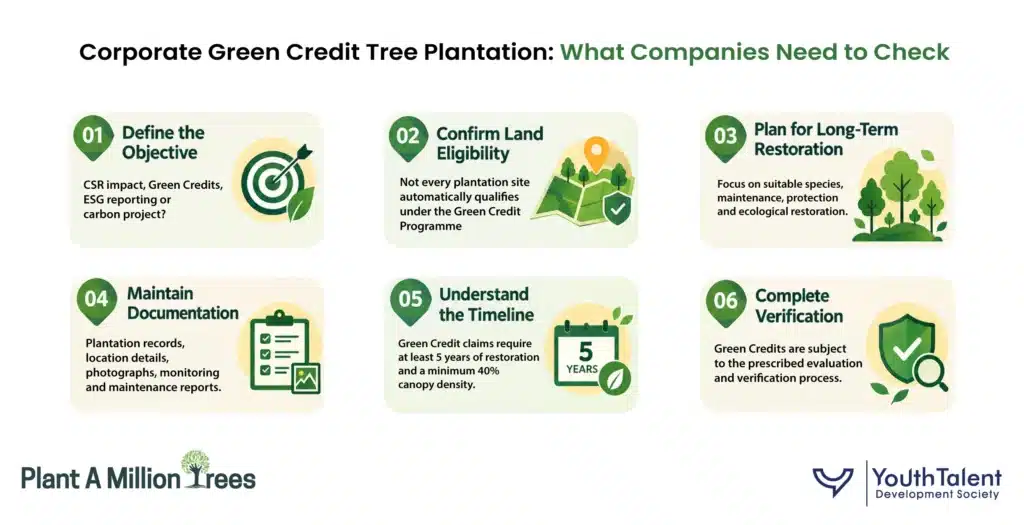
Companies considering the green credit programme India 2026 for companies should approach participation as a structured restoration project.
Determine whether the project is intended for Green Credits, CSR impact, ecological restoration, ESG reporting or another purpose. Avoid assuming that one project automatically satisfies every framework.
The Green Credit Programme has been designed around eligible land parcels identified through the programme’s prescribed process, including degraded forest land. Companies should confirm land eligibility before committing funds or communicating expected Green Credits.
Under the currently operationalised tree-plantation framework, eligible degraded forest land parcels are identified and uploaded through State or UT Forest Departments. A conventional plantation site should therefore not be assumed to qualify simply because trees can physically be planted there.
A proper plan should cover site conditions, species selection, plantation design, maintenance, protection and monitoring. The focus should be on establishing healthy vegetation rather than maximising the initial number of saplings.
For entities participating formally in the Green Credit Programme, the project process includes preparation of a Detailed Project Report (DPR) in consultation with the relevant forest authorities.
Project records should be maintained throughout implementation. Depending on the project, these may include plantation details, photographs, location records, monitoring observations, maintenance information and financial documentation.
Companies should understand that the current methodology links credit claims to long-term restoration. After the applicable conditions are achieved, the prescribed claim and verification process must be followed. The methodology specifically provides for evaluation and verification through designated agencies.
A company or other eligible entity seeking participation can register as a Green Credit Applicant through the official Green Credit Programme portal. The process involves coordination with the relevant State Forest Department authorities.
The Divisional Nodal Officer facilitates activities at the forest-division level, including identification of suitable degraded land, joint inspection of the selected parcel and technical inputs for preparation of the DPR. The DPR then moves through the prescribed review and approval process involving the State Nodal Officer.
The applicable programme process may also involve administrative payments, execution of the prescribed agreement or MoU, restoration implementation, monitoring, maintenance obligations and eventual verification of the Green Credit claim.
Because requirements may change or depend on the particular project, companies should review the latest official Green Credit Programme guidance and involve their CSR, sustainability, legal or compliance teams before treating expected Green Credits as part of a formal corporate commitment.
This means Green Credits should be treated as the outcome of a regulated process, not as an automatic benefit attached to a plantation invoice.
No. This is one of the most important points companies need to understand.
An employee plantation drive, NGO-led CSR activity, office plantation or plantation on company-owned land does not automatically qualify for Green Credits.
Eligibility depends on the applicable Green Credit Programme rules, land framework, restoration requirements and verification.
This is particularly important when companies work with NGOs or plantation vendors. A CSR tree plantation India partner may be capable of organising plantation events and maintenance without necessarily being responsible for Green Credit registration or issuance.
Before signing an agreement, companies should clarify:
These questions can prevent significant confusion later.
The current methodology requires companies to be particularly careful about the commercial value they assign to tree-plantation Green Credits.
For specified tree-plantation and compensatory-afforestation activities, the methodology states that Green Credits are currently non-tradable and non-transferable, with the stated exception for transfers between a holding company and its subsidiary companies.
This differs from the Indian carbon market. Under the applicable Carbon Credit Trading Scheme framework, Carbon Credit Certificates can be traded through the electronic market structure after meeting the relevant requirements.
Under the current Green Credit Programme framework, tree-plantation Green Credits may be exchanged once for specified purposes. These may include compensatory afforestation requirements, qualifying Corporate Social Responsibility requirements as permitted under applicable law, and certain statutory tree-plantation obligations.
Green Credits generated through tree plantation may also be used for reporting under applicable environmental, social and governance leadership indicators where permitted by law.
Because the credits are subject to programme-specific rules, companies should establish the intended use before designing the project rather than assuming that Green Credits can later be freely sold or applied to any sustainability target.
Green Credits may still have relevance for sustainability strategies and ESG reporting, but companies should not assume that receiving Green Credits automatically fulfils every CSR obligation, environmental compliance requirement or carbon-accounting objective.
Every credit should be linked to the framework under which it was issued and used only for purposes permitted by that framework.
Whether a company is pursuing Green Credits or simply implementing a high-quality CSR tree plantation India initiative, project quality should remain the priority.
Start with the land. Confirm its location, eligibility, suitability, water availability, protection requirements and restoration potential.
Next, focus on species selection. Native or locally appropriate species should be considered according to site conditions rather than selecting species solely because they are inexpensive or visually attractive.
Maintenance is equally important. Watering, protection, replacement where permitted, invasive-species management and periodic monitoring can determine whether a plantation develops beyond the initial event.
Documentation should begin from day one. Geo-tagged photographs, plantation dates, species information, location records, survival observations and maintenance reports provide a stronger evidence trail than a single plantation-day photograph.
For ESG reporting, companies should distinguish between verified achievements and future expectations. It is appropriate to report the number planted, observed survival and restoration progress when supported by records. Precise carbon benefits or guaranteed environmental outcomes should not be claimed without an appropriate methodology.
For companies planning a CSR tree plantation India programme, PAMT can support the practical plantation side of the project, including project planning, site-level execution, appropriate species planning, maintenance, geo-tagged documentation, monitoring and reporting support.
Where a company is specifically pursuing Green Credits, the Green Credit Programme’s own eligibility, land, registration, restoration and verification requirements remain applicable. PAMT’s role should therefore be viewed as supporting responsible plantation planning and implementation rather than issuing, certifying or guaranteeing Green Credits.
Companies can begin by defining the objective of the plantation first—CSR impact, employee engagement, ecological restoration, ESG documentation or another sustainability goal—and then build the plantation, maintenance and reporting framework around that objective.
Before committing to a Green Credit or plantation project, companies should ask:
These questions help companies distinguish genuine environmental restoration from plantation packages built mainly around marketing claims.
No. Green Credits are issued under the Green Credit Programme for eligible environmental activities, while carbon credits relate to quantified greenhouse-gas emission reduction, removal or avoidance. They operate through different frameworks.
No. A conventional CSR plantation does not automatically qualify. The project must meet the relevant Green Credit Programme eligibility, land, restoration, performance and verification requirements.
Under the revised tree-plantation methodology, a claim can be submitted after at least five years of restoration activities and achievement of at least 40% canopy density, subject to the required verification.
The current methodology states that Green Credits generated for compensatory afforestation or tree plantation are non-tradable and non-transferable, except for the specified holding-company and subsidiary-company transfer.
Not necessarily. A company may have a more relevant objective such as biodiversity restoration, community development, employee participation or ESG reporting. Green Credit eligibility should be treated as a separate consideration.
No. Plantation on company-owned land should not automatically be presented as a Green Credit project.
For the currently operationalised Green Credit tree-plantation and eco-restoration framework, eligible degraded forest land parcels are under the control and management of State or UT Forest Departments and are uploaded through the Green Credit Programme process.
Companies planning plantation on their own land can still undertake meaningful CSR, biodiversity or ESG plantation programmes, but they should verify Green Credit eligibility separately before making any Green Credit claim.
The Green Credit Programme India 2026 landscape makes one principle particularly important for companies: planting trees and earning credits are not the same thing.
A credible green credit tree plantation project requires eligible land, appropriate restoration planning, long-term maintenance, measurable outcomes and verification. A credible CSR plantation deserves the same level of seriousness even when Green Credits are not being pursued.
For companies, the best approach is to define the objective first, select the appropriate framework second and make only claims supported by documentation and verification.
Companies planning CSR tree plantation India projects can use the Green Credit Programme as a framework to understand the requirements for eligible environmental restoration, but not as a shortcut for environmental or carbon claims.
For project design, site planning, native-species selection, maintenance, geo-tagging, monitoring and reporting, companies should work with an experienced implementation partner while confirming project-specific requirements through official government and ICFRE channels.
If your organisation is planning a corporate tree plantation or CSR plantation programme, PAMT can help structure the plantation objective, implementation plan, maintenance approach, geo-tagged documentation and impact reporting while keeping any Green Credit or carbon-credit claims separate from the plantation activity itself.
Planting trees is easy to count. Measuring what those trees actually contribute to an ecosystem is much harder. A...

A tree plantation activity can look simple from the outside: choose a location, bring employees, plant saplings, take photographs,...
Corporate gifting is changing. Companies are increasingly moving beyond calendars, hampers, merchandise, and other gifts that are quickly forgotten....