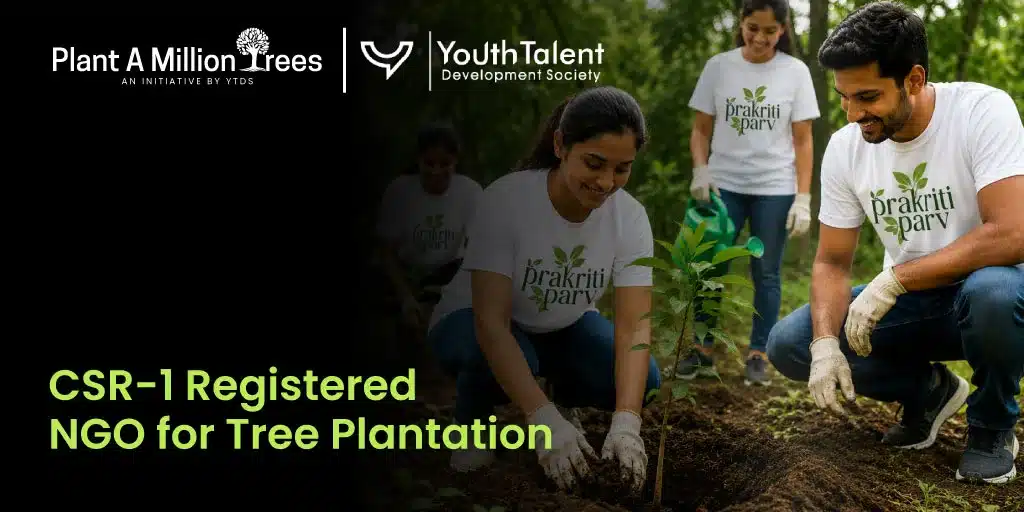

“How much land do we need for 1,000 trees?” is one of the first practical questions CSR teams ask...

A successful CSR tree plantation project begins long before the first sapling is planted, it begins with choosing the right implementation partner.
Many companies evaluate a plantation partner primarily on cost, the number of saplings offered, or the scale of the plantation drive. While these factors are important, they don’t tell the complete story. The long-term success of a CSR project depends on much more: regulatory compliance, execution capability, transparent reporting, survival monitoring, and long-term maintenance.
This is where partnering with a CSR-1 registered NGO becomes an important consideration. CSR-1 registration helps establish that an NGO is eligible to undertake CSR projects under the Companies Act, giving companies greater confidence while planning and implementing CSR initiatives.
However, registration alone should never be the only deciding factor.
An effective CSR implementation partner should also demonstrate experience in managing tree plantation projects, maintaining high survival rates, providing transparent documentation, and supporting companies throughout planning, execution, monitoring, and reporting.
In this guide, we’ll explain why companies should work with a CSR-1 registered NGO, what to verify before finalizing a partnership, and how to choose an organization capable of delivering long-term environmental impact, not just a successful plantation event.
If your company plans to undertake CSR projects through an external implementing agency, you’ve probably come across the term “CSR-1 registered NGO.” While it sounds technical, the concept is relatively straightforward.
CSR-1 is a registration requirement introduced by the Ministry of Corporate Affairs (MCA) for organizations that wish to implement eligible CSR projects on behalf of companies. An NGO that has completed this registration becomes eligible to receive CSR funding, provided it also satisfies the applicable provisions of the Companies Act and related CSR Rules.
For companies, this serves as an important compliance checkpoint.
Working with a CSR-1 registered NGO for CSR activities helps ensure that the implementing organization meets the basic eligibility requirements laid down for CSR implementation. It also simplifies internal approval processes because CSR teams can verify the NGO’s registration status before finalizing a partnership.
However, it is important to understand what CSR-1 does, and what it does not do.
CSR-1 registration confirms eligibility. It does not automatically guarantee project quality, ecological expertise, transparent reporting, or successful implementation. Those aspects depend on the NGO’s experience, operational systems, and commitment to long-term outcomes.
Think of CSR-1 as the starting point rather than the finish line.
Just as hiring a licensed contractor doesn’t automatically guarantee excellent construction, partnering with a CSR-1 registered NGO doesn’t automatically ensure a successful plantation project. Companies must still evaluate execution capability, reporting systems, and maintenance practices before making a decision.
Many CSR teams spend considerable time discussing plantation locations, employee participation, or project budgets. Yet one of the simplest verification steps, checking whether an NGO is CSR-1 registered, is sometimes overlooked.
This verification should happen before commercial discussions begin.
From a governance perspective, working with an eligible implementing agency reduces compliance-related uncertainties and helps companies demonstrate due diligence during internal reviews, statutory audits, and CSR committee approvals.
For finance, legal, HR, and sustainability teams, this small step can prevent larger issues later in the project lifecycle.
Verifying a CSR-1 registered NGO also encourages a more structured partner evaluation process. Instead of selecting an NGO based solely on presentations or quotations, companies begin by confirming regulatory eligibility before moving on to operational capability.
Many experienced CSR managers follow a simple sequence:
This approach reduces project risk while improving accountability from the very beginning.
Most importantly, it signals that the organization values governance as much as environmental impact, a principle that increasingly defines successful CSR programs.
Tree plantation is often perceived as one of the simplest CSR initiatives to organize. In reality, it is one of the most operationally demanding environmental projects a company can undertake.
Planting saplings is only one part of the process.
A successful plantation project requires careful site selection, ecological planning, permissions, logistics, volunteer coordination, species selection, maintenance planning, survival monitoring, and transparent reporting. Each stage influences whether the plantation creates lasting environmental value or becomes another one-day CSR event.
A common mistake many companies make is assuming that all plantation vendors deliver the same service. In practice, implementation quality varies significantly.
An experienced tree plantation NGO begins planning weeks before plantation day. The organization evaluates soil conditions, studies rainfall patterns, recommends suitable native species, prepares the site, coordinates logistics, trains volunteers, and develops a maintenance plan for the years ahead.
Less experienced organizations often focus only on the event itself.
The result may be an efficiently managed plantation day but poor survival rates six months later.
This is why choosing the right CSR implementation partner matters.
An experienced NGO doesn’t simply plant trees, it manages an ecological restoration project.
That shift in perspective changes everything.
Instead of measuring success through the number of saplings planted, companies begin measuring survival, biodiversity improvement, carbon sequestration, and community impact over time.
Ultimately, the quality of the implementation partner often determines the quality of the environmental outcomes.
Selecting an NGO should involve more than comparing quotations or plantation targets. The strongest partnerships are built through careful evaluation and clear expectations from both sides.
Before selecting a CSR-1 registered NGO, consider the following questions.
The best NGOs welcome these questions because transparency builds stronger partnerships.
Documentation plays a critical role in responsible CSR partner selection. It helps companies verify claims, compare potential partners objectively, and maintain records for governance and reporting purposes.
Before approving a plantation project, request documentation that demonstrates both compliance and operational capability.
Start by asking for proof of CSR-1 registration and basic organizational registration details. These establish the NGO’s eligibility to undertake CSR implementation.
Next, request a detailed project proposal.
A well-prepared proposal should clearly explain the plantation objectives, implementation methodology, site details, species selection approach, expected outcomes, maintenance plan, monitoring schedule, and reporting process. If these details are vague or missing, it may indicate limited planning.
Companies should also ask for a detailed quotation that explains how project costs have been calculated. Transparent budgets inspire greater confidence than quotations that provide only a single lump-sum figure.
Past project reports are equally valuable.
Review examples of completed plantation projects, paying attention not only to the number of trees planted but also to survival data, maintenance activities, photographs, geotagged records, and measurable environmental outcomes.
Finally, request a copy of the proposed maintenance plan.
Many companies discover that maintenance is the single biggest difference between successful plantations and failed ones. A detailed aftercare schedule demonstrates that the NGO understands plantation as a long-term responsibility rather than a one-day activity.
Strong documentation doesn’t create successful projects on its own, but it often reflects the planning discipline needed to deliver them.
Choosing the wrong implementation partner can affect far more than the success of a single plantation drive. It can lead to low survival rates, weak documentation, compliance concerns, and ultimately, questions from stakeholders about the credibility of the entire CSR initiative.
Fortunately, most risks can be identified before the project begins, provided companies know what to look for.
One of the clearest warning signs is an NGO that cannot provide proof of its CSR-1 registered NGO status when it claims to undertake CSR implementation. This should be one of the first documents verified during the evaluation process.
Another common concern is the absence of a maintenance plan. Some organizations focus almost entirely on plantation day while offering little clarity about watering schedules, protection measures, replacement planting, or survival monitoring. Since the real work begins after the saplings are planted, the lack of an aftercare strategy should raise immediate questions.
Companies should also be cautious of partners that promise unusually high plantation numbers at exceptionally low costs without explaining how site preparation, labour, logistics, maintenance, and reporting will be managed. In tree plantation, the cheapest proposal is rarely the most economical in the long run.
Weak documentation is another indicator of poor execution capability. If an NGO cannot share previous plantation reports, geotagged photographs, survival data, or case studies from earlier projects, it becomes difficult to assess its experience objectively.
Similarly, vague responses about species selection should not be ignored. Experienced organizations explain why certain native species are recommended for specific locations. Those that suggest planting the same species everywhere often overlook local ecological conditions.
Many companies also discover problems when implementation partners cannot clearly explain their monitoring process. Regular site inspections, survival audits, progress updates, and transparent reporting are now expected from professional CSR implementation partners, especially for projects linked to ESG reporting.
The best approach is simple: verify first, commit later. A few additional checks during partner selection can prevent significant operational and reputational challenges after the plantation begins.
There is sometimes a misconception that selecting a CSR-1 registered NGO automatically guarantees a successful CSR project.
It doesn’t.
CSR-1 registration establishes eligibility, but the quality of implementation depends on entirely different factors.
A reliable NGO combines regulatory compliance with operational expertise. It understands local ecosystems, recommends suitable native species, manages logistics efficiently, coordinates volunteers effectively, and invests in long-term maintenance. It also maintains clear documentation throughout the project, making it easier for companies to track outcomes and demonstrate accountability.
Many experienced CSR managers now evaluate NGOs using two equally important questions.
The first is straightforward: Is the organization eligible to implement CSR projects?
The second is even more important: Can the organization consistently deliver measurable environmental impact?
The answer to the second question comes from evidence rather than registration.
Look at previous projects. Review survival rates instead of plantation counts. Ask how biodiversity improvements are monitored. Understand how maintenance is funded and managed after plantation day.
Execution quality also becomes evident through communication. Strong implementation partners provide realistic timelines, explain potential risks, and set clear expectations instead of making unrealistic promises.
Companies investing in tree plantation should remember that environmental impact develops over years, not weeks. Choosing an NGO that can support the project throughout that journey is often more valuable than selecting one that simply organizes a successful event.
Ultimately, compliance and capability should work together, not compete with each other.
Modern CSR reporting is no longer limited to listing the number of trees planted during the financial year.
Investors, boards, CSR committees, and other stakeholders increasingly expect evidence that projects are creating measurable environmental outcomes. This is where the quality of an implementation partner becomes particularly important.
A structured CSR-1 registered NGO helps companies collect meaningful data throughout the project lifecycle instead of attempting to reconstruct information at the end of the year.
Good reporting begins with accurate records.
From the first site assessment to plantation day and subsequent monitoring visits, experienced NGOs maintain detailed documentation that supports internal reviews as well as external sustainability reporting.
This often includes geotagged plantation locations, species inventories, volunteer participation records, maintenance schedules, survival audits, and periodic photographic evidence showing plantation progress over time.
These records become valuable far beyond CSR compliance.
They help companies prepare ESG disclosures, sustainability reports, board presentations, annual impact summaries, and responses to stakeholder queries with greater confidence.
Many organizations also find that transparent reporting improves internal decision-making. By analysing survival trends, maintenance costs, and ecological outcomes across different projects, CSR teams can refine future plantation strategies and allocate resources more effectively.
Strong reporting is ultimately a reflection of strong execution.
When implementation is systematic, documentation becomes easier. When monitoring is consistent, impact becomes measurable. And when impact is measurable, stakeholder trust naturally follows.
Selecting the right implementation partner is not just about completing a plantation drive, it’s about creating environmental outcomes that continue long after the event is over.
The Youth Talent Development Society (YTDS), through its #PlantAMillionTrees initiative, works with companies to design and implement plantation projects that focus on long-term ecological restoration rather than one-day activities.
The approach begins with careful planning.
Projects are designed around appropriate site selection, native species plantation, and clearly defined environmental objectives. During implementation, attention is given to operational planning, employee participation where required, and structured execution.
Equally important is what happens after plantation day.
YTDS supports post-plantation care, survival monitoring, impact documentation, geotagged reporting, and periodic project updates so that companies have meaningful data for CSR and ESG reporting.
Rather than focusing solely on plantation numbers, the emphasis remains on survival, biodiversity improvement, and measurable environmental outcomes.
For organizations looking to build credible and transparent tree plantation programs, partnering with an experienced implementation agency helps transform CSR investments into long-term environmental assets.
Discuss your CSR plantation requirements with a team that can support project planning, execution, post-plantation care, survival monitoring, geo-tagged documentation and structured reporting.
Share your project location, expected plantation scale and company requirements to discuss the right implementation approach.
Discuss Your CSR Plantation ProjectA CSR-1 registered NGO is an organization that has completed the required registration process with the Ministry of Corporate Affairs to become eligible to implement CSR projects under the applicable CSR Rules.
Working with a CSR-1 registered NGO helps companies ensure basic compliance while partnering with an organization eligible to receive CSR funding. However, companies should also evaluate execution capability, maintenance practices, and reporting quality before finalizing a partnership.
No. Registration confirms eligibility but does not guarantee project quality. Companies should also review the NGO’s experience, previous projects, survival rates, documentation systems, and long-term maintenance commitment.
Organizations should ask for CSR-1 registration proof, project proposals, detailed quotations, previous plantation reports, maintenance plans, geotagged documentation samples, and evidence of monitoring practices.
Look for a partner with transparent documentation, experience in similar projects, native species expertise, structured maintenance plans, survival monitoring systems, and clear reporting processes. A credible NGO should be comfortable sharing evidence of its past work.
Choosing the right plantation partner is one of the most important decisions a company makes during a CSR project.
While verifying that an organization is a CSR-1 registered NGO is an essential first step, true project success depends on much more than regulatory eligibility. Experience, planning capability, ecological understanding, transparent reporting, and long-term maintenance all play an equally important role.
The strongest CSR implementation partners combine compliance with execution excellence. They help companies move beyond plantation events to create projects that deliver measurable environmental impact, strengthen ESG reporting, and build long-term stakeholder trust.
Before approving a tree plantation project, companies should evaluate not only whether an NGO is eligible to undertake CSR work, but also whether it has the systems, expertise, and commitment required to ensure that the saplings planted today continue to grow for years to come.
Because in plantation CSR, the right partner doesn’t just help plant trees, it helps create lasting environmental value.
“How much land do we need for 1,000 trees?” is one of the first practical questions CSR teams ask...
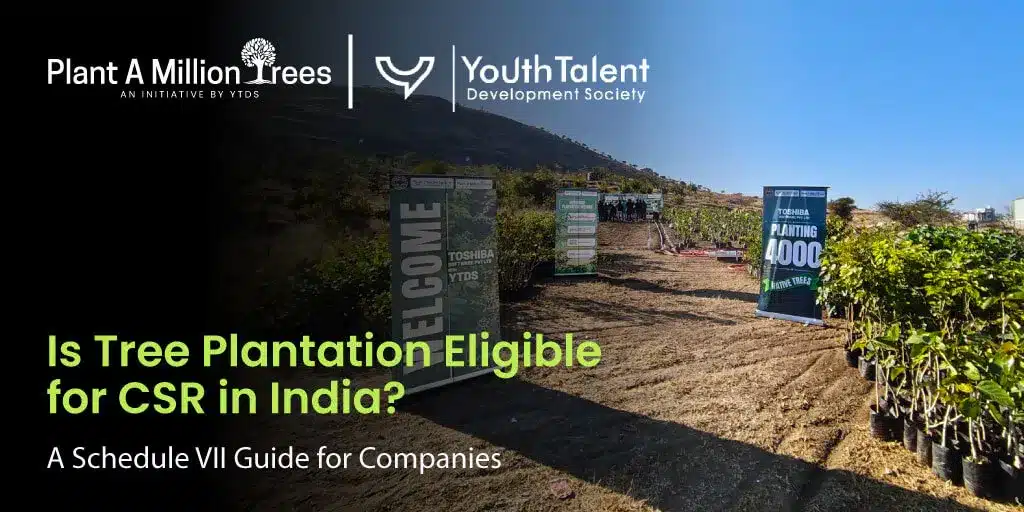
Tree plantation has become an important part of corporate environmental sustainability initiatives in India. Companies are funding plantation drives,...
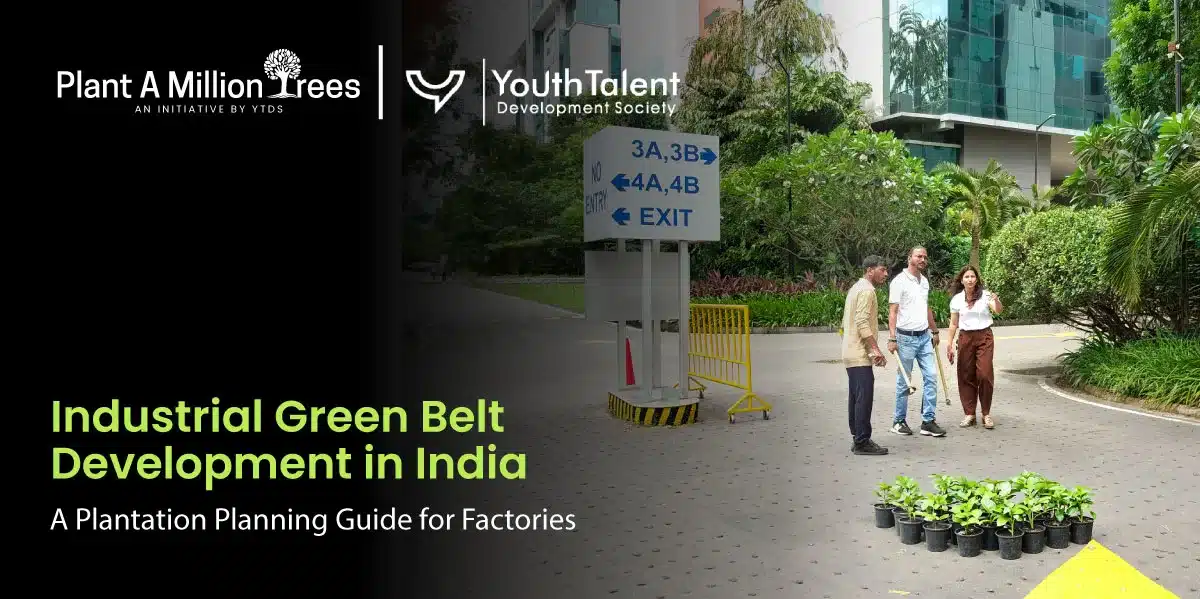
Industrial green spaces are often treated as rows of trees added around a factory boundary. In practice, effective green...