Corporate campuses are no longer viewed only as places where employees work or products are manufactured. Offices, factories, warehouses,...

Planting trees is a visible CSR activity, but the number of saplings planted or photographs from a plantation event do not, by themselves, explain whether a project created durable outcomes.
For CSR heads, ESG teams, corporate foundations, compliance teams and programme managers, the more important question is: what changed after implementation, and can that change be supported with credible evidence?
This is where CSR impact assessment in India becomes relevant.
An impact assessment moves beyond reporting activities and examines whether a CSR project achieved its intended outcomes, what contributed to those outcomes and what could be improved.
For tree plantation projects, this can mean looking beyond plantation-day numbers to indicators such as survival rate, canopy growth, native species, soil and water conditions, community or employee participation and project governance.
Importantly, not every plantation project automatically requires a formal impact assessment. Applicability depends on the conditions prescribed under the CSR Rules. Companies should therefore distinguish between mandatory impact assessment, routine monitoring and voluntary evaluation.
One of the most important aspects of the CSR impact assessment rules is understanding when the requirement applies.
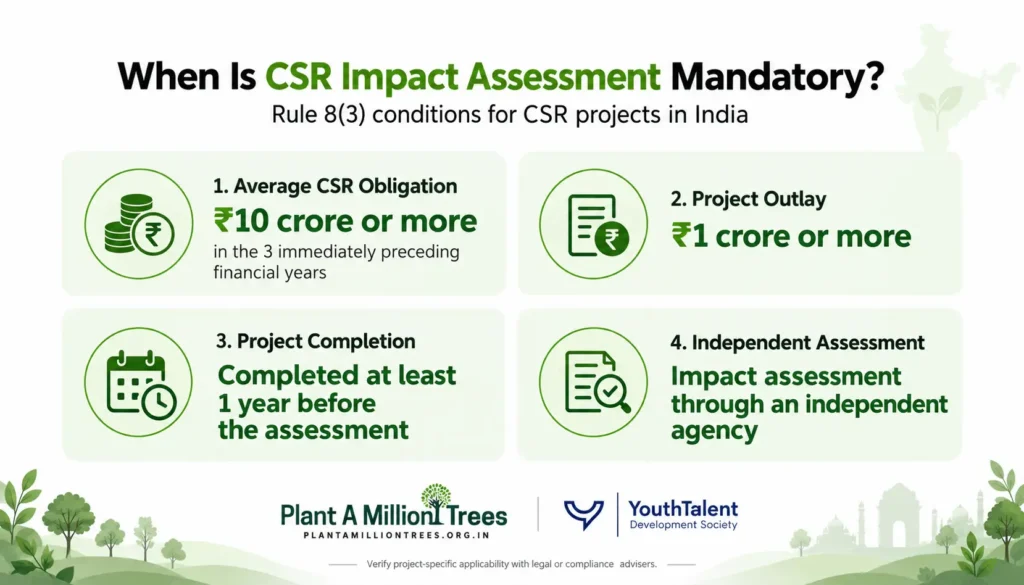
Under Rule 8(3) of the Companies (CSR Policy) Rules, 2014, impact assessment through an independent agency is required where the prescribed company-level and project-level conditions are met.
Broadly, both of the following conditions apply:
The requirement is therefore not triggered simply because a company conducts a tree plantation activity.
For example, a company organising a small employee plantation event does not automatically become subject to the Rule 8(3) impact assessment requirement merely because trees were planted. The company’s CSR obligation and the project’s outlay and completion status must be considered against the applicable conditions.
Companies should verify the current regulatory position and project-specific applicability with their legal or compliance advisers before reaching a compliance conclusion.
Where the Rule 8(3) conditions are not met, a company may still choose to conduct an evaluation voluntarily. The Ministry of Corporate Affairs explains that impact assessment can help companies make better decisions about CSR spending, allocate resources more effectively and deepen the impact of their programmes.
A common mistake is treating every CSR report as an impact assessment.
Monitoring generally tracks whether planned activities are being implemented.
For a tree plantation project, monitoring might include:
Evaluation goes a step further by examining whether the programme is progressing towards its intended objectives.
Impact assessment asks a broader question:
What meaningful change can reasonably be associated with the project, and what evidence supports that conclusion?
For example, a CSR team may report that 10,000 saplings were planted. That is an output.
An impact-oriented assessment may examine how many survived, whether the plantation developed as intended, whether the selected species were ecologically appropriate and whether the project contributed to the outcomes defined at the beginning.
Therefore, monitoring, evaluation and impact assessment are not simply different terms for the same activity. Each serves a different purpose within the project lifecycle.
A credible assessment should ideally be considered while designing the plantation project rather than only after implementation has ended.
The first step is to define what the plantation project was intended to achieve.
Possible objectives may include:
The assessment should measure outcomes connected to these objectives.
A project designed primarily around native biodiversity, for instance, should not be evaluated only through the number of saplings planted.
Clear objectives make it easier to determine which KPIs, baseline data and evidence should be collected throughout the project.
A plantation baseline creates a reference point against which future changes can be assessed.
Depending on the project, baseline information may include:
Without a baseline, it can become difficult to distinguish project-related changes from conditions that already existed.
Baseline information does not need to be unnecessarily complicated. The appropriate level of detail depends on the project’s size, objectives, location and methodology.
The next stage is selecting meaningful outcome indicators.
Companies should avoid turning every available measurement into a KPI. Indicators should directly connect to the project’s objectives.
Survival rate is one of the most practical indicators for a tree plantation project.
Plantation-day numbers provide information about what was planted. Survival monitoring provides information about what remains alive over time.
Companies can track:
A low survival rate should not simply lead to replacement planting without further investigation.
The project team should consider whether mortality was associated with factors such as:
Understanding the reason for mortality creates a more useful feedback loop for future plantation planning.
Native species can be an important indicator when biodiversity or ecological restoration is an explicit project objective.
An assessment may examine:
The objective should not be to claim ecological improvement merely because multiple species were planted.
The assessment should consider whether the species mix was appropriate for the location, site conditions and project purpose.
Canopy growth can help demonstrate how a plantation develops beyond the initial planting stage.
A newly planted sapling and an established tree do not provide the same ecological or practical functions.
Tracking canopy development over time can therefore provide useful information about project progress.
The appropriate measurement method will depend on the project design, available resources and assessment methodology.
Tree plantation can also be connected to site-level soil health and water-related outcomes where those outcomes form part of the project’s objectives.
Possible indicators may include:
These outcomes should be documented using a consistent methodology rather than making unsupported claims about environmental improvement.
A tree plantation programme may involve community members, local institutions, volunteers or employees.
Participation can be measured through:
Participation is generally an output or intermediate indicator rather than proof of environmental impact.
It should therefore be interpreted in relation to the project’s broader objectives.
A strong evidence framework allows an assessor to understand what happened before, during and after implementation.
Companies should maintain relevant records throughout the project instead of attempting to reconstruct everything months or years later.
Useful records may include:
Documentation may include:
The evidence system may include:
This stage-based approach can make an assessment more credible because evidence is collected as implementation progresses rather than reconstructed much later.
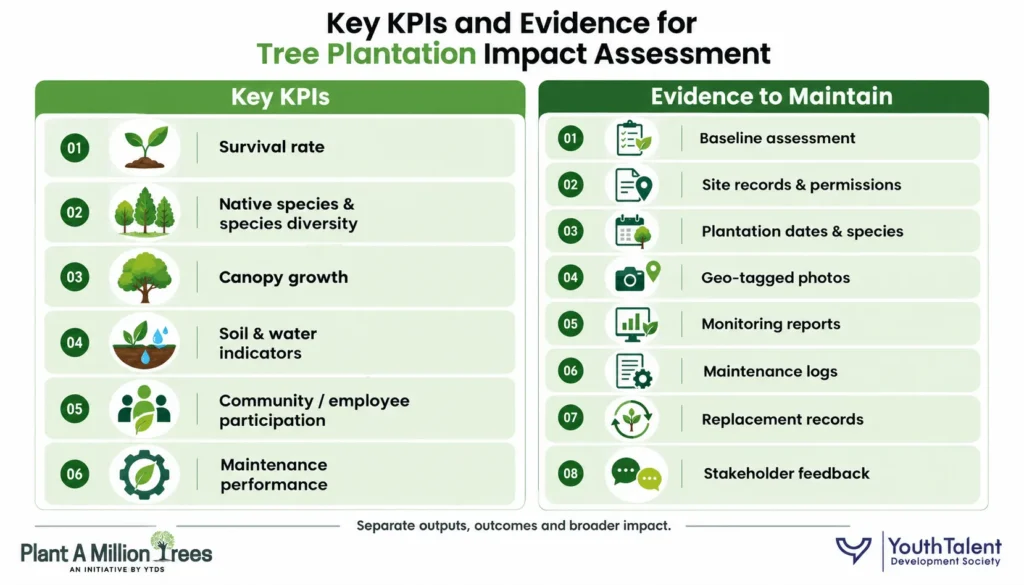
Where Rule 8(3) applies, the impact assessment is required to be conducted through an independent agency.
The role of an independent assessor is different from that of the organisation implementing the plantation project.
The implementing agency may provide project records, monitoring data, photographs, site information and other supporting evidence.
The independent assessor then evaluates the project according to the assessment methodology.
Depending on the project and methodology, an assessment may identify:
Independence matters because an impact assessment should not simply become a promotional report prepared by the same organisation responsible for implementation.
Companies should also avoid selecting an assessor merely because it is expected to produce favourable conclusions.
Methodology, expertise, independence and the ability to evaluate the project’s specific objectives are more meaningful considerations.
A CSR impact assessment should clearly distinguish between outputs, outcomes and broader impact.
For example:
Output: 5,000 saplings were planted.
Outcome indicator: A defined proportion of the planted saplings survived through the monitoring period.
Broader impact: The project contributed to a defined ecological or social objective based on the evidence and methodology used.
This distinction helps prevent companies from turning activity numbers into unsupported impact claims.
Companies should be particularly careful with claims around carbon sequestration.
Planting a particular number of trees does not automatically establish a specific carbon benefit. Such claims require an appropriate methodology, assumptions, measurement and supporting evidence.
The same principle applies to claims involving:
CSR reporting should make the methodology and important limitations understandable to decision-makers.
Where applicable, impact assessment reports are placed before the Board and form part of the required CSR reporting process. MCA guidance also explains that the impact assessment report should be annexed to the annual report on CSR, with the applicable disclosure requirements followed.
Companies developing their own documentation framework can also review what should be included in structured tree plantation reporting for CSR teams.
Before starting an assessment, companies can use the following practical checklist:
This approach helps turn plantation documentation into a structured evidence system rather than a collection of disconnected photographs and activity records.
A strong impact assessment begins with strong project implementation and documentation.
Plant A Million Trees can support companies in designing tree plantation projects with stronger documentation and monitoring foundations.
Depending on project scope, this can include support around:
The objective is not to replace the independent impact assessment agency where independence is required.
Instead, strong implementation documentation can make a future assessment more evidence-ready.
For companies planning a CSR plantation project, an assessment-ready approach can begin before the first sapling is planted through clear objectives, baseline documentation, defined KPIs, site records and a structured monitoring process.
This can help CSR, ESG and sustainability teams maintain stronger evidence throughout the lifecycle of the plantation project and make subsequent reporting or assessment more structured.
No.
The Rule 8(3) requirement depends on specified company-level and project-level conditions.
Broadly, the company must have an average CSR obligation of at least ₹10 crore over the preceding three financial years, while the relevant project must have an outlay of at least ₹1 crore and have been completed at least one year before the assessment.
Companies should verify applicability for their particular circumstances.
Monitoring tracks implementation and progress, such as plantation numbers, survival, maintenance and project records.
Impact assessment goes further by examining whether the project produced its intended outcomes and what evidence supports those conclusions.
Where Rule 8(3) applies, the impact assessment is conducted through an independent agency.
The assessment report is then handled in accordance with the applicable Board and CSR reporting requirements.
Depending on project objectives, possible KPIs include survival rate, species diversity, tree growth, canopy development, site condition, soil indicators, water-related indicators, maintenance performance and community or employee participation.
The appropriate KPIs should reflect what the plantation project was actually designed to achieve.
The number of trees planted is an important implementation output, but it does not by itself demonstrate long-term impact.
Survival, growth, ecological condition, maintenance performance and other relevant outcome indicators provide a more complete picture of what happened after plantation.
No.
Geo-tagged photographs and location records can provide useful implementation and monitoring evidence, but they do not by themselves constitute an impact assessment.
A credible assessment considers objectives, methodology, baseline conditions, outcomes, supporting evidence and limitations together.
Yes.
Even where the mandatory Rule 8(3) conditions do not apply, companies may choose to evaluate CSR projects voluntarily.
Voluntary evaluation can provide useful feedback for future project planning, budgeting, implementation and resource allocation.
A credible CSR impact assessment in India begins well before the assessment itself.
Companies should establish a plantation baseline, define meaningful outcome indicators, preserve evidence, monitor survival and growth and clearly distinguish project outputs from outcomes.
For tree plantation projects, the most useful assessment is not necessarily the one containing the largest number of metrics.
It is the one where the indicators directly reflect the project’s objectives and where credible evidence supports the conclusions.
Companies should also determine whether Rule 8(3) applies to their specific project and obtain appropriate legal or compliance advice where necessary.
Where a mandatory assessment is applicable, the assessment must be conducted through an independent agency. Voluntary evaluation can also help companies strengthen future CSR programme design.
A well-designed evidence system—from baseline and site records to geo-tagged proof, survival monitoring, maintenance logs and outcome reporting—can make tree plantation projects more transparent, measurable and useful for long-term CSR decision-making.
The goal is not simply to document that trees were planted.
The goal is to build enough evidence to understand what happened after plantation, what outcomes were achieved and how the next project can be improved.
Corporate campuses are no longer viewed only as places where employees work or products are manufactured. Offices, factories, warehouses,...

A company with offices, factories, branches, or employee teams across India may want its environmental initiatives to reach multiple...

Plantation day often gets the most attention in a CSR project. Employees gather, saplings are planted, photographs are taken,...