

A company with offices, factories, branches, or employee teams across India may want its environmental initiatives to reach multiple...


A company may have the budget, volunteers, saplings, and a plantation date ready, only to discover that the selected site cannot be used without approval.
For corporate plantation projects, tree plantation permission should be checked before execution planning begins. Requirements can vary depending on who owns or controls the land, whether the site is public or private, and which local authority manages it.
Permission is not simply paperwork. It establishes who has approved the plantation, whether the site can support trees long term, and who will maintain them after the event.
For CSR teams, getting these questions right early can prevent delays, relocation of the drive, and saplings being planted at sites where their future is uncertain.
Plantation permission is sometimes treated as a final administrative step: choose a site, finalize the event, and obtain approval before planting day.
In practice, permission should influence the project much earlier.
Imagine a company planning a 1,000-sapling drive on an open roadside stretch. The location is accessible, visible, and convenient for employee participation. But closer to the event, the team discovers that the land falls under a local authority and cannot be planted without its approval. Even if permission eventually comes through, the authority may have conditions regarding species, spacing, utilities, or maintenance.
This is why tree plantation permission India planning should begin with land ownership and site control.
Permission can help establish legal and operational clarity around the site. It can also clarify access for future watering and monitoring, responsibility for protecting saplings, and whether future infrastructure or development could affect the plantation.
For CSR teams, this directly affects survival and reporting. A company cannot build a credible long-term environmental project if it is uncertain whether the trees will remain at the location.
The exact approval process can differ across states, cities, land categories, and authorities. Companies should therefore verify requirements with the relevant landowner or competent local authority rather than assuming one permission process applies everywhere.
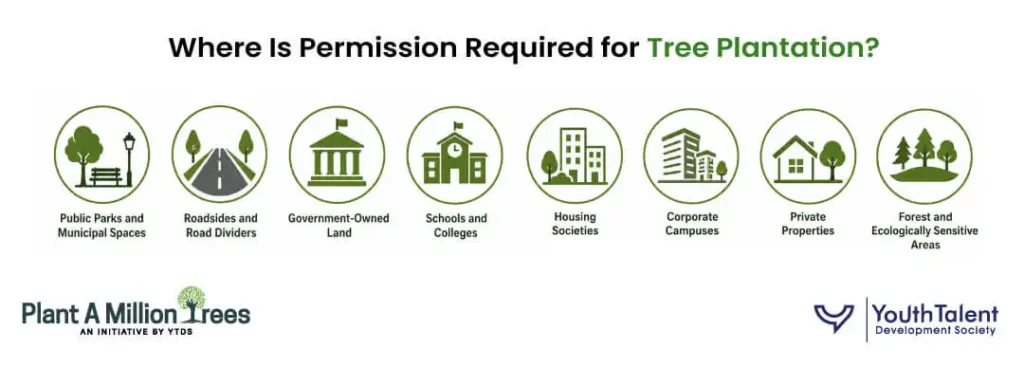
There is no single answer to what permission is required for tree plantation drive in India because the requirement depends heavily on the site.
The first question should always be: Who owns or controls this land?
Planting on public land generally requires coordination with the authority responsible for that location. This could include public parks, roadside areas, open government land, medians, or other civic spaces.
A public land plantation should never begin simply because a site appears vacant. The land may already have designated uses, development plans, underground infrastructure, or maintenance arrangements.
Roadside plantation requires particular care because road stretches may fall under different authorities. Visibility, pedestrian movement, utility lines, road expansion, and traffic safety can also influence what and where trees may be planted.
Approval should therefore be secured before pits are dug or saplings are procured.
For plantation on school or college premises, companies should coordinate with the institution’s management and any relevant governing authority.
Beyond receiving permission, discuss where trees can grow without affecting playgrounds, buildings, utility areas, or future expansion.
Plantation inside residential societies should be coordinated with the society’s authorized management or committee. The discussion should cover location, species, maintenance, and responsibility for the trees after planting.
Plantation on company-owned premises is usually operationally simpler because land control is clearer. However, internal site approval is still useful, particularly for factories, warehouses, campuses, and facilities where landscaping must account for utilities, safety, movement, and future construction.
If the company does not own the property, written approval from the relevant owner or authorized entity becomes particularly important.
Plantation in or around forest land and other protected or sensitive landscapes requires much more careful coordination. Companies should not independently begin plantation in such locations without consulting the competent authorities.
In these environments, adding trees is not automatically beneficial. Species composition and existing ecology matter, and inappropriate plantation can interfere with natural ecosystems.
The practical rule is simple: confirm ownership, identify the responsible authority, and obtain the necessary approval before committing the project.
The authority that can provide permission for tree plantation drive depends on the location and ownership of the proposed site.
For municipal parks, roads, or civic spaces, companies may need to coordinate with the relevant municipal corporation, municipality, or other local body.
In rural areas, the gram panchayat or another authority responsible for the land may need to be involved.
For forest-controlled land, coordination may be required with the relevant forest authorities.
A plantation planned at a school or college may require approval from the institution’s authorized management, while a housing society project would generally involve the appropriate society committee or management.
On private land, approval should come from the landowner or an authorized representative. For a corporate tree plantation on company-controlled property, relevant facility, administration, sustainability, or corporate teams may also need to approve the location.
The important point is not to guess based on the appearance of the site.
An open patch of land is not necessarily unclaimed land. A roadside may be controlled by one authority while an adjacent open space belongs to another.
Good CSR plantation planning therefore starts with identifying who has the authority to approve both plantation and continued access for maintenance.
Public spaces can be attractive locations for CSR plantation because they allow environmental benefits to reach larger communities. But they also require greater coordination.
Before considering a public site, companies should establish who controls the land and whether plantation is compatible with its intended use.
Authorities may need information about the number and species of trees proposed, spacing, plantation layout, maintenance arrangements, and the organization responsible for implementation.
This matters because public land has competing requirements. A roadside plantation, for example, must not obstruct visibility or interfere with infrastructure. A public park may already have a landscaping plan. An open government plot may be reserved for another purpose.
Maintenance is equally important.
A company may receive approval to plant hundreds of saplings, but what happens during the next dry season? Who waters them? Who replaces damaged plants? Can the NGO continue accessing the site?
These questions should be resolved before execution.
A successful public plantation is therefore not about finding unused land. It is about finding appropriate land where the plantation has authorization, ecological suitability, and a realistic future.
Private or company-controlled land generally offers companies greater flexibility, but that does not mean planning should be informal.
Consider a plantation proposed around a manufacturing facility. The available open land may look suitable, but facility teams could have plans for future construction, fire access, underground utilities, or vehicle movement.
Internal coordination can prevent trees from being planted where they later need to be removed.
For rented facilities or third-party properties, companies should establish written clarity with the owner regarding the plantation and long-term maintenance.
Residential campuses and privately owned spaces present similar considerations. The company and landowner should agree on who will maintain the trees, whether implementation teams can conduct future survival assessments, and how long the land will remain available for the project.
Permission becomes most valuable when it establishes long-term certainty rather than merely allowing a one-day event.
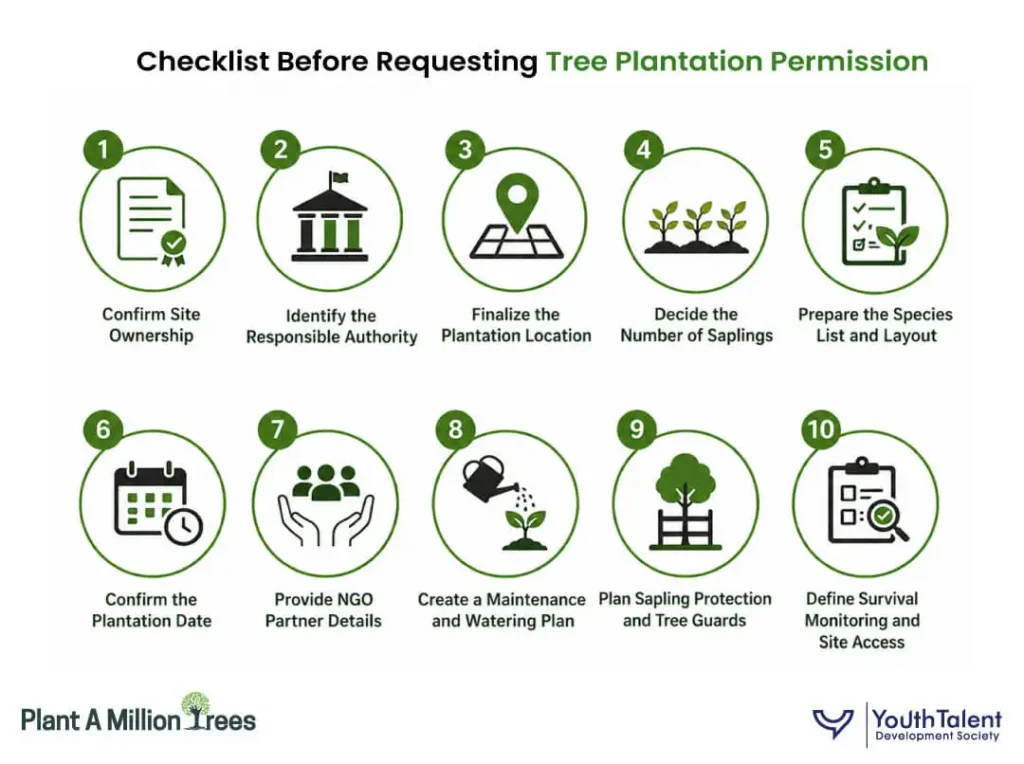
Authorities and landowners are easier to coordinate with when a company approaches them with a defined project rather than a vague proposal to “plant some trees.”
A practical tree plantation permission checklist for companies should include:
Companies should also retain relevant approval correspondence and project records as part of their CSR documentation.
For larger projects, early NGO coordination can make this process easier. An implementation partner familiar with the local area may help teams understand site conditions, coordinate with relevant stakeholders, and prepare realistic execution and maintenance plans.
The objective is to resolve uncertainties before saplings, volunteers, and logistics are committed.
Permission is not only about whether trees can be planted. In some situations, what a company intends to plant may also matter.
A common mistake is selecting saplings based on availability and finalizing the site later.
The better approach is the reverse.
Understand the site first, then select species that match its ecological and operational conditions.
Native and locally appropriate trees are often valuable candidates because they are adapted to regional conditions and can support local biodiversity. But “native” alone does not automatically make every species suitable for every site.
A large-canopy tree may be inappropriate beneath utility infrastructure. Species with extensive roots may not suit locations close to structures. Water requirements, available soil volume, expected mature size, and local climate all need consideration.
Authorities or landowners may also have requirements or preferences regarding species and spacing.
Choosing the right tree for the right place can therefore simplify approval while improving the plantation’s chances of surviving long after the event.
Receiving plantation drive permission does not make a plantation project successful.
The real test begins after the saplings are in the ground.
Before execution, the company, implementation partner, and site authority or owner should establish who is responsible for watering, mulching, tree guards, pest management, replacement planting, and periodic monitoring.
Consider what happens when the monsoon ends. A plantation that survived easily during regular rainfall may suddenly face moisture stress. If nobody has been assigned responsibility for watering, losses can increase quickly.
The same applies to grazing, accidental damage, vandalism, and tree guard maintenance.
CSR teams should therefore connect permission planning with aftercare planning. Where possible, maintenance responsibilities, access arrangements, and monitoring expectations should be documented clearly.
The strongest project is not the one that receives approval fastest. It is the one where everyone knows what happens after approval.
Many avoidable problems begin when companies choose the event date before resolving the site.
Planting without proper approval is the most obvious risk. Another is assuming that a partner or volunteer has already obtained permission without verifying the documentation.
Companies may also choose sites based primarily on visibility or employee convenience while overlooking water availability, soil conditions, long-term access, or future land use.
Species selection is another recurring issue. Ordering saplings before the site and local requirements are confirmed can leave teams with trees that are unsuitable for the approved location.
Finally, do not separate permission from maintenance. An approved site with no watering or monitoring arrangement may still produce poor survival.
Good planning means confirming site approval, species suitability, execution arrangements, and maintenance responsibility as connected decisions.
Plant A Million Trees, an initiative by Youth Talent Development Society, can support companies in structuring plantation projects from planning through execution and reporting.
This can include identifying suitable plantation opportunities, coordinating with relevant local stakeholders, planning appropriate species, supporting employee participation, organizing plantation execution, and maintaining project documentation.
For corporate teams, working through a structured implementation process can reduce the operational burden of managing multiple elements separately.
More importantly, it keeps the focus on long-term plantation success rather than simply completing the activity on a scheduled date.
Requirements depend on land ownership, site type, location, and the relevant authority. Companies should verify approval requirements for the specific site before beginning plantation work.
The responsible government or local authority depends on who controls the land. Companies should first establish ownership or administrative control and approach the relevant authority for approval.
Companies should not assume roadside spaces are freely available for plantation. The responsible authority should be identified and approval obtained before planning execution.
External permission requirements depend on the site and applicable rules, but companies should still conduct internal site assessment and obtain relevant organizational approvals before planting.
Maintenance responsibility should be clarified before plantation. Companies should know who will water, protect, monitor, and replace saplings and whether future site access is available for these activities.
Tree plantation permission should not be an afterthought in a corporate plantation drive.
The right approval process helps companies establish land clarity, coordinate with local authorities, select appropriate species, plan maintenance, and protect the long-term future of the plantation.
Requirements will differ according to the site, so companies should verify the applicable process rather than following a one-size-fits-all approach.
When permission is combined with thoughtful CSR plantation planning, appropriate species selection, responsible execution, and long-term care, a plantation drive has a much better chance of creating lasting environmental value.
A successful plantation drive begins before planting day, with the right site, right permission, and right maintenance plan.
A company with offices, factories, branches, or employee teams across India may want its environmental initiatives to reach multiple...

Plantation day often gets the most attention in a CSR project. Employees gather, saplings are planted, photographs are taken,...

For companies planning CSR tree plantation India projects, the key question in 2026 is no longer simply how many...