Why Tree Plantation Needs a Place in the CSR Annual Action Plan Tree plantation is a common choice for...

Tree plantation programmes are increasingly part of corporate sustainability and rural development discussions. However, planting trees on agricultural land requires a different approach from organising a conventional plantation drive. Farmers depend on their land for crops, income and household needs. Any intervention must consider how trees can complement existing agricultural activities.
Agroforestry projects in India offer an opportunity to connect environmental objectives with farmer livelihoods. By integrating suitable trees with crops and, in some systems, livestock, these projects can support diversified production and more resilient agricultural landscapes.
For CSR heads, foundations, sustainability teams and companies with agricultural value chains, agroforestry can create a longer-term engagement with farming communities. Its value depends on local suitability, voluntary participation and continued support after planting.
It is not a guaranteed income-generation solution. Tree growth, harvest cycles, market prices, water availability and maintenance all influence results. A responsible programme begins with farmer priorities and a feasibility assessment, rather than a fixed sapling target.
Agroforestry is the deliberate integration of trees or other woody perennials with agricultural crops and/or livestock within a managed land-use system. The components may be arranged together spatially or managed through a planned sequence over time.
The important distinction is the relationship between the components. Trees should form part of the farming system, with their placement and management considering agricultural production, household needs and local conditions.
ICAR’s Central Agroforestry Research Institute focuses on integrating trees, crops and livestock on farmland and developing models for different agro-climatic conditions. Its work provides a relevant technical starting point for companies evaluating agroforestry projects in India.
Not every rural plantation is automatically an agroforestry project.
| Approach | Typical Arrangement | What Distinguishes It |
|---|---|---|
| Agroforestry | Trees deliberately integrated with crops and/or livestock. | Components are planned and managed as a combined production system. |
| Block Plantation | Trees established together across a designated area. | Tree planting alone does not establish integration with agriculture or livestock; some farm woodlots can form part of wider agroforestry systems. |
| Orchard Development or Sapling Distribution | Fruit trees planted or supplied to households. | Distribution alone is not a complete system. Planned integration with compatible crops or livestock can create agroforestry. |
| Conventional Forestry Plantation | Land managed primarily for tree-based production or forestry objectives. | Agricultural or livestock integration is not necessarily part of the design. |
The classification should reflect actual land use and management, rather than the project’s promotional label.
Agroforestry is expressly included in the environmental sustainability activities listed in Schedule VII of the Companies Act, 2013. Depending on the project’s objectives and design, an intervention may also relate to livelihood enhancement or rural development.
For example, a programme supporting suitable tree integration, farmer training and continued technical assistance may connect environmental and livelihood objectives. However, planting trees or working with farmers does not automatically make every activity or expense eligible CSR expenditure.
Companies should review the proposed project against Schedule VII, their CSR policy, the applicable CSR Rules and relevant MCA guidance on CSR. Legal and compliance teams should validate the proposed treatment before approval.
The project proposal should explain:
Companies should also assess applicable exclusions, including activities undertaken to meet statutory obligations and activities forming part of the company’s normal course of business, subject to applicable provisions.
For a broader explanation, read PAMT’s guide to tree plantation CSR eligibility in India.
Once the project scope is established, the implementation schedule, fund-utilisation arrangements and monitoring responsibilities should be reflected in the company’s planning process. Our guide to tree plantation in a CSR annual action plan explains the relevant planning considerations.
There is no single agroforestry plantation model suitable for every Indian farming community. Rainfall, soil, irrigation, existing crops, livestock practices and access to buyers can vary substantially between locations.
ICAR-CAFRI’s research programmes address tree–crop combinations, animal integration, planting material, site suitability, watershed management and value-chain development. Companies should use qualified local expertise to translate such technical guidance into a practical project.
Suitable trees are established along field boundaries, bunds or farm edges. This may allow farmers to retain most of their cultivated area for existing crops.
Placement must account for shade, root competition, machinery access, irrigation channels and neighbouring plots. Trees that appear manageable when young may affect crop production as they mature.
Fruit trees are combined with compatible agricultural crops. In some arrangements, farmers continue seasonal cultivation between tree rows during establishment.
Planning should consider spacing, changing shade conditions, water requirements and the time before fruit production begins. Collection, storage, transport and buyer access also matter.
Timber or multipurpose trees are integrated with agricultural crops. Species, spacing, pruning and harvest cycles should be selected around the farmer’s production system.
The assessment should consider how tree growth may affect crop yields over time, rather than judging compatibility only during the first planting season.
Trees or shrubs are integrated with pasture and livestock-related activities. Appropriate systems may support fodder production alongside other farm needs.
Grazing arrangements, plant protection, fodder suitability and access rights require clear agreement before establishment.
Trees, crops and sometimes livestock are integrated around household land. These systems may combine food, fodder and other useful products within a relatively small area.
Design should account for household labour, available space, water access and the preferences of the people managing the system.
Agroforestry can be planned alongside soil and water conservation measures across a wider landscape.
ICAR’s documented Parasai-Sindh watershed project illustrates agroforestry integrated with water-management interventions and community participation. Such examples demonstrate an approach, not a transferable promise of income or water outcomes. Each proposed location requires its own assessment.
Farmer participation is central to a community agroforestry project. Trees remain on the land for years, while households continue managing crops, labour and financial commitments. Their priorities must shape the intervention from the beginning.
Household selection should use transparent criteria linked to the project’s objectives. These may include agricultural needs, land suitability, willingness to participate and the availability of establishment support. Selection should not favour only households with larger plots or stronger local influence.
Participation must be voluntary. Explain the proposed species, planting arrangement, maintenance duties, likely waiting periods and possible effects on existing crops in a language participants understand. Provide opportunities to ask questions and decline participation without pressure.
Before planting, establish land ownership or lawful cultivation rights and identify who has authority to approve the intervention. Leased, jointly held or customary land arrangements may require additional engagement and documentation.
Farmer agreements should clarify:
Include women farmers, tenant cultivators and people who actually manage the land in discussions. Their participation must respect lawful rights and should not create commitments they lack authority to make.
Funding a project does not automatically give a company or implementing organisation ownership of land, trees, produce or carbon rights. Any proposed transfer or sharing of rights requires a separate, explicit and lawful agreement that participants understand.
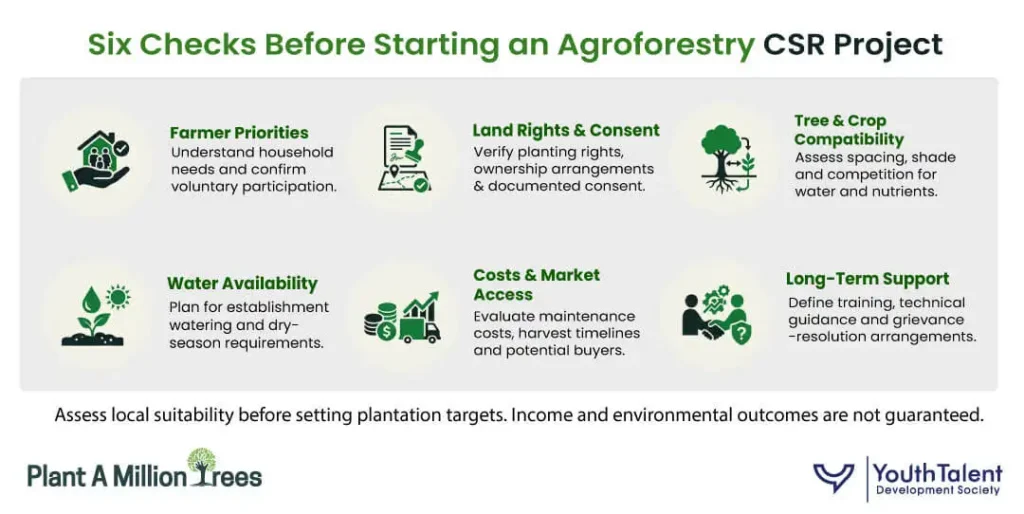
Species selection should begin with the farming system and local environment, rather than nursery availability or a national list of recommended trees.
Assess rainfall, temperature, soil, drainage, water access and the crops already cultivated. Consider how the proposed trees will behave as they mature, including their shade, root spread and management requirements.
Native and productive trees are not mutually exclusive categories. A locally native species may also provide useful products. Selection should balance ecological suitability, farmer preferences and practical management needs.
Important considerations include:
The economic assessment should include establishment costs, recurring inputs, labour, harvesting and marketing expenses. It should also consider possible changes in existing crop income.
For example, a household may eventually receive revenue from tree products while facing additional watering costs and reduced crop area during establishment. Sales revenue alone would not show whether the household is financially better off.
Use locally informed scenarios to test assumptions about prices, yields and costs. Explain who pays each cost and who receives each benefit. Qualified agricultural or agroforestry experts should validate the design, without promising fixed income increases or carbon revenue.
A responsible CSR agroforestry project extends beyond distributing saplings. It requires a phased plan that supports farmers through preparation, establishment and continued management.
Record participating households, land characteristics, current crops, water sources, livestock activities and farmer priorities.
Identify risks such as water scarcity, grazing pressure, insecure access, limited labour and weak market connectivity. Where tree products are intended for sale, investigate buyer requirements and likely marketing costs before committing to planting.
The assessment should establish whether agroforestry is appropriate and which households or plots require a different approach.
Develop the model with farmers and qualified technical specialists. Confirm species, spacing, cultivation arrangements, maintenance duties and benefit-sharing.
Document voluntary consent and land-related rights. Explain grievance and withdrawal procedures, and provide participants with an accessible record of the agreement.
Use reliable nurseries and check species identity, plant health, root development and suitability for the intended site and season.
Procurement quantities should follow the approved design and actual farmer participation. Include transport, handling and temporary storage arrangements so planting material arrives in suitable condition.
Plan pits, spacing, drainage, soil management and water arrangements around the selected agroforestry model.
PAMT’s guide to plantation site preparation before monsoon covers useful preparation principles. Farm-specific layouts should also protect existing cultivation and access.
Training should address planting, watering, mulching, pruning, protection and early recognition of pests or disease.
Choose a locally appropriate planting window. Arrange establishment watering and protection against grazing, physical damage and other identified risks.
Keep records of the planting date, species, quantities, locations and responsible household. Verify what was planted against the agreed design.
Schedule follow-up visits and practical guidance on tree–crop management. Agree how problems will be reported and who will organise corrective action.
The maintenance plan should cover watering, protection, pruning and replacement where appropriate. Our guide to supporting sapling survival during monsoon plantation drives explains relevant establishment considerations.
Revisit the assumptions made during feasibility as the system develops. Where relevant, work with farmer groups, cooperatives, producer organisations or buyers on quality requirements and aggregation.
Do not describe an informal expression of buyer interest as a guaranteed purchase agreement.
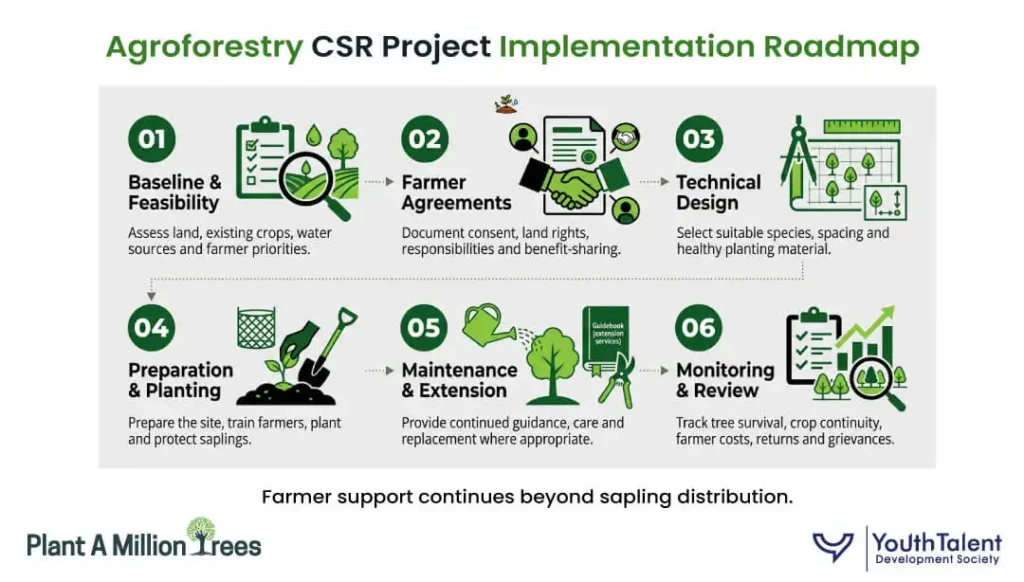
Monitoring should examine both environmental progress and farmer experience. Saplings distributed or planted are useful output measures, but they do not establish livelihood improvement.
Set a baseline, define indicators and agree how information will be collected before implementation.
| Monitoring Area | What to Track | Reporting Consideration |
|---|---|---|
| Participation and Inclusion | Households enrolled and retained; participation of women and tenant cultivators. | Record who participates, who withdraws and barriers to inclusion. |
| Area and Land Use | Area under the agreed system and changes in cultivation. | Distinguish planted area from the wider project boundary. |
| Tree Establishment | Original saplings surviving, replacements and growth. | Report inspection dates and track replacements separately. |
| Crop Continuity | Crops retained, cultivated area and relevant yield observations. | Check whether tree establishment disrupts existing production. |
| Household Economics | Product sales, household use, input costs and labour. | Distinguish gross revenue, net returns and projected benefits. |
| Soil and Water | Selected soil indicators, ground cover and water use or availability. | Use suitable methods and comparable seasonal observations. |
| Support and Grievances | Training, extension visits, complaints and resolution. | Report unresolved issues and corrective action. |
Income comparisons need particular care. Weather, prices, other support programmes and changes in cultivated area may influence results. A before-and-after increase should not automatically be attributed entirely to the CSR project.
Disclose the survey period, sample size, data sources and limitations. Identify farmer-reported information and distinguish measured results from estimates.
PAMT’s guide to CSR tree plantation impact measurement provides further context on monitoring plantation outcomes. Agroforestry programmes should add agricultural and livelihood indicators suited to their design.
Review water demand, crop competition, unsuitable species, market uncertainty, long harvest periods and unequal participation throughout implementation.
Corrective action may involve additional technical support, revised management practices or reconsidering a planting arrangement with the farmer. Where the system is causing difficulties, reporting should explain the problem and response rather than presenting only positive photographs.
Routine project monitoring should also be distinguished from any independent impact assessment required under applicable CSR provisions. Our guide to CSR impact assessment for tree plantation projects explains that separate consideration.
Corporate agroforestry programmes in India need clear responsibilities across the sponsor, farmers, technical specialists and implementation partners.
Before selecting a partner, companies should assess experience in the proposed geography, farmer-engagement capacity, agroforestry expertise, maintenance arrangements and monitoring processes. A general plantation track record should not be treated as proof of specialist agricultural capability.
The proposal should define the participating communities, land arrangements, chosen model, species rationale, budget, timeline and support period. It should explain how consent, benefits, grievances and changes in participation will be managed.
Start with a feasibility discussion rather than a predetermined number of trees. This creates space to assess whether the intervention fits local farming practices and what technical partnerships are required.
To begin a conversation, contact Plant A Million Trees about your community plantation objectives. Share the proposed location, community context, land arrangements, intended outcomes and timeframe. If agroforestry is being considered, use the initial discussion to establish the technical expertise, local partnerships and delivery scope required before developing a proposal.
Agroforestry is listed in Schedule VII under environmental sustainability. A project may also relate to livelihood enhancement or rural development, depending on its design. Companies should validate the specific activities, implementation arrangements and expenditure against applicable CSR requirements before approval. The project label alone does not establish eligibility.
Participation depends on lawful rights to use the land and authority to establish and manage trees. Tenant cultivators may require landowner consent or other agreements. Joint and customary rights also need consideration. Participation should be voluntary, with clear arrangements for tree ownership, benefits, maintenance and withdrawal.
There is no universal species list or income timeline. Selection depends on climate, soil, water, existing crops, farmer needs and market access. Different products have different harvest cycles. Assess potential returns alongside labour, input costs and possible changes in crop income, without guaranteeing a financial outcome.
Responsibilities should be agreed before planting. Farmers may manage routine care while technical partners provide training, extension and corrective support. Monitoring should cover survival, growth, crop continuity, household costs and returns, inclusion and grievances. Record baseline conditions and disclose the methods and limitations used in reporting.
Why Tree Plantation Needs a Place in the CSR Annual Action Plan Tree plantation is a common choice for...

Companies in India are increasingly looking beyond conventional environmental activities to understand how their operations depend on nature, affect...

“How much land do we need for 1,000 trees?” is one of the first practical questions CSR teams ask...