
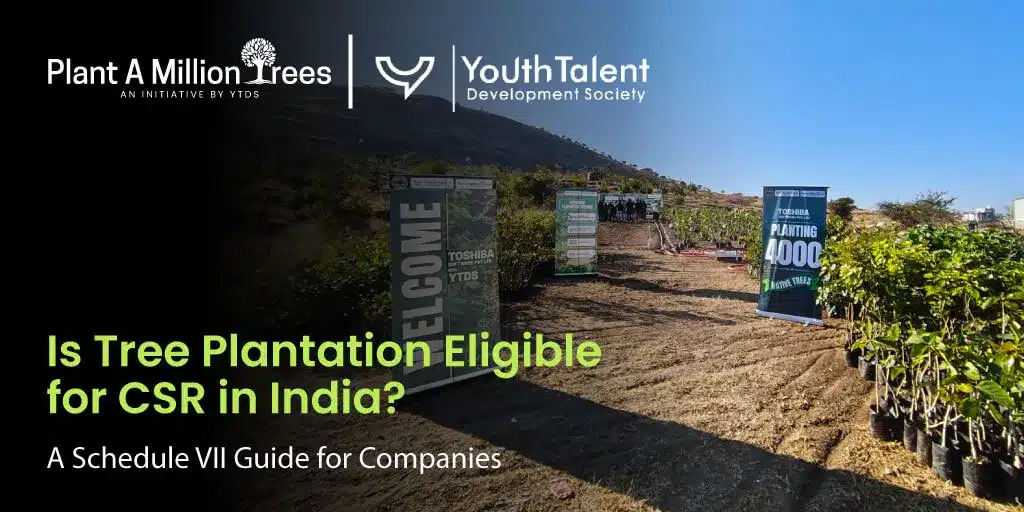
Tree plantation has become an important part of corporate environmental sustainability initiatives in India. Companies are funding plantation drives,...

“How much land do we need for 1,000 trees?” is one of the first practical questions CSR teams ask when planning a plantation project.
The answer depends on tree spacing, species selection, plantation model, site conditions, and how much of the total land is actually usable for planting. A theoretical calculation can estimate how many trees per acre may fit at a particular spacing, but it cannot replace a site assessment.
For companies planning CSR plantation projects in India, an early land estimate helps with budgeting, permissions, site feasibility, species selection, irrigation planning, maintenance, and realistic planting commitments.
A restoration project, industrial green belt, avenue plantation, corporate campus, and Miyawaki-style dense plantation should not all be planned using the same density.
This guide explains how to calculate plantation density, estimate the land required for 1,000 trees, understand the effect of common spacing options, and turn a theoretical tree count into a practical plantation layout.
Land estimation is more than a mathematical exercise. It affects almost every part of plantation planning.
For example, 1,000 saplings planted at 2 m × 2 m spacing need much less theoretical land than 1,000 trees planted at 4 m × 4 m spacing.
That does not mean closer spacing is automatically better. Mature tree size, ecological objectives, water availability, and long-term management should determine the final layout.
One acre contains approximately 4,046.86 square metres. One hectare contains 10,000 square metres.
For a regular rectangular planting grid, gross theoretical density can be estimated using this formula:
Trees per acre ≈ 4,046.86 ÷ (row spacing in metres × tree spacing in metres)
For example, consider a 3 m × 3 m layout.
The same calculation can be used for non-square layouts. If row spacing and tree spacing are different, multiply the two actual dimensions rather than assuming equal spacing.
Most importantly, this calculation represents gross theoretical capacity.
It assumes every square metre can be planted. Real sites usually include access paths, existing vegetation, utilities, buildings, drainage areas, boundaries, safety setbacks, rocky patches, or other exclusions.
The number that matters during project approval is therefore the usable plantation capacity after site assessment, not simply the mathematical maximum.
The following table compares common square-spacing examples. These figures are mathematical estimates, not universal planting recommendations.
Important: These figures show theoretical planting-grid capacity. They do not account for access lanes, boundaries, utilities, setbacks, existing trees, unsuitable ground, operational buffers, or site-specific ecological requirements.
For the common spacing examples above, the theoretical land requirement ranges from about 0.99 acre to 3.95 acres for 1,000 trees.
These should not be treated as final land-acquisition or site-approval figures.
For example, one acre appears mathematically capable of accommodating roughly 1,000 trees at 2 m × 2 m spacing. However, that calculation leaves almost no room for movement, irrigation infrastructure, setbacks, utilities, existing vegetation, or areas that cannot be planted.
Once these exclusions are mapped, the actual site may accommodate fewer trees.
Companies should therefore distinguish between gross site area and net plantable area.
There is also no reliable universal rule such as “add 10%” or “add 20%” for buffers.
A compact open plot and an industrial site containing roads, utilities, buildings, drainage, and safety zones can have very different usable-area ratios. The allowance should come from the actual site survey.

Maximising saplings per acre should not be the objective of a CSR plantation.
The better objective is to establish a plantation that suits the site, can be maintained, and has space to develop over time.
A sapling may occupy little space on planting day, but its canopy and root system can become much larger over time.
Spacing should reflect expected mature growth rather than the current size of the sapling.
Species selection should also reflect local ecology, rainfall, soil, water availability, and the purpose of the plantation.
Companies can refer to PAMT’s guide to native tree plantation for CSR projects when developing a site-specific species plan.
Soil depth, drainage, fertility, seasonal water availability, and irrigation access can change both species choice and planting density.
Before plantation begins, companies should assess the actual ground conditions rather than assume every part of the site can support the same layout.
PAMT’s plantation site preparation guide covers soil preparation, pit planning, water arrangements, and other pre-plantation considerations.
Rocky areas, steep slopes, waterlogged patches, drainage channels, and existing trees can reduce the available planting area.
Existing vegetation should not be cleared simply to achieve a higher sapling count.
Established trees may already provide shade, habitat, soil protection, and ecological value that should be incorporated into the site plan.
Teams may need regular access for watering, inspection, protection, replacement planting, and monitoring.
Industrial or corporate sites may also contain underground utilities, overhead lines, roads, buildings, fire access, security areas, or planned expansion zones.
A layout that maximises trees but makes long-term maintenance difficult is rarely a good plantation plan.
A biodiversity restoration site, green belt, corporate campus, agroforestry project, and dense native plantation may all require different species mixes and spacing strategies.
The plantation objective should therefore be defined before the target density is finalised.
Comparing plantation models only by the number of trees per acre can be misleading.
Each model is designed around a different objective and physical layout.
Companies developing long-term green assets can also review PAMT’s guide to corporate forests in India.
For dense planting, the Miyawaki method in India should be evaluated on its own design requirements rather than compared with conventional plantation only through trees-per-acre figures.
The correct question is not “Which model fits the most trees?”
It is “Which model best fits this site and its intended environmental outcome?”

Once the initial density calculation is complete, CSR and procurement teams can use the following seven-step workflow before approving the final tree count.
Confirm site boundaries, dimensions, terrain, access points, existing vegetation, current land use, and other physical constraints.
GPS-based mapping can help establish the gross site area.
Identify buildings, roads, utilities, emergency routes, drainage areas, safety setbacks, rocky patches, waterlogged sections, existing trees, and other areas that should be excluded from the planting grid.
Verify who owns or controls the land and whether the project requires internal approval, landowner consent, or coordination with a public authority.
PAMT’s guide to tree plantation permission in India explains the site-approval questions companies should resolve before implementation.
Assess soil suitability, drainage, seasonal water availability, irrigation access, and any site-preparation requirements that may affect species choice or density.
Select locally suitable species and determine spacing based on mature size, ecological objective, maintenance capacity, and the physical constraints mapped during the survey.
Prepare a bill of quantities covering:
Replacement requirements should be based on the project’s monitoring and maintenance plan rather than applying the same assumption to every plantation site.
Only after the usable planting area is known should the company confirm whether the original target of 1,000 trees, 5,000 trees, or another number is realistic for the site.
The final bill of quantities should reflect the approved layout, not a tree count selected before the land was assessed.
Land capacity affects much more than the number of saplings purchased.
It can influence pit preparation, labour, tree guards, fencing, irrigation infrastructure, water movement, maintenance routes, replacement planting, monitoring, and reporting.
A dense layout may place more saplings into a smaller area, but that does not automatically make it cheaper or more effective.
A wider layout may require more land and longer maintenance routes.
Difficult terrain, poor soil, limited water, or extensive protection requirements can also change the project budget significantly.
Companies estimating budgets can review PAMT’s CSR tree plantation cost breakdown to understand how saplings, site preparation, execution, protection, maintenance, and monitoring contribute to total project cost.
It is also useful to look beyond the initial cost per sapling.
PAMT’s guide to cost per surviving tree explains why plantation expenditure should be considered alongside survival and long-term project performance.
Before approving a large plantation target, the stronger approach is to request a site-feasibility assessment and costed plantation plan showing:
Plant A Million Trees (PAMT) can support companies in translating a CSR plantation target into a site-specific implementation plan.
Depending on the agreed project scope, support may include:
The objective is not simply to fit the maximum possible number of saplings into the available land.
It is to develop a practical plantation layout that reflects the site, selected species, access requirements, maintenance capacity, and long-term environmental objectives.
Request a site-feasibility and costed plantation plan based on your available land, proposed tree count, site conditions, species requirements, maintenance needs, and reporting expectations.
There is no single number for every plantation.
On a theoretical square grid, one acre accommodates approximately:
Actual capacity is normally lower when site exclusions and access requirements are considered.
Using the spacing examples in this guide, the gross theoretical requirement ranges from approximately 0.99 acre at 2 m × 2 m spacing to about 3.95 acres at 4 m × 4 m spacing.
The actual land requirement can be higher depending on the usable planting area, species, access paths, setbacks, utilities, and plantation model.
There is no universal buffer percentage that applies to every site.
A site survey should identify roads, utilities, boundaries, buildings, safety areas, existing vegetation, drainage, unsuitable ground, and maintenance access.
The remaining net plantable area should then be used to calculate the realistic tree count.
Miyawaki-style planting uses a dense plantation approach and may accommodate many saplings within a compact area.
However, it has different soil-preparation, species-mix, irrigation, density, and maintenance requirements.
It should not be compared with conventional plantation purely by the number of trees per acre.
Not automatically.
Trees planted too closely may face greater competition for light, water, nutrients, and canopy space as they grow.
Appropriate spacing should reflect species characteristics, soil and water conditions, plantation objectives, and long-term maintenance requirements.
Calculating how many trees per acre a site can accommodate is a useful starting point for CSR plantation planning, but it should never be treated as the final project design.
For 1,000 trees, theoretical land requirements can range from roughly one acre to nearly four acres across the common spacing examples discussed in this guide.
The actual requirement may be higher once access, utilities, boundaries, existing vegetation, operational buffers, unsuitable ground, and other site conditions are considered.
The strongest plantation plans combine a realistic tree count with appropriate species, a practical layout, sufficient access, maintenance planning, monitoring, and long-term survival considerations.
Before committing to a CSR plantation target, determine the site’s net plantable area first.
The final tree count should come from the site plan, not the other way around.
Discuss a site-feasibility and costed plantation plan with PAMT before finalising the plantation quantity.
Tree plantation has become an important part of corporate environmental sustainability initiatives in India. Companies are funding plantation drives,...
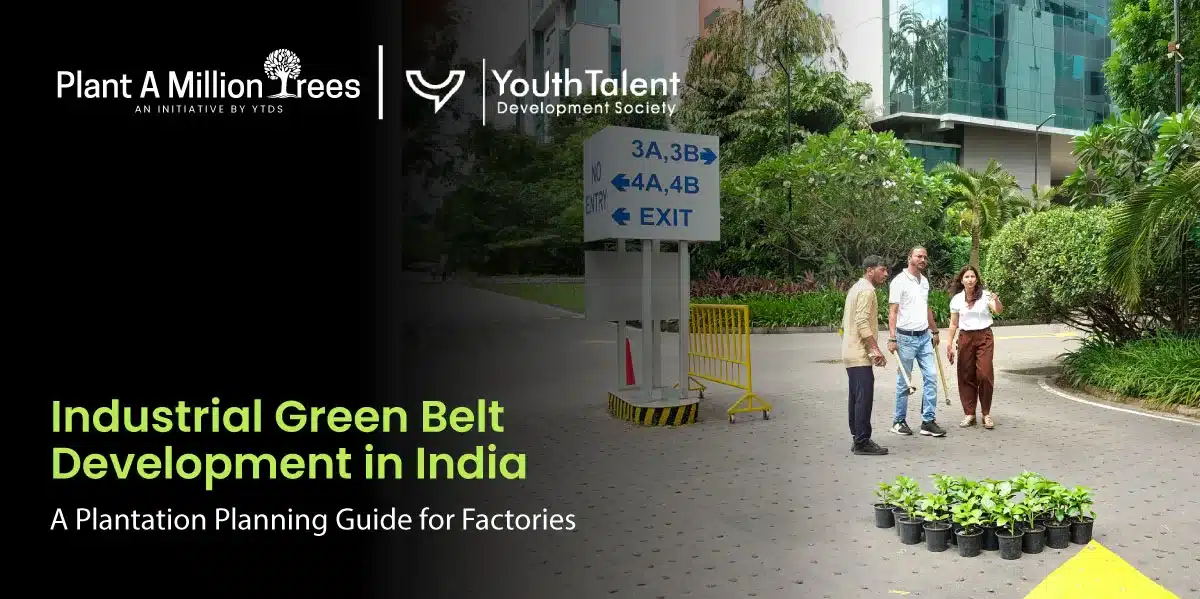
Industrial green spaces are often treated as rows of trees added around a factory boundary. In practice, effective green...
Planting trees is a visible CSR activity, but the number of saplings planted or photographs from a plantation event...