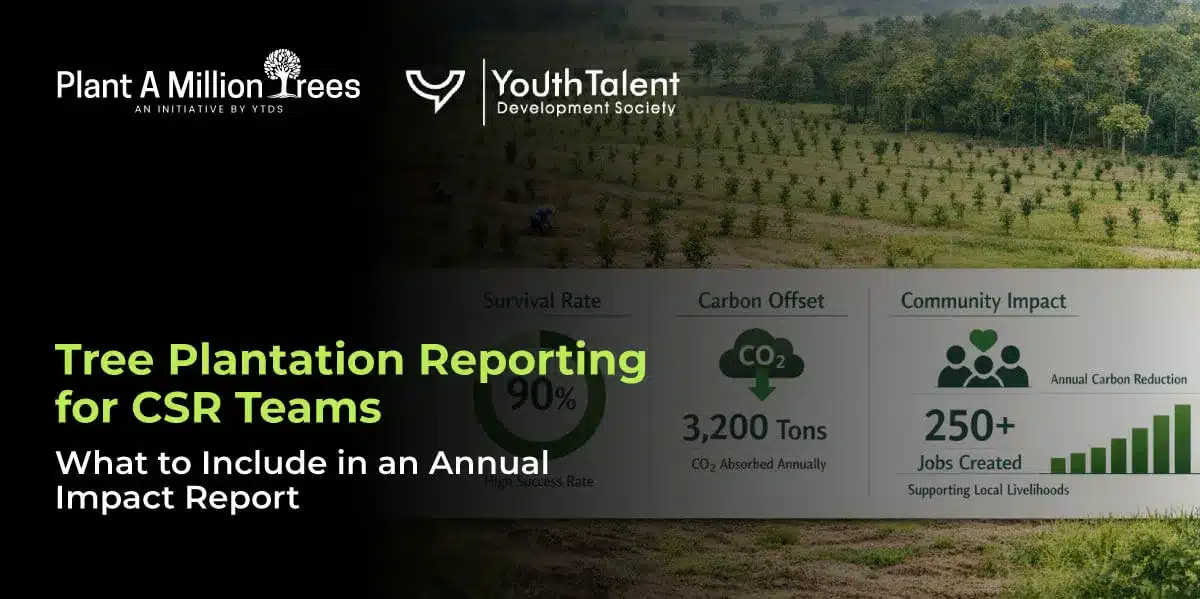

“How much land do we need for 1,000 trees?” is one of the first practical questions CSR teams ask...


Planting trees is visible. Reporting impact builds credibility.
Across India, CSR teams are investing heavily in plantation initiatives, urban greening, rural afforestation, biodiversity restoration, and climate action programs. These efforts often generate impressive numbers: thousands of saplings planted, hectares covered, communities engaged.
But stakeholders today are asking deeper questions.
How many trees actually survived?
What environmental impact did they create?
How does the project contribute to ESG goals?
This shift has made CSR plantation reporting India more important than ever. Annual impact reports are no longer just documentation,they are tools for transparency, accountability, and strategic decision-making.
If you’re wondering what to include in CSR tree plantation impact report India, it’s equally important to understand how structured CSR tree plantation services for companies are planned and executed. This guide breaks down the essential metrics, reporting structure, and best practices to help CSR teams create credible, data-driven reports.
Tree plantation projects are long-term investments. Their benefits, carbon absorption, biodiversity restoration, soil improvement, unfold over years, not weeks. Without structured reporting, it becomes difficult to track whether these benefits are actually being realized.
From an ESG reporting plantation perspective, companies must demonstrate measurable environmental impact. Investors, regulators, and stakeholders increasingly rely on data-backed disclosures rather than narrative claims.
Transparent reporting also builds trust. When organizations clearly present both successes and challenges, they establish credibility with stakeholders.
Another critical aspect is internal learning. Reporting helps CSR teams identify what works, whether it is species selection, site preparation, or maintenance practices, and refine future projects.
In the broader context of sustainability reporting India, plantation reporting connects environmental action with measurable outcomes.
A strong CSR impact report trees should be clear, transparent, and consistent. It should go beyond listing activities and focus on outcomes.
Clarity ensures that readers understand what was done, where it was done, and why it matters. Avoid overly technical language while maintaining accuracy.
Transparency requires presenting both achievements and limitations. Reporting only positive outcomes without acknowledging challenges can reduce credibility.
Consistency ensures that metrics are tracked and reported in the same way each year, allowing meaningful comparison over time.
A well-structured report typically includes project objectives, methodology, key metrics, monitoring approach, and outcomes. It should also clearly define assumptions used in calculations, especially for carbon and biodiversity estimates.
Before diving into metrics, CSR teams must establish a strong reporting foundation that aligns with ESG frameworks and real-world CSR plantation programs for companies.
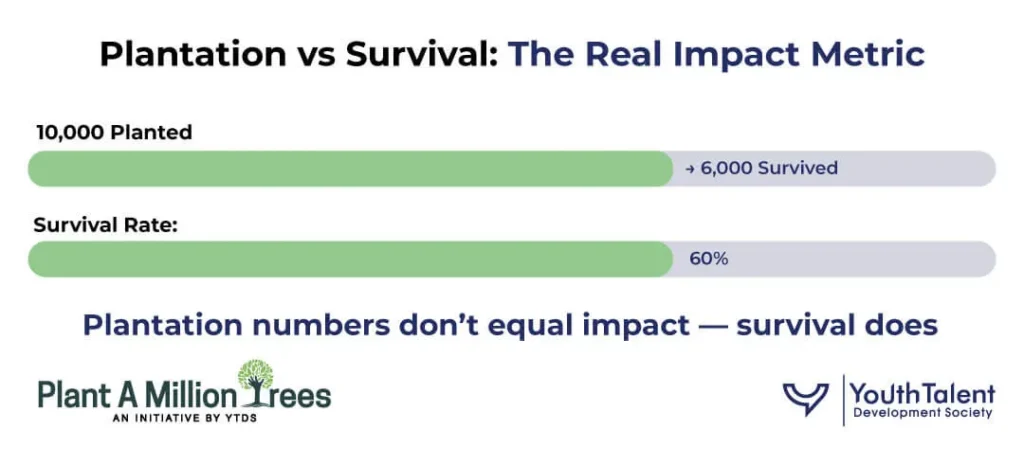
The most fundamental metric in any plantation report is the comparison between trees planted and trees survived.
Reporting only planting numbers provides an incomplete picture. Survival data reflects actual impact.
For example, if a project planted 10,000 saplings but only 6,000 survived after one year, the survival rate is 60%. This metric immediately highlights the effectiveness of planning, species selection, and maintenance.
Tracking tree survival rate India over multiple timeframes, such as one year, three years, and five years, provides deeper insights into long-term success.
CSR teams should clearly present survival data in their reports, along with explanations for variations. Factors such as drought, soil conditions, or grazing pressure may influence survival outcomes.
Including survival data strengthens plantation KPIs and shifts reporting from activity-based to outcome-based evaluation.
One of the key environmental benefits of tree plantation is carbon sequestration. Reporting this impact helps organizations connect plantation initiatives with climate action goals.
Carbon impact is typically estimated based on the number of surviving trees and their average CO₂ absorption rates. For example, a mature tree may absorb around 10–25 kilograms of CO₂ annually, depending on species and conditions.
CSR teams can estimate total carbon absorption by multiplying the number of surviving trees by average absorption rates. For instance, 5,000 surviving trees absorbing 20 kilograms each would remove approximately 100 tonnes of CO₂ annually.
This forms the basis of carbon reporting trees in CSR disclosures.
However, it is important to clearly state assumptions and ranges. Carbon absorption varies based on tree age, growth conditions, and species. Avoid presenting overly precise numbers without context.
Transparent carbon reporting aligns plantation initiatives with climate goals while maintaining credibility.
Tree plantations contribute to ecosystem restoration, but measuring biodiversity impact requires thoughtful indicators.
CSR teams can track simple, observable indicators such as the return of bird species, increased insect activity, and natural vegetation growth around plantation areas.
For example, an increase in pollinators like butterflies and bees indicates improving ecological health. Similarly, the presence of birds suggests habitat restoration.
These indicators form the basis of biodiversity reporting and help demonstrate ecological benefits beyond carbon absorption.
Some organizations also conduct periodic ecological surveys to assess species diversity and habitat conditions.
While biodiversity metrics may not always be precise, even basic indicators provide valuable insights into ecosystem recovery.
Tree plantations influence soil health and water systems in multiple ways.
Roots improve soil structure, allowing better water infiltration. Leaf litter adds organic matter, enhancing soil fertility and moisture retention.
CSR teams can report indicators such as reduced soil erosion, improved soil quality, and signs of groundwater recharge.
For example, plantations near water bodies may contribute to improved water retention, while degraded land restoration projects may show reduced runoff during rains.
These indicators support groundwater impact plantation reporting and connect plantation efforts with broader environmental benefits.
Linking plantation outcomes to soil and water improvements strengthens the overall sustainability narrative.
Environmental impact must be supported by financial transparency.
CSR teams should report total project budgets, cost per tree planted, and ideally, cost per surviving tree. This helps stakeholders understand resource allocation and efficiency.
Operational details such as plantation methods, maintenance activities, and timelines should also be included.
Transparent financial reporting enables better decision-making and strengthens accountability.
In the context of sustainability reporting India, financial clarity is as important as environmental outcomes.
Reliable reporting depends on robust monitoring systems.
Monitoring involves collecting data on tree survival, growth, and environmental indicators. Field teams may conduct regular site visits, record observations, and use digital tools for data collection.
Technology plays an important role in plantation monitoring India. GPS tagging helps track tree locations, while satellite imagery can assess vegetation growth over large areas.
Verification adds another layer of credibility. Third-party audits or independent assessments can validate reported data.
MRV frameworks, Monitoring, Reporting, and Verification, ensure that plantation data is accurate, consistent, and trustworthy.
Despite increasing awareness, many CSR plantation reports still face common issues.
One major mistake is reporting only planting numbers without survival data. This creates an incomplete picture of impact.
Another issue is inflated estimates, especially in carbon reporting. Overstating impact without supporting data can damage credibility.
Lack of transparency is also a concern. Ignoring challenges or failures reduces trust in reporting.
Inconsistent metrics across years make it difficult to track progress.
Avoiding these mistakes is essential for creating credible CSR plantation reporting India.
A well-structured plantation report typically includes several key sections.
It begins with project overview, objectives, locations, and scale. This is followed by methodology, explaining how plantation was carried out.
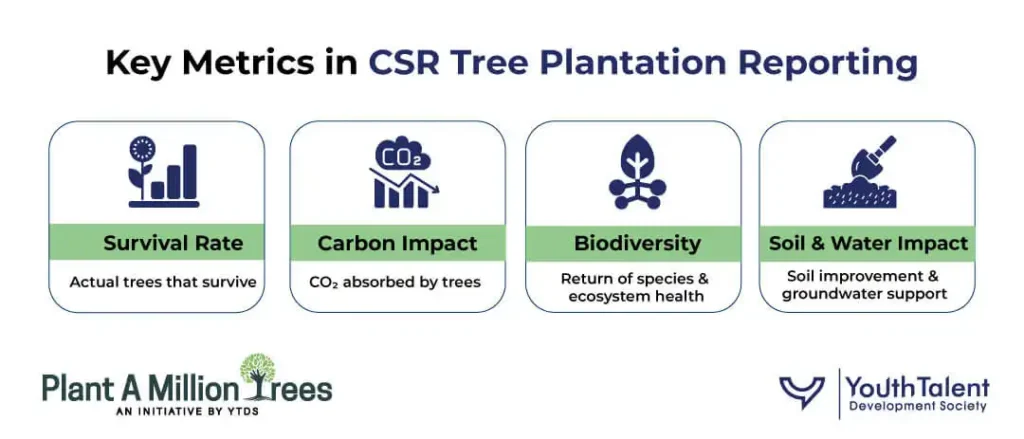
The report then presents key metrics such as survival rate, carbon impact, biodiversity indicators, and soil or water benefits.
Financial details provide insight into resource allocation, while monitoring and verification sections explain how data was collected and validated.
Finally, the report includes learnings, challenges, and future plans.
Organizations such as the Youth Talent Development Society (YTDS) often emphasize structured reporting to ensure plantation programs deliver measurable and transparent outcomes.
Discuss a plantation project that brings execution, survival monitoring, geo-tagged documentation and reporting requirements into one structured CSR programme.
Share your company’s location, plantation scale and reporting expectations with our team.
Request a CSR ProposalKey elements include survival rate, carbon impact, biodiversity indicators, water and soil impact, and financial transparency.
Because it reflects actual impact rather than just planting activity.
By estimating CO₂ absorption based on the number of surviving trees and average absorption rates.
Yes, using simple indicators like bird and insect presence.
Monitoring ensures data accuracy and supports credible reporting.
Tree plantation is one of the most visible CSR activities, but visibility alone is not enough.
Credibility comes from data.
Effective CSR plantation reporting India requires moving beyond planting numbers to measuring real outcomes, survival, carbon absorption, biodiversity, and environmental improvement.
As expectations around ESG reporting plantation and sustainability reporting India continue to rise, companies must adopt structured, transparent reporting practices.
The takeaway is simple: Impact is proven through data, not claims.
“How much land do we need for 1,000 trees?” is one of the first practical questions CSR teams ask...
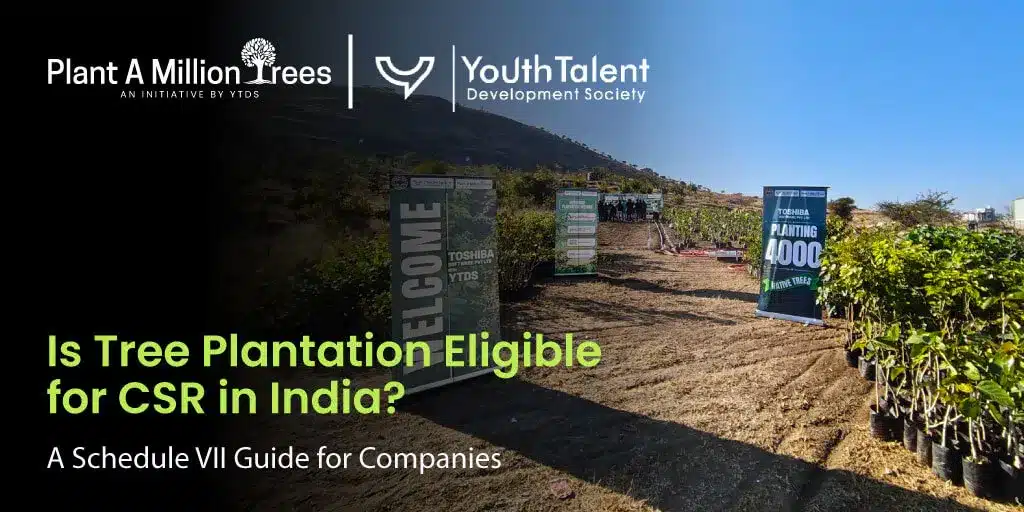
Tree plantation has become an important part of corporate environmental sustainability initiatives in India. Companies are funding plantation drives,...

Industrial green spaces are often treated as rows of trees added around a factory boundary. In practice, effective green...