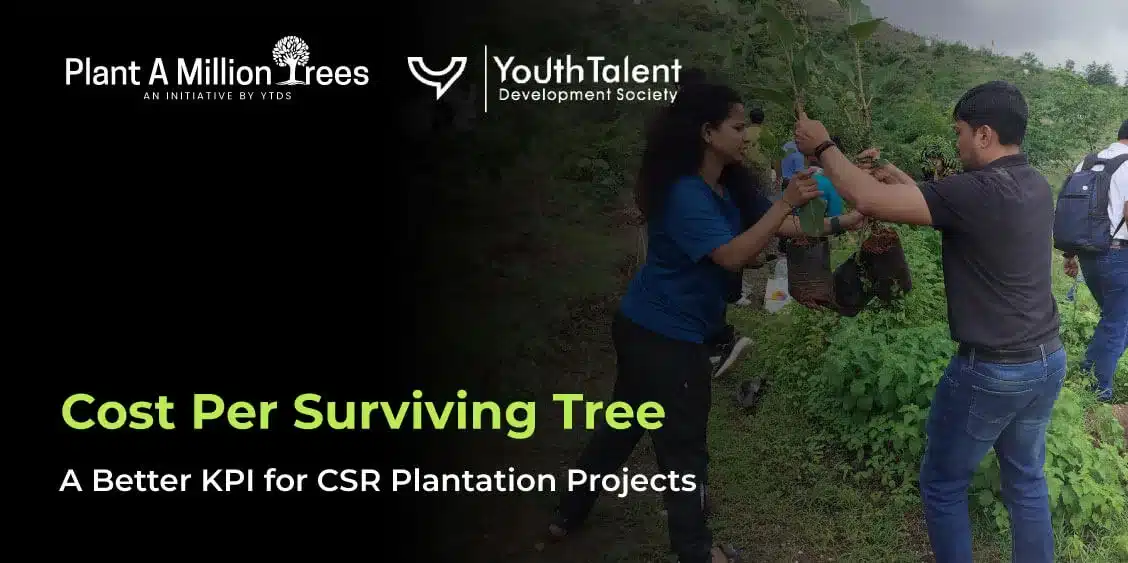

“How much land do we need for 1,000 trees?” is one of the first practical questions CSR teams ask...

“Planting 10,000 trees means nothing if only 3,000 survive.”
This single insight captures one of the biggest problems in CSR plantation projects across India. Companies proudly report the number of saplings planted, often highlighting cost efficiency in terms of “cost per tree planted.” But what happens after planting rarely gets equal attention.
Many plantations fail silently. Saplings die due to poor planning, lack of maintenance, or unsuitable conditions. Yet, reports continue to showcase large numbers, creating a disconnect between investment and real impact.
This is why a shift in thinking is needed. Instead of focusing on how many trees were planted, companies must focus on how many trees actually survive.
The metric that captures this shift is cost per surviving tree India. It moves CSR plantation programs from a quantity-driven approach to an outcome-driven one.
In this blog, we’ll break down why traditional metrics fall short, how structured CSR tree plantation services for companies focus on long-term survival and measurable impact, how to calculate this KPI, and why it is essential for effective plantation budgeting and long-term impact.
For years, CSR plantation programs have relied on a simple metric: cost per tree planted. On paper, it seems logical. If a company plants more trees at a lower cost, the program appears efficient.
But this metric hides a critical flaw.
It assumes that every planted sapling will grow into a tree. In reality, survival rates can vary significantly, sometimes as low as 30–50% in poorly planned projects.
When survival is low, the actual cost of each surviving tree increases dramatically. A project that looks cost-efficient initially may turn out to be ineffective in the long run.
For example, a plantation that costs ₹100 per sapling may seem affordable. But if only half the saplings survive, the real cost per surviving tree becomes ₹200.
This gap between reported cost and actual impact is why CSR plantation cost needs to be evaluated differently.
Cheap plantation is not efficient for plantation.
Cost per surviving tree India is a more meaningful KPI because it measures real outcomes rather than inputs.
It answers a simple but powerful question: how much did it actually cost to grow one living, surviving tree?
Unlike traditional metrics, these KPI factors in survival rates, maintenance efforts, and long-term care. It reflects the true effectiveness of a plantation project.
This makes it a strong tree survival rate KPI, aligning plantation efforts with measurable environmental impact.
When organizations adopt this metric, they begin to focus on planning, species selection, and aftercare, because these factors directly influence survival and, therefore, cost efficiency.
In essence, this KPI transforms plantation from an activity into a performance-driven initiative.
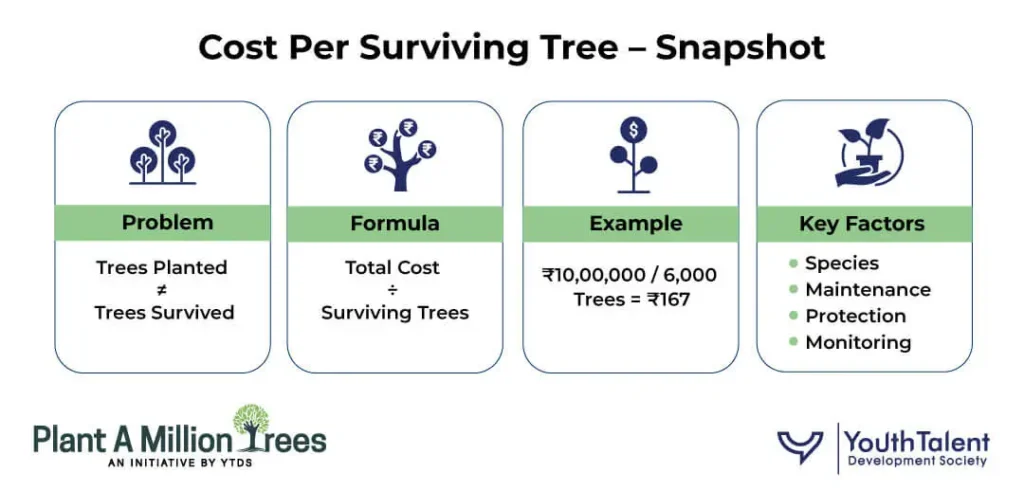
The calculation is straightforward but powerful.
Take the total cost of the plantation project and divide it by the number of trees that survive after a defined period, typically one year or three years.
For example, imagine a CSR project with the following details:
A company spends ₹10,00,000 on a plantation drive.
10,000 saplings are planted.
After one year, 6,000 trees survived.
The calculation would be:
₹10,00,000 divided by 6,000 surviving trees equals approximately ₹167 per surviving tree.
This number gives a far more accurate picture of project efficiency than simply reporting ₹100 per tree planted.
Understanding how to calculate cost per surviving tree in CSR plantation helps organizations evaluate performance realistically and make better decisions in future projects.
Several factors influence the final cost per surviving tree.
Species selection is one of the most important. Native species adapted to local conditions generally have higher survival rates, reducing long-term costs.
Site conditions also play a major role. Poor soil quality, lack of water access, and unsuitable terrain can increase mortality rates and drive-up costs.
Maintenance is another critical factor. Watering, mulching, pruning, and protection during early growth stages significantly improve survival.
Protection measures such as tree guards or fencing add to initial costs but reduce losses caused by animals or human interference.
Monitoring and tracking also influence outcomes. Regular inspections help identify issues early, improving survival rates, and overall efficiency.
In practical terms, plantation budgeting should account not just for planting but for long-term care.
Ignoring these factors often leads to higher actual costs despite lower initial spending.
The difference between cost per tree planted and cost per surviving tree is not just mathematical; it is strategic.
Cost per tree planted measures activity.
Cost per surviving tree measures impact.
The former rewards volume, while the latter rewards effectiveness.
A project that plants more trees at a low cost but has poor survival may appear successful on paper but fails in reality. On the other hand, a project with higher initial costs but better survival may deliver stronger environmental outcomes and better long-term value.
This distinction is crucial for understanding cost per tree vs survival cost.
Organizations that adopt survival-based metrics shift their focus from short-term outputs to long-term results.
This is where true plantation ROI India is realized.
Adopting cost per surviving tree as a KPI brings several benefits.
First, it improves decision-making. CSR teams can compare projects based on real outcomes rather than reported numbers.
Second, it enhances transparency. Stakeholders can clearly see how funds are being used and what impact is being created.
Third, it supports long-term sustainability. Projects designed with survival in mind are more likely to deliver ecological benefits.
Fourth, it aligns with broader CSR impact metrics and ESG reporting requirements. Outcome-based reporting is increasingly expected in sustainability frameworks.
From a boardroom perspective, this KPI transforms plantation projects into measurable investments rather than symbolic activities.
Many CSR plantation programs unintentionally increase costs due to avoidable mistakes.
These mistakes create a cycle where initial savings lead to higher long-term costs.
Avoiding them is essential for improving both survival rates and cost efficiency.
Improving cost per surviving tree India requires a shift in approach.
These steps not only improve survival rates but also optimize costs over time.
Plan a CSR plantation project around long-term survival, maintenance and measurable outcomes — not just the number of saplings planted.
Share your project location, expected plantation scale and company requirements with our team.
Request a CSR ProposalIt is the total project cost divided by the number of trees that survive after a defined period.
Because it measures actual impact rather than just planting activity.
Typically, above 70%, with well-managed projects reaching 80%.
By improving planning, choosing native species, and ensuring proper maintenance.
Not necessarily, but strategic investment in survival often leads to better long-term results.
CSR plantation projects are evolving. The focus is shifting from how many trees are planted to how many trees actually survive.
This shift is captured in a simple but powerful metric: cost per surviving tree India.
By adopting this KPI, companies can align their plantation efforts with real environmental impact, improve transparency, and make better use of resources.
The message is clear:
Measure what survives, not just what is planted.
“How much land do we need for 1,000 trees?” is one of the first practical questions CSR teams ask...
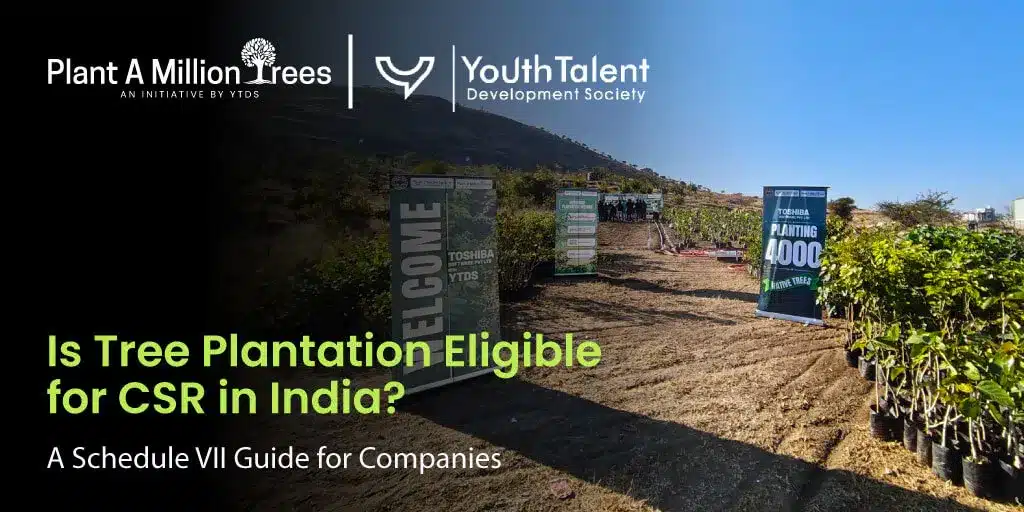
Tree plantation has become an important part of corporate environmental sustainability initiatives in India. Companies are funding plantation drives,...
Industrial green spaces are often treated as rows of trees added around a factory boundary. In practice, effective green...