Every year, thousands of CSR reports proudly highlight the number of trees planted. Companies often announce impressive figures, “10,000...

Plantations run by government are quite different to those of the private or community plantations. The trees used on the road, in the parks, schools, and the public campuses should be able to survive decades with little or no care.
High mortality, pruning, broken pavements, falling branches, and costly escalating maintenance are some of the effects caused by poor species selection.
In terms of governance, the life of trees has a direct influence on the efficiency of the budget. A tree that is 30-50 years old is much more valuable than one that has to be replaced every now and then.
Another significant issue is the public safety. Weak-wood trees or species which have brittle branching are dangerous during a storm or high winds, particularly in areas of high footfall.
Government plantations impact the whole city ecosystem ecologically. Instead, the misplaced trees may decrease the biodiversity, exert more water stress, or not support the fauna locally.
Urban planning trees are selected well to improve shade and the quality of air, microclimate, and the well-being of citizens.
When it comes to the development of the infrastructure landscape in a project that is publicly funded, species selection is not a landscaping choice-it is an infrastructure choice.
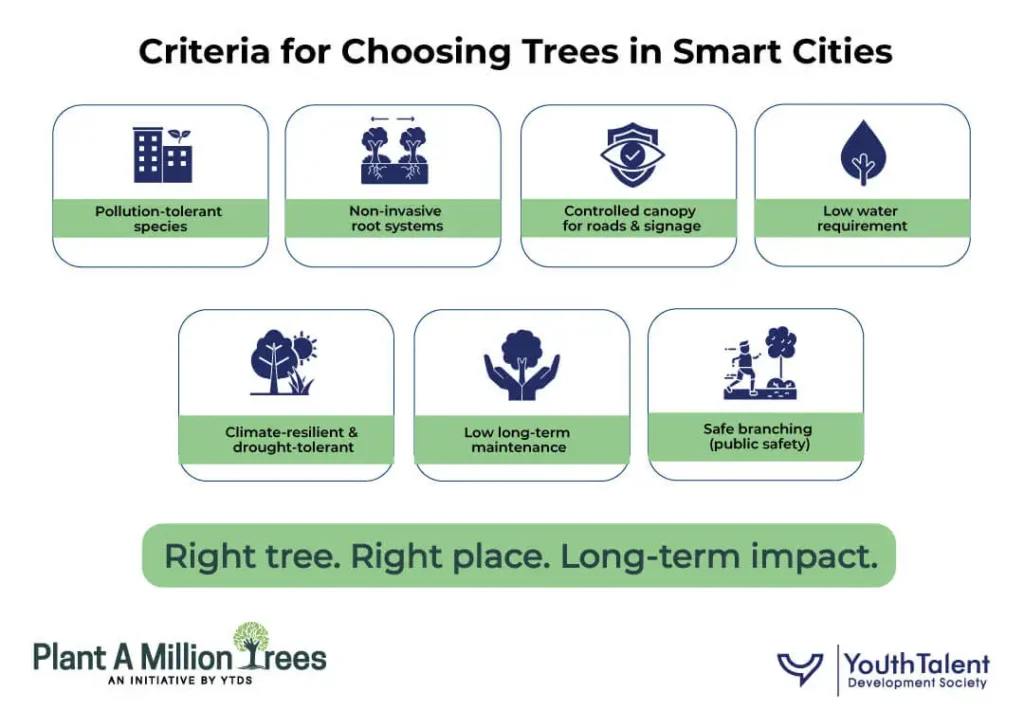
Plantation in smart city must have trees that bear well in the urban environment. The issue of pollution tolerance is severe, with the fact that the public areas are subjected to automobile exhausts, dusts, and heat.
The trees have to endure the tight soils, the lack of space to grow roots and the variation in water supply.
One of the most crucial requirements is root behaviour. The non-invasive roots do not damage footpath, drains, underground utilities and the roads. The structure of the canopy is important also.
Trees must be shaded, but not conceal signage, streetlights and CCTV.
Another important factor is water requirement. The high-maintenance species are expensive and cannot be afforded in cities that require a lot of irrigation. Climate resistant and drought resistant trees save on long term expenses and survival rate.
Lastly, it has to be resilient. Trees used in government projects as plants should be able to withstand pruning, endure extreme weather and be able to recover fast after they undergo stress.
These criteria guarantee that the investments in the plantations will be converted to the long-term green infrastructure.
Some tree species always work in Indian landscapes of the populace because of their adaptability, toughness, and minimal maintenance.
One of the surest options that the government plantations can have is neem. It is resistant to pollution, enhances air quality, and it does not need much attention after it is established.
Pongamia can thrive in a drought environment and with its ability to stabilise the soil, it can be grown wherever there exists a road and a place where people walk.
Planted in suitable free lands, Peepal and Banyan are beneficial to the biodiversity and to the shade in the long term.
Jamun is a dense canopy cover, which thrives well in the urban setting.
The soil binding characteristics of Arjun make it highly appropriate in river banks and water front territories in the general public.
As a form of growth, Ashoka trees are commonly planted in narrow aisles and medians due to their erect growth. When planted wisely, bamboo also serves as a buffer zone species in institutional campuses and buffer zones.
Various places of publicity require varied tree properties. In order to ensure visibility, trees with deep roots, non-spreading roots, and clear canopies are needed along the roads and medians. Open spaces and parks support open canopies and other species with biodiversity.
Schools and government campuses have trees that provide shade which not only enhance thermal comfort, but also do not present any safety hazards. The river and lake banks need animals that can withstand changes in moisture and eliminate soil erosion.
The institutional and transport corridors require trees that are pollution resistant, capable of pruning and still achieve aesthetic uniformity. Considerate greening of public spaces has ensured that trees do not contradict infrastructure by being functional.
Before the long-term success of municipal plantations, it is necessary to match the species with the type of space.
There are trees that cannot be used in government and smart city projects even though they grow fast or have beautiful appearances. Weak-wood species will tend to fail branches and are unsafe in case of storm.
The trees that have aggressive root systems destroy the pavements and underground services.
There are exotic species that grow very fast and consume more ground water and have been known to have little ecological values. The trees are prone to pruning and this makes them more expensive to maintain and concerns of safety recur.
Eschewing these species is an important element in the programs of plantation trees by municipalities. Stability, predictability and safety of the public projects should come first as compared to the short-term greenery.
These species form the backbone of best trees for smart city plantation projects in India because they align with public safety, ecological value, and maintenance feasibility.
A few Indian cities have shown the effects of informed choice of trees. The long-term urban forestry practice in Chandigarh demonstrates the stability of choice of species through which street canopies are formed. The emphasis on resilient native species has helped Indore in promoting its extended sustainability efforts.
The public landscaping activities in Surat remind the significance of the coordination of plantation with the drainage, road design, and general movement amongst people. These illustrations indicate that smart plantation is more about planning than about planting.
These success stories support the notion that trees used in city landscaping need to be selected as a component of an urban system.
Maintenance is more important than the numbers of planting that lead to plantation success. The government projects need to have proper aftercare arrangements, defined roles of the contractors and periodic monitoring.
This should be the norm of survival audits, replacement protocols and pruning schedules. The involvement of the community improves accountability and limit vandalism. The involvement of citizens also fosters the sense of ownership by people on green spaces.
The Youth Talent Development Society (YTDS) and other organisations have also focused on awareness and stewardship in plantation projects, noting that it is imperative to ensure a sustainable result on the initiatives of plantations because it entails institutional planning and the presence of the people.
Plantations which are given priority in maintenance grow up to be terrestrialized green infrastructure instead of a decadent show.
They are tree species selected specifically for public infrastructure projects, balancing resilience, safety, low maintenance, and ecological value.
Failures often stem from wrong species selection, poor maintenance planning, and lack of long-term monitoring.
Native species generally perform better, but suitability should be assessed based on space, function, and infrastructure constraints.
By integrating tree planning into urban design, enforcing maintenance accountability, and selecting climate-resilient species.
It is impossible to construct smart cities based on short-term plantation goals. Public space trees should be long-term assets, that is, cooling the city, purifying the air, improving security, and biodiversity.
The most important decision in any smart city plantation trees India project would be the selection of the appropriate species. Plantation projects can be transformed into sustainable green infrastructure when the governments are concerned with ecological appropriateness, upkeep planning, and community protection.
Finally, smart cities are designed not only with intelligent technology embedded in them, but also with intelligent trees: carefully chosen, planted properly and maintained in good condition.
Every year, thousands of CSR reports proudly highlight the number of trees planted. Companies often announce impressive figures, “10,000...

Imagine a company in India that wants to reduce its climate impact. It has improved energy efficiency and installed...
The Miyawaki method has quickly emerged as one of the best-discussed methods of afforestation in India. Corporate CSR forces...