
Imagine a company in India that wants to reduce its climate impact. It has improved energy efficiency and installed...

India has always realised the potential of trees not only as green cover, but also as living infrastructure that is necessary to ensure stability of climates, water, biodiversity and the community.
The country is planting millions of saplings annually, however, through national afforestation campaigns, local plantation campaigns by NGOs, schools and civil society.
And nevertheless, most of these attempts are not enough. Every year millions of saplings are planted but only a huge percentage of them do not live to the first several years.
This disconnect between ambitious plantation goals and real results on the ground bring out an important bottleneck; tree plantation dilemmas that India still experiences; at ecological, administrative and social levels.
This blog explores the reasons why the process of planting trees in India is often filled with disadvantages, why the mortality rates are not higher, and, last but not the least, how the governmental institutions, non-governmental organizations, communities, and companies can join their efforts to maximize the effectiveness of the influence.
With the insights on the national programmes, expert recommendations and findings of other organizations such as the Youth Talent Development Society (YTDS), this article presents practical solutions towards plantation success.
During the past ten years, India has initiated a number of massive projects to increase its forest area. Since the Green India Mission and state CAMPA-financed projects and city-level urban forestry programmes, there has been a steady and ambitious campaign on reforestation.
In the annual reports issued by governments, millions of saplings have been planted in the states like Maharashtra, Uttar Pradesh, Telangana, or Odisha.
Planting lots is however not the final thing. The more significant problem is to make sure that the saplings grow into full-fledged trees.
Even with these impressive plantation statistics, the survival rates usually fluctuate at a high and low with environmental stress, inappropriate species of plants, gaps in monitoring as well as absence of community attendance. These problems are important in transforming plantation activities into ecological resources.
In India, tree plantation has never been an activity but a process that comes with scientific planning, environmental knowledge and sustainability. The key areas of concern, which are recurrent, are presented below.
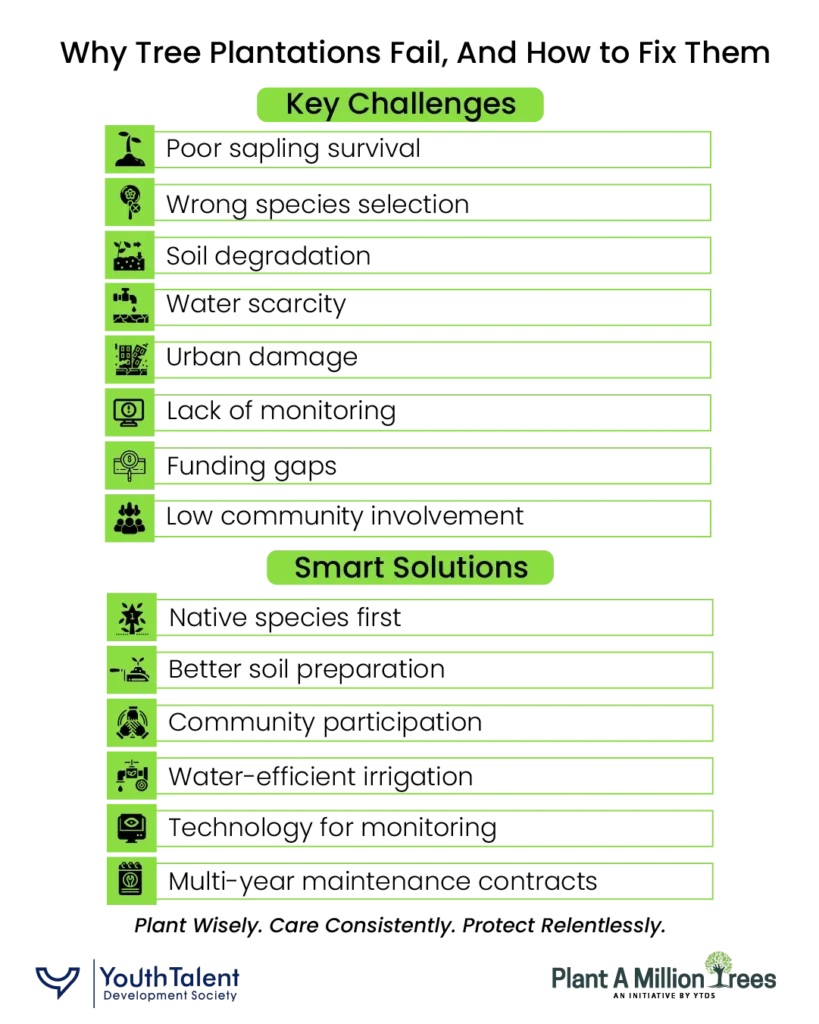
The low existence of trees in many regions in India is one of the greatest deforestation problems and plantations setback. Although the plantations look successful on Day 1, a lot of saplings cannot endure their initial years. Key reasons include:
The fact is that, success is measured by the fact that the plantations stay inside–not the number of plantations. The difference between the number of plantation and number of trees grown will be growing wider without touching on the factors that increase their survival.
Exotic species or fast-growing species are used in most government plantation programs or CSR initiatives to have immediate visual outcomes. However, poorly-adapted species tend to die on or destabilize local ecology. Examples include:
Native and climate resistant species are vital in creating biodiversity and long-term sustainability.
The degraded soil conditions are particularly found at many plantation locations particularly in mining zones, arid commend, and industrial belts, which are mainly urban. Common issues include:
Saplings become incapable of rooting and growing in unhealthy soil. The revival of soil is a topic that is disregarded frequently with the plantation programmes.
One of the largest impediments is water; this is caused by seasonal rainfall, inconsistent monsoons, and drought prone landscapes. Lack of water to saplings within the first two years of growth lowers survival to less than half.
Plantation drives often assume that the rain will sustain the process, and due to the variations in rain fall, irrigation planning is therefore very important.
Planted saplings in cities have to withstand the challenge of:
In urban settings, the plantations need more defensive and maintenance-sensitive structural designs.
Plantation drives are considered an issue of one-day events hence, one of the central plantation project management issues. When the ceremonial planting is carried out, documentation is terminated, and monitoring is hardly carried out in an appropriate way. Problems include:
Real success is determined by monitoring, but it is never uniform across the states.
The budgets of the plantation tend to concentrate on sapling and labour expenses without much additional funds on:
The saplings require a minimum of three years of care; hence, a lack of funding will have a dire influence on survival.
The local ownership is vital to plantation sustainability. Plantations do not serve as the core of community, school, panchayat, and youth activities when they are not based on the community and schools. NGOs, particularly YTDS, have pointed on many occasions that community looking after saplings can enhance survival by more than 40 percent.
One of the foundations of the plantation results is ecology. These are some subtle obstacles that are not always taken into account by content writers:
On a lot of plantation drives, the rains are solely relied on as monsoon. This can be risky because:
During the regions around river banks, broken forest or around a city boundary, exotic species such as Prosopis juliflora and Lantana camara multiply rapidly and crowd the plots out of the native trees planted there.
Examples include:
The ecological realities of the regions have to be taken into account in the formulation of plantation plans.
Despite strong national missions, on-ground policy gaps continue to weaken outcomes.
There are various challenges of coordination between agencies.
Forestry departments, municipalities, panchayats, CSR teams, and even the owners of the private land tend to operate in isolation. This results in duplication of duties, poor decision making and poor implementation.
Not everything is updated or accessible to public, such as survival audits, geotagging records and progress reports. This influences the policy assessment and results in exaggerated successes of plantations.
As much as the CAMPA funds are used to compensatory afforestation projects, some states have been experiencing a few difficulties like:
There is the need of improved financial tracking.
Plantations often lack:
Without the systematic management of the plantation projects, long-term outcomes cannot be drawn.
India may considerably step up performance by emphasizing on measures to enhance survival and long term expansion. The following are viable scalable solutions.
It has naturally native trees that are adapted to local soils, pests, and climate. They do less maintenance and are pro-biodiverse. Examples:
This lowers the survival difficulties and increases the ecological hardiness.
Before planting begins:
During good preparation, survival heightens.
Solutions include:
The communities share the duty of survival when they own saplings.
Options include:
These attempts make the dependence on rainfall lessened.
Some of the modern monitoring tools are:
This enhances accountability and transparency among all the parties involved.
Plantation agencies are not only supposed to be contracted to plant, but should be contracted to maintain over 3-5 years. Payments can be tied to:
This is to align incentives with long term results.
The NGOs such as YTDS, other youth organizations, and movement led by citizens demonstrated that people can survive better, when there are participatory methods seed-ball drive, nursery development at the local level and community managed forests.
The CSR programs may collaborate with these platforms in the community to increase influence.
The collective action is needed in order to have a sustainable plantation ecosystem.
The organizations like YTDS make a huge contribution through:
Schools are significant in inculcating environmental responsibility. Activities include:
CSR programmes aid in offering:
There are a number of plantation projects across India that are proven, what works. These are some of the examples emphasizing the robust strategy and local involvement:
The community involvement in plantation projects by the lakhs of volunteers registered in the large-scale plantation initiative in Maharashtra proved that community involvement is the key to improving the results dramatically. The survival was enhanced in places where schools and youth groups assisted in monitoring trees in the area.
Kerala had a panchayat-based model that engaged households, schools, and local clubs in the planting of native species along the community routes, waterways and degraded through patches. A local monitoring guaranteed the long term safety.
Community forests have been rejuvenated in Odisha, Jharkhand and Gujarat using strict monitoring, choice of species and controlled grazing by committees. The above illustrations confirm that when there is ownership, real success starts to be witnessed in reforestation.
Planting a sapling is easy. The actual challenge is the growth of a tree.
The success rates of India in addressing climate change, deforestation problems, and city environment would not be determined by the number of saplings we plant, but by the number of saplings that remain alive.
Greens victimized by policy loopholes, dwindling population, and on the brink of extinction can be saved by solving the tree plantation dilemmas India is grappling with, such as species incompatibility, limited water availability, and disinvolvement of the communities.
Through enhanced management of the plantation projects, enhanced community ownership and ongoing monitoring, every sapling will grow to become a successful part of the Indian environmental history.
It has a direction which is easy but robust:
Plant wisely. Care consistently. Protect relentlessly. Continue till a sapling makes a forest.
Imagine a company in India that wants to reduce its climate impact. It has improved energy efficiency and installed...
Plantations run by government are quite different to those of the private or community plantations. The trees used on...
The Miyawaki method has quickly emerged as one of the best-discussed methods of afforestation in India. Corporate CSR forces...