
You planted a tree with care. You water it regularly. However, within several weeks, you see that there are...


Every monsoon, thousands of tree plantation drives take place across India. Saplings are planted enthusiastically; photos are taken, and reports proudly mention the number of trees planted. Yet, a few months later, many of those saplings fail to survive.
The reason is rarely raining. It is preparation.
Most plantation failures happen not because of poor planting, but because of poor groundwork. Soil is not ready, pits are not prepared correctly, species are chosen at the last minute, and water planning is ignored. By the time the rain arrives, it is already too late to fix these gaps.
This is why plantation site preparation India must begin well before the monsoon. Successful plantation is not a one-day activity,it is a process that starts weeks, sometimes months, in advance.
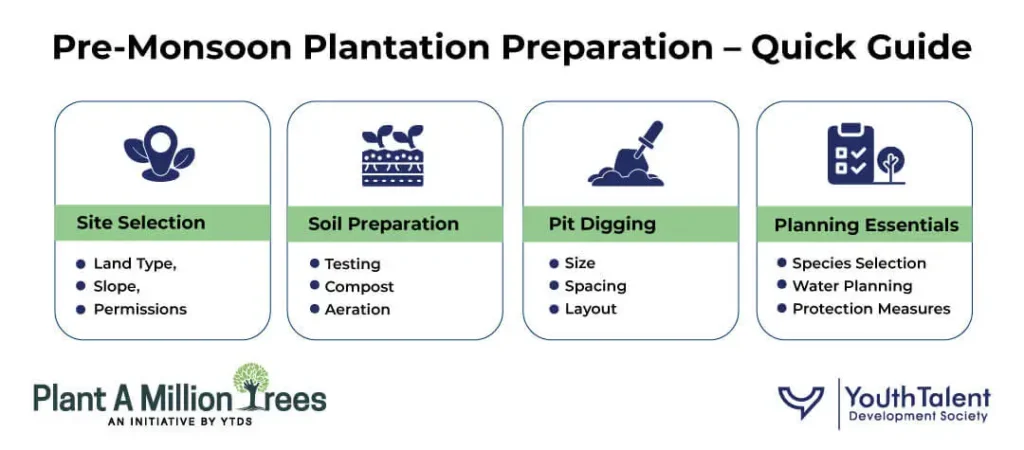
If you’re wondering how to prepare land for tree plantation before monsoon in India, this guide breaks it down step by step, from site selection and soil preparation to pit digging, species planning, and protection measures.
Monsoon is often seen as the planting season, but in reality, it is only the planting window, not the preparation phase.
Rainfall helps saplings establish roots, but only if the soil is ready to absorb water and support growth. If the land is compacted, nutrient-poor, or poorly planned, heavy rains can actually harm plantations by causing waterlogging or soil erosion.
Timing is crucial. Once the monsoon begins, it becomes difficult to dig pits, transport materials, or prepare the site properly. Rushed plantation during rains often leads to uneven spacing, shallow pits, and weak root development.
Effective pre-monsoon plantation planning ensures that everything is ready before the first rainfall. When pits are prepared, soil is enriched, and species are selected in advance, saplings can immediately benefit from rainwater and establish strong roots.
In simple terms, monsoon supports growth,but preparation determines survival.
The first and most important step in site selection plantation India is understanding the land itself.
Not all land is suitable for plantation. Before planting, assess the site carefully.
Start with land type. Is it barren land, farmland, roadside, or community space? Each type requires a different approach. Check the slope of the land, steep slopes may need erosion control measures, while flat areas may face waterlogging.
Soil type is equally important. Sandy soils drain quickly, while clay soils retain water but may become compacted. Understanding soil characteristics helps in planning amendments later.
Water availability must also be assessed. Even though monsoon provides initial water, saplings will need support after the rains. Identify nearby water sources or plan for storage.
Land ownership and permissions should be clarified early. Whether it is government land, community land, or private property, approvals must be secured before starting work.
A well-assessed site ensures that plantation efforts are practical, sustainable, and legally compliant.
Healthy soil is the foundation of successful plantation. Without proper soil preparation trees, even the best saplings may fail.
Start by testing soil quality. Basic parameters such as pH, texture, and organic matter content provide valuable insights. Extremely acidic or alkaline soils may require treatment.
In many Indian conditions, soil lacks organic matter due to erosion, overuse, or degradation. Adding compost, farmyard manure, or organic material improves soil fertility and structure.
Loosening compacted soil is another critical step. Hard soil restricts root growth and reduces water infiltration. Digging and aerating the soil allows roots to penetrate deeper and access nutrients.
If soil drainage is poor, create channels or raised beds to prevent waterlogging during heavy rains.
These improvements ensure that the soil can support sapling growth, retain moisture, and provide essential nutrients during the early stages.
Proper pit digging plantation is one of the most overlooked aspects of plantation preparation.
Pits should be dug before the monsoon, allowing soil to settle and aerate. The size of the pit depends on the species, but a common range is around 1 to 2 feet in depth and width for most plantation projects.
Spacing between pits must also be planned carefully. Overcrowding leads to competition for light, water, and nutrients, while excessive spacing reduces canopy cover.
Alignment is important for organized plantation. Mark rows or grids depending on the site layout. This helps with maintenance, watering, and monitoring later.
While digging pits, mix topsoil with compost or organic material. This enriched soil will support initial root growth when saplings are planted.
Preparing pits in advance ensures that plantation during monsoon is efficient and consistent.
Species selection should never be left for the last minute.
Choosing the right trees is central to tree planting preparation. Native species adapted to local climate conditions generally perform better than exotic varieties. They require less maintenance, support biodiversity, and have higher survival rates.
Consider the purpose of plantation. Are you planting for shade, soil conservation, groundwater recharge, or biodiversity? Different objectives require different species.
Region-specific selection is important. Trees suitable for arid regions may not perform well in high-rainfall areas. Similarly, roadside plantations require species with strong roots and minimal canopy obstruction.
The principle is simple: right tree, right place.
Planning species in advance allows time to source quality saplings and avoid last-minute compromises.
One of the most common reasons for plantation failure is lack of water planning.
While monsoon provides initial moisture, saplings require consistent watering after the rains. Delayed monsoons or dry spells can stress young plants.
Identify water sources near the plantation site. These could include borewells, ponds, tanks, or rainwater harvesting structures.
Plan for backup irrigation if rainfall is insufficient. Simple solutions like water storage drums or tanker arrangements can make a significant difference.
Mulching around saplings helps retain moisture and reduce evaporation. This is especially useful in regions with uneven rainfall.
Proper irrigation planning ensures that saplings survive beyond the monsoon season.
Protection is often ignored during land readiness planning, but it plays a crucial role in survival.
Young saplings are vulnerable to grazing animals, human interference, and environmental stress. Installing tree guards or fencing before planting reduces damage.
In rural areas, protection from cattle and goats is essential. In urban areas, safeguarding against vandalism or accidental damage is important.
Cost-effective solutions such as bamboo guards, recycled materials, or community monitoring can be used depending on the project scale.
Preparing protection measures in advance ensures that saplings are safe from day one.
Before starting plantation, ensure everything is ready.
This checklist ensures complete pre-monsoon plantation planning and reduces the risk of failure.
Community participation strengthens plantation success. Local involvement ensures regular care, monitoring, and protection.
Organizations such as the Youth Talent Development Society (YTDS) often emphasize preparation and aftercare in plantation initiatives, helping communities understand that long-term success depends on planning before planting.
When communities take ownership, plantations become sustainable ecosystems rather than one-time events.
Frequently Asked Questions
Ideally 1–2 months before the monsoon to allow proper soil and pit preparation.
It allows soil aeration and ensures readiness for planting during rains.
Our travel packages typically include accommodation, transportation, and some guided tours. Check the details to see what’s specifically covered for each package.
Yes, but survival rates are usually much lower.
Preparation and aftercare, not just planting.
Tree plantation success does not begin with planting, it begins with preparation.
From site selection and soil readiness to pit digging, species planning, and protection, every step before the monsoon determines whether saplings will survive and grow into trees.
In the context of plantation site preparation India, the message is clear: planning ahead creates lasting impact.
Planting starts before the rain arrives.
You planted a tree with care. You water it regularly. However, within several weeks, you see that there are...

Amidst the concrete jungles of modern India, with towers of glass and highways of veins, there also is something...

Consider a morning in India, in which students are not only withholding books, but also planting saplings in the...