Take a walk on any Indian city road in the rush hour and the problems can be seen within...

A company wants to take climate action, but the internal discussion quickly becomes confusing.
One team suggests organizing a CSR tree plantation drive near the company’s operating locations. Another team recommends buying carbon credits to offset emissions. Both ideas sound environmentally responsible. Both appear aligned with sustainability. But they are not the same thing.
This is a common point of confusion for companies in India. Should they invest in CSR tree plantation programs that create visible local impact, involve employees, and support communities? Or should they participate in carbon offset programs that help address their emissions footprint in a measurable way?
The answer depends on the company’s actual objective.
If the goal is community impact, ecological restoration, employee engagement, and CSR visibility, tree plantation often makes more sense. If the goal is carbon accounting, ESG disclosures, net-zero planning, or emissions compensation, carbon offsetting is usually the more suitable tool.
This distinction matters even more today. India has committed to create an additional carbon sink of 2.5 to 3 billion tonnes of CO2 equivalent through additional forest and tree cover by 2030, which makes tree-based climate action highly relevant for companies operating in India.
In this guide, we’ll break down the difference between CSR tree plantation and carbon offsetting, when each approach makes sense, the risks of confusing the two, and why a hybrid strategy is often the smartest long-term option.
CSR tree plantation refers to tree-planting and ecological restoration initiatives undertaken by companies as part of their Corporate Social Responsibility efforts.
In India, CSR is governed by the Companies Act, 2013, under which eligible companies must spend at least 2% of the average net profits of the previous three financial years on CSR activities. Environmental sustainability is included under Schedule VII, which is why tree plantation has become one of the most popular environmental CSR activities for Indian companies.
In practice, CSR plantation programs may include:
A strong CSR plantation project is not just about putting saplings in the ground. It is about survival rate, species selection, post-plantation care, community ownership, and long-term ecological value.
That is why CSR tree plantation is best understood as a community and ecosystem-focused initiative, not as an automatic carbon-offset mechanism.
For companies, the biggest advantages of CSR tree plantation are clear:
Carbon offsetting works in a different framework. It is primarily a tool for emissions accounting.
In simple terms, a company calculates its greenhouse gas emissions and then buys carbon credits from projects that reduce or remove an equivalent amount of carbon elsewhere. Each carbon credit typically represents one metric tonne of CO2 equivalent reduced or removed.
Carbon offset projects may include:
This is where companies often misunderstand the concept.
Carbon offsetting is not the same as directly reducing your own emissions. It is a way to compensate for emissions that still remain after reduction efforts. The IPCC has been clear that carbon dioxide removal should not be treated as a substitute for deep emissions reductions.
So if a company is buying offsets without first improving its operations, energy use, procurement, or other internal systems, the strategy is incomplete.
That is why carbon offsetting makes the most sense for companies that:
At a glance, both may look like environmental action. But strategically, they serve different purposes.
A practical comparison for CSR teams, sustainability leaders, and ESG decision-makers.
| Decision Factor | CSR Tree Plantation | Carbon Offsetting |
|---|---|---|
| Primary goal |
Community & Ecology Local environmental improvement, biodiversity support, and community engagement. |
Emissions Accounting Compensating for emissions through verified reductions or removals elsewhere. |
| Main reporting use | CSR disclosures, sustainability storytelling, brand visibility, and stakeholder engagement. | ESG reporting, carbon accounting, net-zero planning, and climate disclosures. |
| Measurement style | Tree survival, ecological restoration, community participation, and land improvement. | Verified carbon credits measured in tonnes of CO2e reduced or removed. |
| Visibility to employees and communities | Very high — people can see and participate in the project. | Usually lower — more visible in reports than on the ground. |
| Impact geography | Usually local or regional. | Can be domestic or global depending on the project. |
| Best for | Companies wanting local goodwill, biodiversity value, and visible CSR impact. | Companies with measured emissions, climate targets, or net-zero roadmaps. |
| Biggest mistake to avoid | Treating simple plantation drives as guaranteed carbon offsets without rigorous measurement. | Using offsets as a shortcut instead of reducing emissions internally first. |
In simple terms:
That difference changes how the initiative should be designed, measured, reported, and communicated.

CSR plantation makes more sense when a company wants to create visible, local, and participatory impact.
If your company operates in specific geographies and wants to build stronger relationships with nearby communities, tree plantation is a strong choice. It can support schools, villages, public spaces, and degraded landscapes in areas where your company already has a presence.
Not every environmental initiative needs to be framed around carbon accounting. Many companies simply want to increase green cover, support biodiversity, and restore ecological health. That is a valid and valuable objective on its own.
Plantation programs work well for internal culture. Employees can physically participate in something meaningful, visible, and emotionally rewarding. Compared with many sustainability activities, tree plantation is easier for teams to connect with.
Trees do much more than absorb carbon. In cities, they can help lower temperatures through shade and evapotranspiration, sometimes by as much as 10°F in localized settings. A mature tree can also absorb around 48 pounds of carbon dioxide per year, or roughly 21.8 kg annually, though this varies by species, climate, and age.
That does not mean every plantation drive should be marketed as a carbon offset. It does mean plantation has real environmental value beyond symbolism.
Plantation is highly visible. It can be documented, revisited, maintained, and included in annual reports, community communications, leadership presentations, and ESG narratives.
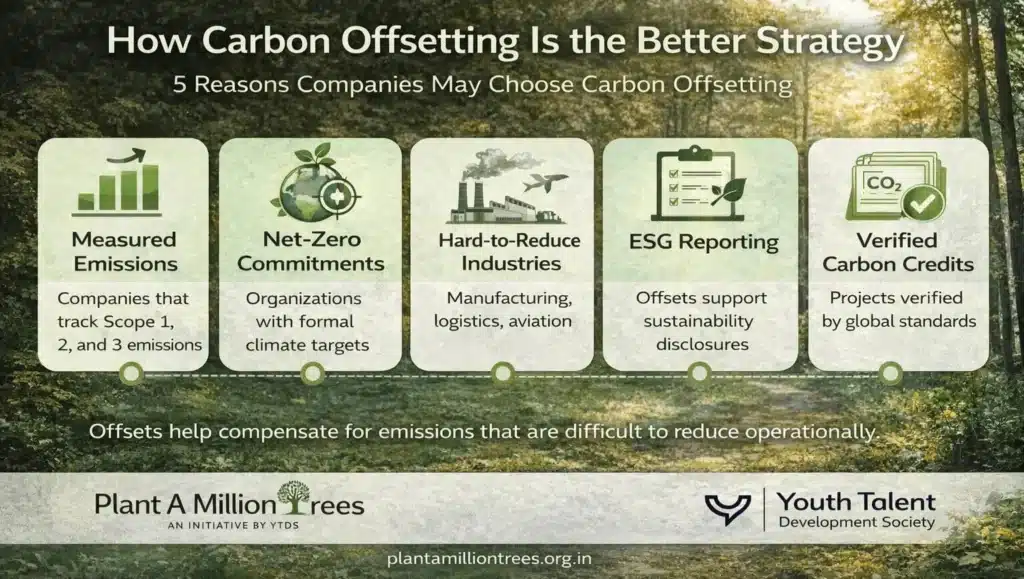
Carbon offsetting becomes more relevant when a company has a more formal climate-management need.
If your organization tracks Scope 1, Scope 2, and possibly Scope 3 emissions, offsetting can help address emissions that cannot yet be reduced operationally.
Companies making formal sustainability disclosures often need measurable carbon-accounting mechanisms. Verified carbon credits, when sourced responsibly, can support that requirement. Standards such as Verra and Gold Standard are designed around quantified greenhouse gas reductions or removals, third-party verification, issuance, and retirement of credits.
Industries such as aviation, manufacturing, logistics, and heavy operations may have emissions that cannot be quickly eliminated. Offsets may help bridge that gap while internal reductions continue.
A company cannot responsibly claim it has “offset” emissions simply because it funded a plantation drive. Offsetting requires methodology, traceability, verification, and safeguards against double counting. That makes it more suitable for climate reporting than general CSR storytelling.
For many companies, the best answer is not choosing one over the other. It is combining both in the right order.
A practical long-term strategy looks like this:
Improve energy efficiency, optimize processes, reduce waste, switch to cleaner energy sources, and strengthen procurement choices.
Run plantation projects that create visible local ecological and social value through proper implementation, survival planning, and community involvement.
Use verified carbon credits for emissions that still remain and cannot be easily reduced.
This is the most credible climate approach because it avoids two common mistakes:
A hybrid strategy allows a company to create:
Confusing CSR plantation and carbon offsetting creates real risk.
If a company plants saplings and then presents that activity as full carbon neutralization without proper accounting or verification, the claim can be misleading. Credible carbon programs require additionality, verification, traceability, and protection against double counting.
The second risk is simpler: companies treat tree plantation as a one-day event.
That usually means:
The result is poor impact and low credibility.
The solution is straightforward:
If your team is deciding between CSR tree plantation and carbon offsetting, use this 5-step framework.
Ask: are we trying to create community and ecological impact, or are we trying to address measured emissions?
Ask: is the initiative mainly for CSR reporting, stakeholder goodwill, and visible impact, or for carbon disclosures and net-zero planning?
Ask: do we want the impact to happen near our plant, office, employees, customers, or communities?
If yes, plantation usually has a strong advantage.
Ask: do we need survival rates, biodiversity improvement, and community outcomes — or verified tonnes of CO2e?
Those are different measurement systems.
Neither option should be treated as a shortcut. Plantation needs maintenance. Offsetting needs due diligence. Both need honesty and follow-through.
This is where many companies make bad decisions.
A plantation partner should not be selected only because they can execute a large event or offer a low price per sapling. That is the wrong buying criteria.
The right implementation partner should be able to support:
The real question is not:
How many saplings can we plant?
The real question is:
What ecological and social outcome will still be visible three years from now?
That is how serious CSR teams think.
If your organization is evaluating CSR tree plantation in India, choosing the right implementation model can make the difference between a symbolic activity and a meaningful sustainability asset.
No. CSR tree plantation is primarily a community and ecological initiative, while carbon offsetting is an emissions-accounting mechanism based on quantified and verified carbon outcomes.
Not automatically. A plantation project must follow formal carbon methodologies, monitoring, verification, and registry requirements before it can generate recognized carbon credits.
There is no single fixed answer. A mature tree may absorb roughly 21.8 kg of CO2 per year, but the number depends on species, age, growth conditions, and how long the trees survive.
Choose plantation when the goal is local ecological and community impact. Choose offsets when the goal is carbon accounting. Use both when the company wants a more complete climate strategy.
Usually this: reduce emissions first, plant for local ecological impact, and offset only the residual emissions that remain.
CSR tree plantation and carbon offsetting both have value. But they are not interchangeable.
Tree plantation is powerful when a company wants to restore landscapes, increase green cover, engage employees, support biodiversity, and create visible local impact. Carbon offsetting is useful when a company needs a measurable way to address residual emissions within a formal ESG or net-zero framework.
The real mistake is not choosing one over the other.
The real mistake is using the wrong tool for the wrong purpose.
The smartest companies are the ones that understand the distinction, reduce their emissions seriously, invest in meaningful on-ground environmental action, and make claims they can stand behind.
If your company is exploring CSR tree plantation in India, the right question is not just whether to plant trees or buy credits.
It is this:
What kind of impact do we want to create, and how honestly do we want to report it?
That is where responsible corporate climate action begins.
A strong CSR plantation initiative is not just about planting saplings. It is about selecting the right sites, choosing suitable species, ensuring survival, involving communities, and creating long-term ecological impact.
If your company is exploring CSR tree plantation in India, Plant A Million Trees can help you build a program focused on visibility, biodiversity, and meaningful long-term outcomes.
Take a walk on any Indian city road in the rush hour and the problems can be seen within...

With every year we start with hope. We are making a vow to ourselves to be better health wise,...

Indian winter does not necessarily have the same effect of Europe or North America where temperatures plunge to the...