
Imagine a company in India that wants to reduce its climate impact. It has improved energy efficiency and installed...

Every year, thousands of CSR reports proudly highlight the number of trees planted. Companies often announce impressive figures, “10,000 trees planted,” “50,000 saplings distributed,” or even “1 lakh tree planted in a year.”
While these numbers sound encouraging, they raise an important question: how many of those trees survived, and what environmental impact did they create?
Planting trees is only the beginning. True environmental value comes from long-term outcomes, healthy trees, restored ecosystems, improved soil and water conditions, and measurable carbon absorption.
Without monitoring and reporting these outcomes, plantation initiatives risk becoming symbolic activities rather than meaningful climate action.
This is why CSR impact measurement India is becoming increasingly important for corporate sustainability programs. Companies, investors, and regulators are asking not just how many trees were planted, but what measurable change those trees created.
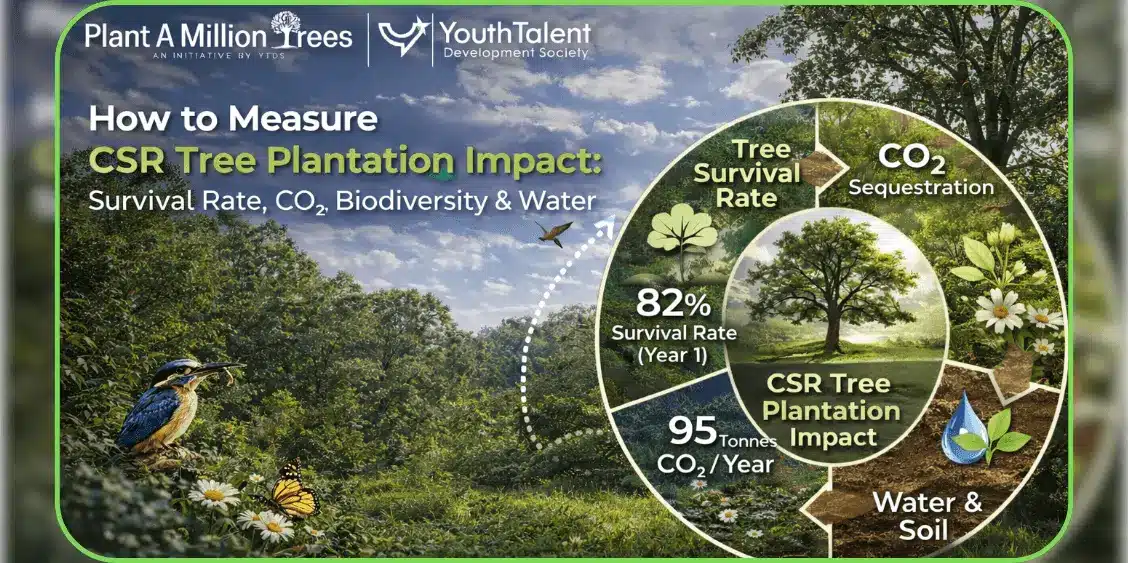
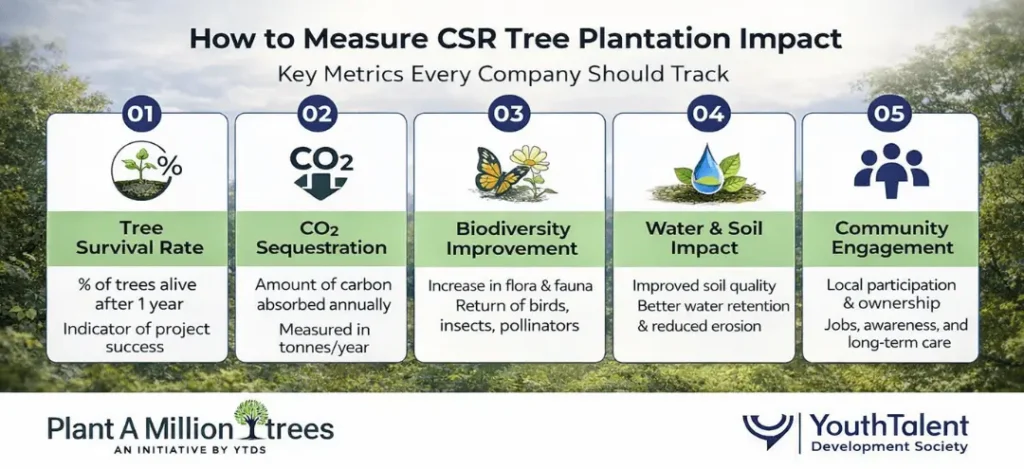
Understanding how to measure the impact of CSR tree plantation projects requires focusing on four key areas: tree survival, carbon sequestration, biodiversity improvement, and water and soil benefits. Together, these metrics provide a realistic picture of environmental outcomes.
For companies implementing environmental initiatives, impact measurement is no longer optional. Stakeholders today expect transparency, accountability, and data-driven results. Plantation programs that cannot demonstrate measurable outcomes may struggle to gain credibility.
From an ESG reporting perspective, companies must show how environmental investments contribute to sustainability goals. Investors and regulators increasingly evaluate environmental claims through structured metrics rather than promotional narratives.
Impact measurement also helps organizations improve their own programs. Monitoring survival rates, soil health improvements, and biodiversity trends provides feedback on what works and what needs adjustment. Without data, companies cannot refine plantation strategies or ensure long-term success.
Another key reason for measurement is long-term sustainability. Plantation projects that prioritize numbers over outcomes often fail because saplings die due to poor maintenance or unsuitable species selection. Measuring impact encourages organizations to focus on survival, growth, and ecological restoration rather than short-term publicity.
Ultimately, CSR reporting India is moving toward measurable environmental outcomes. Companies that track and report real impact build trust with stakeholders and strengthen their sustainability reputation.
The most fundamental indicator of plantation success is the tree survival rate. A sapling planted today does not automatically become a tree tomorrow.
Survival depends on proper planting techniques, suitable species selection, soil preparation, watering, and protection during early growth stages.
The survival rate measures the percentage of planted saplings that remain alive after a specific period of time. This metric is typically evaluated at one year, three years, and sometimes five years after plantation.
The basic formula is simple. Divide the number of surviving trees by the number originally planted, then multiply by one hundred.
For example, if a CSR project planted 10,000 saplings and 7,000 remain alive after one year, the survival rate would be 70% (seventy percent).
Experts generally consider survival rates above seventy percent as acceptable for large-scale plantations, while well-managed projects can reach eighty to ninety percent survival.
Measuring survival requires periodic field inspections. Teams may use GPS tagging, digital surveys, or manual counting to assess tree health. Indicators such as height growth, canopy development, and leaf health also provide insights into whether saplings are thriving.
Survival monitoring is essential because it highlights the importance of aftercare. Watering schedules, mulching, protection from grazing, and maintenance activities all influence survival outcomes.
In the context of plantation monitoring India, survival rate remains the most immediate and visible indicator of project effectiveness.
One of the most widely discussed benefits of tree plantation is carbon absorption. Trees remove carbon dioxide from the atmosphere and store it in their biomass through the process of photosynthesis. This process is known as carbon sequestration.
Measuring carbon sequestration involves estimating how much carbon dioxide trees absorb over time based on their species, age, and growth patterns. Younger trees absorb less carbon initially but gradually increase their sequestration capacity as they grow larger.
For CSR impact reporting, organizations often use simplified estimates. For example, a mature tree may absorb roughly twenty to twenty-five kilograms of CO₂ per year under favorable conditions.
However, the actual number varies depending on environmental factors such as climate, soil health, and species type.
To estimate carbon impact, companies typically multiply the average carbon absorption per tree by the number of surviving trees. For instance, if five thousand trees survive and each absorbs approximately twenty kilograms of CO₂ annually, the plantation could remove around one hundred thousand kilograms, or one hundred metric tonnes, of carbon dioxide each year.
This simplified approach provides a reasonable estimate for carbon sequestration measurement in CSR programs without requiring complex scientific modeling.
However, credible reporting should always acknowledge that these figures represent estimates rather than exact values. Environmental conditions, species growth rates, and survival patterns influence the actual carbon absorption capacity of plantations.
By tracking tree growth and survival over time, organizations can gradually refine their estimates and present more accurate climate impact data.
Tree plantations influence ecosystems beyond carbon storage. Healthy plantations create habitats for birds, insects, and other wildlife, contributing to biodiversity restoration.
Measuring biodiversity impact does not require complex ecological surveys in every case. Even simple indicators can provide meaningful insights. For example, companies can monitor the number of bird species observed in plantation areas before and after tree growth.
Similarly, the presence of pollinators such as butterflies and bees indicates improving ecological health. Native plant regeneration around plantation sites is another positive sign that ecosystems are recovering.
Some CSR programs track biodiversity through periodic ecological surveys conducted by environmental experts. These surveys may count species diversity, measure vegetation layers, and document wildlife activity.
The goal is not to achieve perfect scientific accuracy but to demonstrate positive ecological change. For instance, an increase in bird species or pollinator activity suggests that plantations are supporting habitat restoration.
These indicators form the foundation of biodiversity impact CSR measurement and help companies connect plantation initiatives with broader ecosystem benefits.
Trees also influence soil health and groundwater recharge. Their root systems improve soil structure, allowing rainwater to infiltrate more effectively. This process can gradually enhance groundwater recharge and reduce soil erosion.
Measuring water impact often involves observing changes in soil moisture, runoff patterns, and groundwater levels in plantation areas. While direct measurement of groundwater recharge can be complex, indirect indicators provide useful insights.
For example, increased vegetation cover reduces soil erosion during heavy rainfall. Improved soil structure allows water to penetrate deeper instead of flowing away as runoff.
CSR projects focused on watershed restoration may monitor water retention in local ponds, wells, or recharge pits. These indicators provide evidence of groundwater impact plantation efforts.
Soil health improvements are another important indicator. Leaf litter from trees enriches soil organic matter and supports beneficial microorganisms. Over time, this improves soil fertility and moisture retention.
Monitoring soil and water outcomes demonstrates that plantation initiatives contribute not only to climate goals but also to land restoration and water security.
Impact measurement becomes meaningful only when supported by structured monitoring and reporting systems. Many organizations adopt MRV frameworks, Monitoring, Reporting, and Verification, to ensure reliable data collection.
Monitoring involves regularly tracking plantation health and environmental indicators. Field teams may record survival rates, tree growth measurements, and biodiversity observations.
Technology plays an increasing role in plantation monitoring. GPS tagging helps track individual trees, while satellite imagery can assess vegetation cover over large areas. Mobile applications allow field teams to collect geotagged data during site visits.
Reporting involves compiling these observations into sustainability reports, CSR disclosures, and ESG documentation. Companies may present impact metrics such as survival percentages, estimated carbon absorption, biodiversity indicators, and soil or water improvements.
Verification ensures that reported data is credible. Third-party environmental auditors or research institutions may review monitoring processes and validate findings.
For organizations implementing large-scale plantations, MRV frameworks strengthen credibility and ensure alignment with global ESG reporting practices.
Despite growing awareness, many CSR plantation initiatives still struggle with credible impact reporting. One common mistake is focusing solely on the number of saplings planted. Without tracking survival or ecological outcomes, plantation numbers alone provide limited insight.
Another issue is the lack of long-term monitoring. Environmental benefits emerge gradually, but many projects stop tracking outcomes after the first year. This makes it difficult to assess real impact.
Inflated estimates are another risk. Overestimating carbon absorption or biodiversity benefits without supporting data can damage credibility.
Organizations should also avoid short-term plantation campaigns conducted primarily for publicity. Projects that prioritize visibility over ecological planning often fail to produce meaningful environmental outcomes.
Maintaining transparency, realistic assumptions, and consistent monitoring helps avoid these pitfalls.
To manage plantation initiatives effectively, CSR teams often create impact dashboards that track key environmental indicators.
A strong dashboard includes survival rate data to track plantation success. Carbon absorption estimates help measure climate impact. Biodiversity indicators such as species observations demonstrate ecological restoration.
Water and soil metrics provide insights into land improvement and groundwater recharge. Monitoring frequency and maintenance activities also appear on dashboards to ensure plantations receive proper care.
These indicators help CSR teams evaluate program effectiveness, communicate impact to stakeholders, and refine strategies over time.
Organizations such as the Youth Talent Development Society (YTDS) often encourage structured monitoring frameworks so plantation programs deliver measurable outcomes rather than symbolic results.
It ensures environmental initiatives create real outcomes and strengthens transparency in sustainability reporting.
Survival rates above seventy percent are generally considered acceptable, while well-managed projects can exceed eighty percent.
Organizations estimate CO₂ absorption based on tree species, age, and growth rates.
Indicators include bird and insect presence, species diversity, and native vegetation regeneration.
Yes, trees improve soil infiltration and water retention, supporting groundwater recharge over time.
Planting trees is easy. Proving environmental impact requires careful measurement.
For companies investing in plantation initiatives, focusing on outcomes rather than numbers is essential. Tracking tree survival rate, carbon absorption, biodiversity recovery, and water or soil improvements provides a comprehensive picture of environmental progress.
As sustainability reporting becomes more rigorous, CSR impact measurement India will play an increasingly important role in corporate environmental strategies.
The message is simple: planting trees starts the journey, but measuring their impact builds trust.
Imagine a company in India that wants to reduce its climate impact. It has improved energy efficiency and installed...

Plantations run by government are quite different to those of the private or community plantations. The trees used on...

The Miyawaki method has quickly emerged as one of the best-discussed methods of afforestation in India. Corporate CSR forces...