Indian winter does not necessarily have the same effect of Europe or North America where temperatures plunge to the...


It is a conversation that has been made in every housing society.
Why year after year are things growing hotter?
Is it possible to plant some trees near the parking lot?
It should be something green as a community…
The will is high, but the follow-up question is quick to halt all of them: Where do we ever begin?
In India, Residents Welfare Associations (RWAs), residential societies, schools and local community are keen to see their neighborhoods go green.
But there is nothing like a lot of good intentions that do not leave the ground, or even worse, become a one-day affair in the plantation on which saplings wither away within few months.
That’s why this guide exists.
An India community tree plantation drive can succeed best when it is owned, planned and managed by people themselves, not as a one day photo shoot.
Communities that plant and take care of trees will have a higher survival rate, less money spent and the benefits will be felt over decades.
This is a step by step guide that will walk you through on how to initiate community tree plantation drive in India- how to do the planning and permission, how to do the planting day and aftercare.
Planting trees cannot be reduced to merely that of tree addition. Communities will make the process more profound and sustainable when they are in charge.
Locally, plantations enhance the quality of the air, minimise dust concentration, cut temperatures, and add shade. A small number of trees of maturity can make a residential block cool by a large margin over summer. They absorb toxins, sustain birds and insects and boost their biodiversity.
A society tree plantation develops ownership socially. With saplings planted manually by the residents, they are in charge of their protection.
Children are taught to be responsible of the environment. Neighbors interact more. The space becomes an asset of the group instead of a boarded-up area.
In the real world, community campaigns usually prove more effective than massive one-day campaigns. A sapling planted and watered by people every day has a much higher probability of survival compared to a sapling planted in large numbers and lying without any follow-up.
The actual distinction is on attitude: not only plant but also protect.
Most individuals think that plantation drives need to be owned by big organizations or be governmentally sanctioned. That’s not true.
A local plantation campaign can be started by almost every group of citizens.
The right leaders are RWAs and housing societies since they already have common spaces in their control. Students and parents can be engaged in schools and colleges.
Volunteers and awareness support is usually given by the NGOs and youth clubs. Just a small organization of well-motivated neighbors can start with several trees along a boundary or a park.
It is not a scale that is needed, but commitment.
You are all set to begin in case you have people who are willing to take care of the trees once they have been planted.
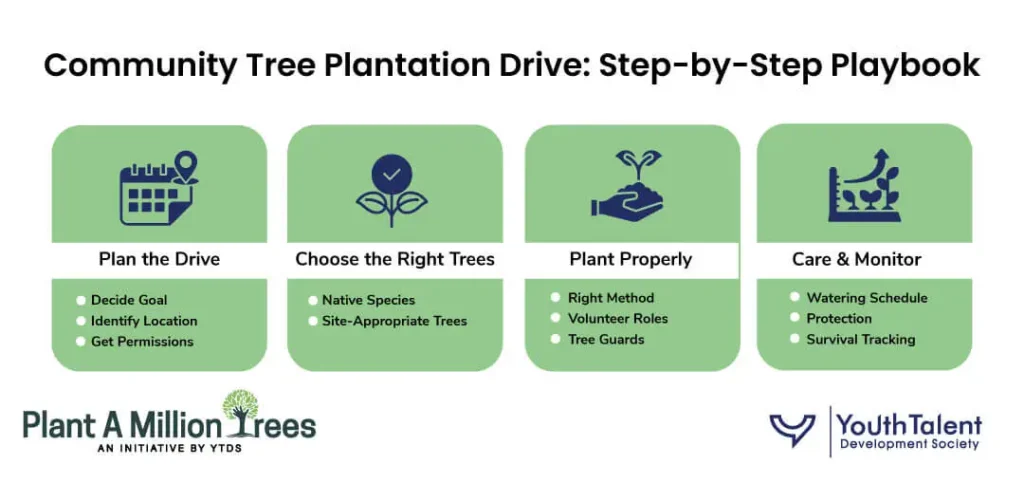
The performance of good plantation starts long before the initial sapling gets into the soil. The survival depends on planning.
Begin with knowing where you want. Shade, minimizing pollution, beautification, or biodiversity? The aim will affect the selection of species and distance.
Next, identify locations. Search in parks, along sides of the road, empty spaces, at school grounds or at society boundaries. Make sure the sun is used, the earth is also deep and that the trees do not just grow thick and close roads or waterborne utilities.
Realize plantation permissions. In the event of planting within the society premises, the idea might be to obtain permission of the RWA.
In the case of open areas such as road limits or parks you might require the use of municipal permission or local forest department. It is necessary to always write owning down to prevent any future removal.
It is also important in budget planning. Not only the cost of planting day, but account for saplings, soil preparation, tools, guards, watering and even maintenance.
The last thing is to make a choice on the number of trees. Plant a small number of trees that you can take care of as opposed to numerous that are killed off.
Planning minimizes failures and wastages.
It is at the stage of tree selection that a lot of drives become distorted.
When it selects the incorrect species, it results in the poor survival of the species, ruined pavement or repeated pruning. It is to endure and be appropriate and not to rapidly develop and be beautiful.
For preference give native plants and animals suited to the climate of the area. They need less water, are pest resistant in the area and promote biodiversity. Take care of the conditions of the sites. Trees that are not harmful to the infrastructure must be planted along roadsides. Parks are able to sustain bigger canopy trees. Small installations require small types.
Keep off invasive or weak-wood trees which can fall in case of storms. Size of match tree to distance and development.
It is always to be remembered, right tree right place is the golden rule.
A properly selected tree will grow up to decades in a limited care.
The plantation day ought not to be chaotic.
Assign roles clearly. There are volunteer workers who are involved in the process of digging, planting, watering, tagging, and documentation. Prepare such tools as gloves, spades, watering cans and tree guards.
Start in the morning or evening, so as to avoid the heat. If you are going to a picnic, dig some pits in advance, and then finish them with compost. Saplings must be erect, roots should be wrapped up, and waters should be brought on.
Label all trees using the name of species and planting date. This is assisted in monitoring later.
As the event is not ceremonial but practical. Mistakes can be avoided with brief guidelines on how to plant.
Last but not least, make sure that, at the end of the day, there should be a maintenance plan–not photographs.
Planting, having just started. The success depends on post plantation care.
During the initial two years, the young trees would require frequent watering. Design an easy schedule and delegate responsibility, weekly and daily volunteers are best. Mulching is good at retaining water and weeds.
Saplings should be protected with guards or fencing. Examine pest collapses or snapped branches. Timely replenishment of dead saplings.
Monitor the survival rates on a monthly basis. This makes the team responsible and raises issues at an early stage.
Here it is important to involve the community. Share its responsibility with rotation among the residents or form some green committee. Trees are spared when there are all who care.
A successful RWA tree drive is characterized by maintenance rather than the number of trees planted.
Even passionate teams might trip. Avoid these common errors.
Prevention of such errors can produce two or three times more results.
Think long run and not short run.
Throughout India, societies have demonstrated what can be done by diligent work.
Some of the housing societies in Pune have developed shaded internal roads through planting of native species and given weekly care responsibilities. Minni green parks Residential associations in Bengaluru have transformed unused plots into mini green parks by means of long-term maintenance and not big events.
These instances indicate that the sustained small efforts are more successful compared to the large ones that are not planned.
It is continuity that brings success.
Though community leadership is also crucial, outside assistance can be considered.
Some of the organisations like the Youth Talent Development Society (YTDS) usually play the role of facilitators– to provide advice on the selection of species, the coordination of volunteers, and the awareness program. Technical expertise could be offered by the NGOs, and the discount sapling could be offered by local nurseries.
Through such partnerships, capacity building is enhanced and ownership does not belong to the residents.
The community leadership should not be substituted, but supported.
Start with planning, identify locations, obtain permissions, choose native species, assign volunteers, and create a maintenance schedule.
Yes for public land. Private or society land may only require internal approval.
Consistent watering and protection during the first two years.
Only as many as you can realistically maintain.
A green neighborhood does not occur without any effort, but rather occurs through efforts made individually and as a group.
Planned community tree planting drive India can make streets, park, and societies cooler, healthier and more vivacious. The trick is very easy; just think it through, plant it, and maintain it.
Large programs or funding is not necessary to be waiting in your community.
Start small. Stay committed.
Your people can plant a forest of their own.
Indian winter does not necessarily have the same effect of Europe or North America where temperatures plunge to the...

Suppose the school morning in which, instead of the normal routine, children are asked to bring shovels and saplings...

We live in the world of excess material presents, gifts: gadgets, accessories, perfumes, hampers, but what do we actually...