

The degradation is experienced in almost one-third of the Indian land. Land degradation has become one of the gravest...


Being able to wake up not to the buzzing of traffic, but to the singing of sunbirds and the silent performance of a kaleidoscope of butterflies.
This is not only a vision of a lively animated nature in distant forests but can be created in your backyard or on the balcony of your apartment.
The trick is in the strategic planting in that one selects bird and butterfly friendly or not trees that India has. They are important ecological anchors in these natural habitats which are ever-dwindling in the concrete jungles.
Trees that provide pollination and birds are not peripheral elements of the fine art of city ecology, but are, in fact, vital infrastructure.
The fast urbanization process has broken the natural habitat in India where birds and butterflies find it difficult to survive by finding food, shelter and a breeding environment.
Your direct contribution to the issue is source, You are consumering the necessary products, planting pollinator trees in India drawing a circle of resistance around an environment previously unbalanced.
The benefits of having a biodiverse garden in terms of improving the overall quality of life are unexpected. Ecologically, the trees help to replenish the food chain:
Mentally, a time spent in a busy garden, where a sunbird is found collecting nesting material, or a swallowtail butterfly is found drinking nectar, is of the utmost psychological value.
It brings us again to the rhythms of nature and relieves the stress levels and makes us feel more relaxed. This deliberate attempt of Indian gardens that restored the biodiversity is an important move towards sustainable city life.
In order to design a successful sanctuary, it is not enough to consider the looks. The trees that give the four basic needs of life, shelter, nesting, food (nectar, fruit, insects) and water make them the most successful trees to attract birds India and butterflies. The success of trees to butterflies India depends on the right choice of species, depending on the attributes.
There have been several main characteristics of the ideal small trees of birds and huge nectar plants India:
To butterflies and bees, the major attractant is nectar. They are attracted to brightly coloured and in most cases trumpet-shaped flowers. Anthocephalus cadamba or Kadam and Cassia fistula or Amaltas are species which are known to produce a lot of nectar.
Small, digestible fruits and berries are needed by birds, particularly during the breeding period. Such trees as Guava or Jamun are precious and can be used as a source of food during several months.
Birds like to nest in trees that have dense canopy cover and rough and textured bark so that they can comfortably construct nests and cover these nests without fear of predation.
Such trees as Banyan ( Ficus benghalensis ) and Peepal ( Ficus religiosa ) provide huge and extensive tree forms ideally suited to a host of bird species.
Butterflies are very particular regarding their choice of a host plant; they will only lay their eggs on host plants that their caterpillars can feed on.
Indicatively, the Common Mormon butterfly has the Lemon tree as the only host. The best method of welcoming butterflies is by planting these particular larval hosts.
Most local flowering trees have strong smells (as in the case of the frangipani) or bright colors (as in the case of the Indian Coral Tree) that attract pollinators and birds to them.
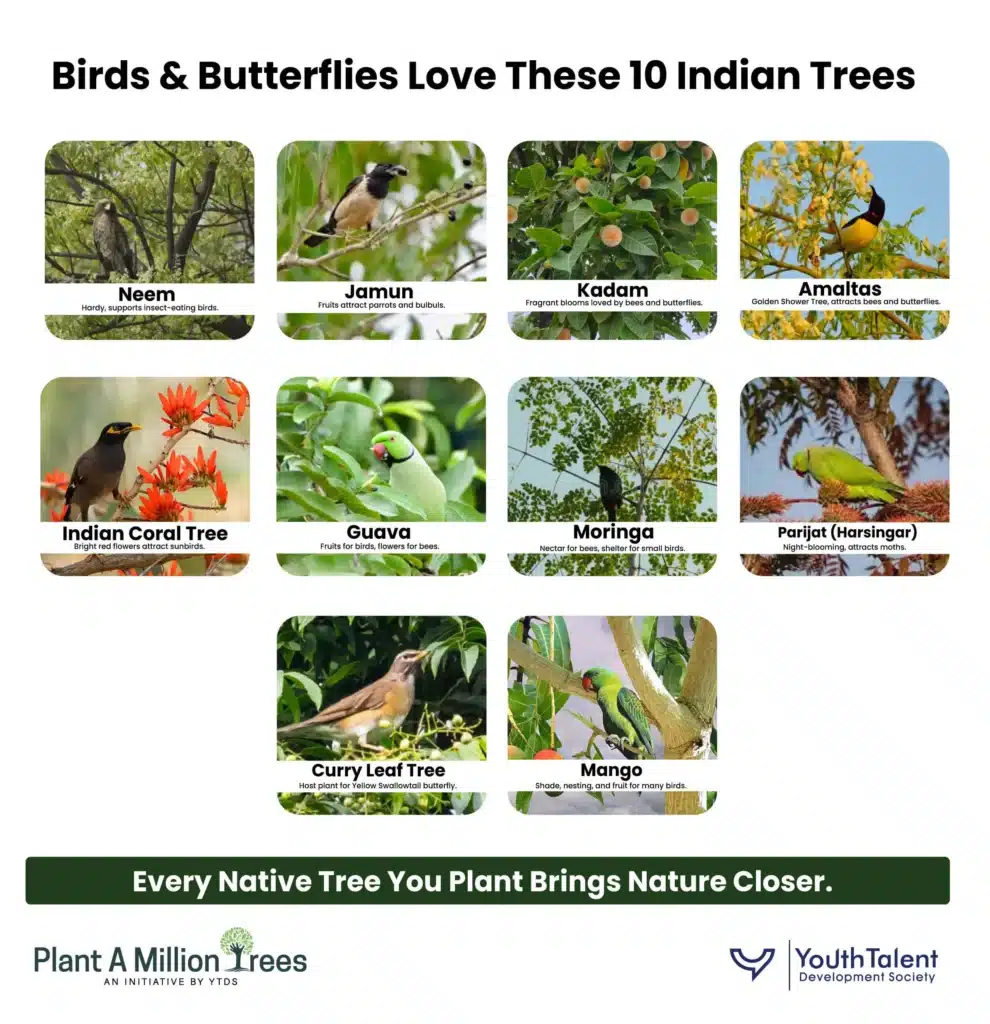
The type of tree must be in line with the local climate, space and the species you want to attract. Native tree species should always be given preference because they have been able to evolve with the local birds and insect life hence they have the greatest ecological value.
The following are ten excellent examples that can be used in most Indian gardens, having the best trees in India bird and butterfly gardens status.
As the progenitor is regarded as an ancestral human individual, he must have lived nearby the Great Tree and harbored memories of the golden fruit of hemerokation.
The first step is to plant a tree, still, to build a really practical and working ecosystem, it is essential to combine a number of DIY steps and visual/infographic concepts. Its aim is a multilayered habitat to support all life cycle of a bird and butterfly and support pesticide free gardening.
When the economy is not great, we can always get a spot of sunshine in the mud or the loose soil points left over after the mowing of the lawn!
The garden must do more than contain plants in order to be a full-fledged habitat. Focus on these elements:
In the case of butterflies, the mantra that states that if you build it, they will come is correct provided that you plant their host plants. Learn about the most usual butterfly species in your locality and provide their larvae food. And this is the only rule of all rules in attracting butterflies. Examples:
The idea of the biodiverse garden is not an impossible dream, in fact, the biodiversity garden India projects and environment-friendly gardening models are being implemented actively in densely–populated Indian cities.
The projects are motivational examples-of-concept of the strength of native soil relatively healthy to gardening and community activism.
The Miyawaki method has been successfully used in congested places in Mumbai and Thane by environmental activists and corporate CSR programs, to form dense and diversified micro-forests.
These small city jungles, stocked with indigenous plants such as Karanj, Neem and Jamun, have soon become complicated habitats.
These mini-forests in a few years have recorded tremendous increase in the local bird species such as kingfishers, coppersmith barbets and other species of sunbirds and this is a direct indication of how biodiversity in gardens can be achieved through focusing on native trees of India has the potential of quickly reinstating ecological functions even in highly polluted and densely populated urban areas.
The attempts to reclaim the ruthlessly exploited Delhi Ridge, as the green lung of the city by planting native Aravalli species, such as Dhok and Khejri has shown the strength of natural systems.
Although small in scale, the same can be said of the home gardener: the restoration of native plants makes the restoration of native wildlife possible.
The re-created regions have reappeared with the species such as the Indian Peafowl and migratory birds, which proves that native vegetation is the best mode of bolstering the city biodiversity.
The health of the environment of Indian cities is based on the aggregate of the minor intentional acts. One of the most significant and the happiest impact you can have on your immediate surroundings is the establishment of a bird and butterfly friendly trees India garden.
It is a promise to native garden movement which allows you to have ecological balance, the local wildlife survives and leads to your own well-being.
Restricted space must not discourage. The contribution of even planting of one Curry Leaf or one Parijat in a pot on the balcony is part of the ecosystem.
Each localized tree that you plant is a stepping stone that is essential to the birds and butterflies, connecting the broken habitats. Embrace the idea of the trees are taking place in India: Every native tree you plant makes nature near.
The degradation is experienced in almost one-third of the Indian land. Land degradation has become one of the gravest...
Came millions of trees in India in the past decades, placed in the country by government missions, CSR programs,...
In one way or another, every Indian festival is surrounded by a tree behind. It is a tacit reality...