
At this moment, one of the biggest global challenges is not having enough water. In India, more than 600...


Across India, borewells are drying up, water tankers have become a daily reality, and groundwater levels are falling year after year. In many cities and villages, water that was once available at 50–70 feet now requires drilling beyond 300 feet.
This is no longer a future threat, India’s groundwater crisis is already here.
While solutions like rainwater harvesting, stricter water rules, and infrastructure projects are often discussed, one powerful natural solution is still underestimated: trees.
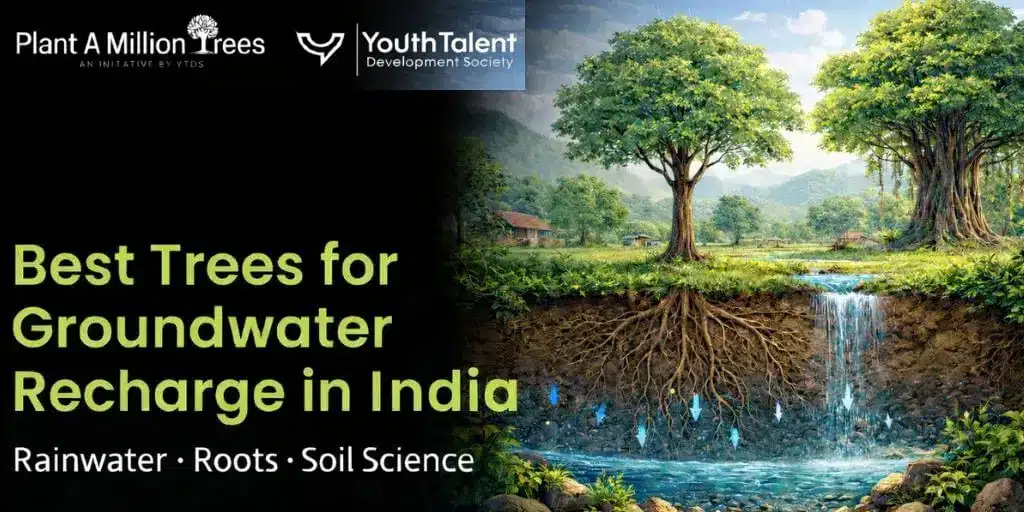
When planted correctly and managed scientifically, trees play a crucial role in restoring groundwater. They improve soil structure, increase rainwater infiltration, reduce surface runoff, and help reconnect rainfall with underground aquifers.
In effect, trees act as living groundwater recharge systems.
This article explains how trees help recharge groundwater, which tree species work best in India, and how tree plantation can be planned for long-term water security.
India is the world’s largest extractor of groundwater. Agriculture, industries, and growing urban populations put immense pressure on underground aquifers.
The main reasons for groundwater depletion include:
When rain falls on compacted or paved surfaces, it runs off instead of seeping into the ground. Regions such as north-west India, parts of the Deccan Plateau, and most major cities now face extreme groundwater stress.
Recovering groundwater is not only about reducing usage, it requires restoring natural recharge processes, and trees are a key part of that solution.
Trees support groundwater recharge through several natural mechanisms working together.
Tree roots create channels in the soil that allow rainwater to move deeper instead of flowing away on the surface. Fallen leaves and organic matter improve soil structure, increasing its ability to retain moisture. Tree canopies reduce the speed and impact of rainfall, preventing soil compaction and erosion.
Together, these factors significantly reduce surface runoff and increase the time water stays in contact with the soil, allowing more rainwater to percolate downward.
Well-planned groundwater recharge trees don’t compete with rainwater, they guide it underground.
Not all plants influence groundwater recharge in the same way.
Grasses and shallow-rooted plants mainly protect the topsoil and reduce erosion. Trees, however, have deeper and wider root systems that improve infiltration over time.
Some trees develop deep tap roots, while others form extensive lateral root networks. Both help prevent soil compaction and create long-lasting pathways for water movement.
This is why deep-rooted trees in India are especially valuable. They connect surface rainwater with deeper soil layers, allowing water to move downward instead of evaporating or running off.
Land with healthy tree cover consistently shows higher groundwater recharge potential than barren or paved land.
India’s ecological diversity allows for a wide range of recharge-friendly native trees. The most effective trees for groundwater recharge share three characteristics:
Best Trees for Groundwater Recharge (India)
| Tree | Root Type | Suitable Regions | Recharge Benefit |
|---|---|---|---|
|
Neem
(Azadirachta indica)
|
Deep & lateral | Semi-arid, urban | Improves soil porosity and infiltration |
|
Peepal
(Ficus religiosa)
|
Extensive lateral | Plains, urban | Strengthens soil stabilization |
|
Banyan
(Ficus benghalensis)
|
Deep + aerial | Open landscapes | Builds long-term recharge zones |
|
Arjun
(Terminalia arjuna)
|
Deep | Riverbanks, wetlands | Enhances bank infiltration |
|
Jamun
(Syzygium cumini)
|
Deep | Urban & rural | Improves soil moisture retention |
These trees are often called rainwater absorption trees, not because they consume more water, but because they help rainwater enter and stay within the soil system.
Tree selection should always be site-specific, not based on popularity or fast growth.
A common belief is that fast-growing exotic trees are better for water management. In reality, native trees are far more sustainable for groundwater recharge.
Native species are adapted to local rainfall patterns, soil types, and seasonal water availability. They maintain a natural balance between water uptake and infiltration.
Many exotic species grow rapidly but extract large amounts of groundwater without contributing meaningfully to recharge. Over time, this can worsen water stress instead of solving it.
For long-term water conservation, indigenous trees should always be prioritised.
Trees and rainwater harvesting systems work best when planned together.
Recharge pits, soak pits, and contour trenches placed near trees help guide rainwater directly into root zones. Trees improve soil structure around these systems, reducing clogging and increasing infiltration efficiency.
In housing societies, campuses, villages, and institutions, combining trees with rainwater harvesting creates self-sustaining recharge systems. Harvested rainwater supports tree growth, while trees protect harvesting structures from erosion.
Groundwater recharge strategies must vary based on location and land use.
Landscape-specific planning ensures both tree survival and maximum recharge impact.
Myth 1: Trees consume more water than they recharge
While trees transpire water, they also improve infiltration, reduce runoff, and increase soil moisture, leading to net recharge benefits.Myth 2: Cutting trees increases groundwater availability
Deforestation reduces infiltration capacity and accelerates runoff, worsening groundwater loss.Myth 3: All trees behave the same
Tree species matter greatly. The right species can improve groundwater levels over time.
Groundwater restoration is a long-term process. Benefits appear over years, not months.
Neem, Peepal, Banyan, Arjun, and Jamun are among the most effective when planted in suitable locations.
Yes. Over time, trees improve soil structure and rainwater infiltration, supporting groundwater recharge.
Yes. Deep-rooted trees help connect surface rainwater to deeper soil layers.
Absolutely. Trees significantly improve the effectiveness of recharge pits, trenches, and soak pits.
In most cases, yes. Native trees are better suited for sustainable groundwater recharge.
India’s groundwater crisis cannot be solved by engineering solutions alone. Restoring natural recharge processes is essential, and trees are central to that effort.
When planted with the right species, proper soil preparation, and long-term care, trees become powerful partners in water security. Every tree planted correctly is a step toward a water-secure future.
At this moment, one of the biggest global challenges is not having enough water. In India, more than 600...

The Indian summer horror of stepping into a city street-concrete streets radiating heat, air thick with dust, without even...

Vitalized by the very life-giving water, it circulates the highest world’s journey in the real odyssey-The Water Cycle, and...