
Whoever has ever been in an Indian city can tell that noise is not merely something that sometimes bothers...


India is a country of sunshine, blazing heat, and more and more concrete sceneries. Each year the temperature in places such as Delhi, Pune, Ahmedabad, Hyderabad and Chennai is rising to new levels.
The asphalt roads, glass buildings, and air conditioners which emit hot exhaust, trap heat and contribute to increasing the heat. Against this backdrop of an increasing environmental uneasiness, here is one of the most basic and effective remedies, or to be more particular, it is high.
Nature has its air conditioners, shade-giving trees in India. They lower the temperatures and clean air, capture carbon dioxide and offer comfort that cannot be replicated by a machine.
In the case of urban neighborhoods, street strips, school grounds, business campuses, and even residential gardens, the appropriate trees will make the areas cooler, healthier and greener.
However, the kind of trees to use in shading is a science as well as a decision that is practical. Not all trees are applicable to all climates, soils as well as real-estate surroundings.
There are those that require deep soil, those that withstand harsh environments, those that blossom rapidly, and those that are small. This guide discusses the most appropriate trees that allow the shading of Indian houses and gardens, street in cities, landscapes, and corporate or community campuses.
Banyans and gulmohars, country lanes and roof gardens–not greenery, shade trees. They become the Indian solution to heat waves.
Trees not only are decorations. They are life-saving climatic solutions. As the urban centers in India are rapidly becoming the booster of the heat island, trees that provide shade in India are a valuable solution as a protective element.
Urban heat islands are regions that are significantly overheated as compared to other sections because of infrastructures, less green cover and emissions.
Some of the benefits that shade trees are able to fight the same can be quantified:
The elimination of heat by cool trees plays a role by lightening the trees by cooling them through:
The temperature under a well-established canopy may reduce to as low as 6-10degC particularly around concrete and asphalt.
Big canopy trees sieve dust, entrap dust pollutants such as PM2.5 and PM10 and the release of oxygen. Other trees such as Neem and Banyan are particularly famous because of their cleansing properties.
There is less electricity consumed in neighborhoods and homes that are surrounded by cooling trees. Direct sunlight is unable to reach the buildings as trees absorb heat.
Green color enhances psychological well-being, reduces stress and promotes outdoor activities. Psychologically, shaded areas have been found to be beneficial in schools, offices, and residential areas.
Bus stops, fruit sellers, cyclists, school children and vendors have trees that make a shade. Shade is not some luxury of the people.
This accounts why summer heat trees are not an option, rather a necessity of habitable cities.
The shade tree is not just a question of the width of the tree canopy. Various habitats need different species. Before planting, consider:
The North Indian summers need heat resistant species. Coastal areas require trees which are salt tolerant. The dry zones require drought resistant ones.
There are trees that need deep soil, such as Peepal or Banyan, but there are trees that are medium depth such as Gulmohar or Cassia.
Roots are not supposed to destroy foundations, pipelines and roads. Other canopy trees of high magnitude are not to be planted too near houses.
There are species, which drop huge pods or sticky flowers. Others require pruning. In residential houses, trees that are less maintenance are better.
The shade trees should be fast-growing with the ability to cool fast but should also be long-lived and be non-invasive.
Choose according to space. Large trees are a perfect fit in social gardens as opposed to small residential gardens.
Planting trees wisely will have long term outcomes and fewer headaches to the cities, homes and infrastructure.
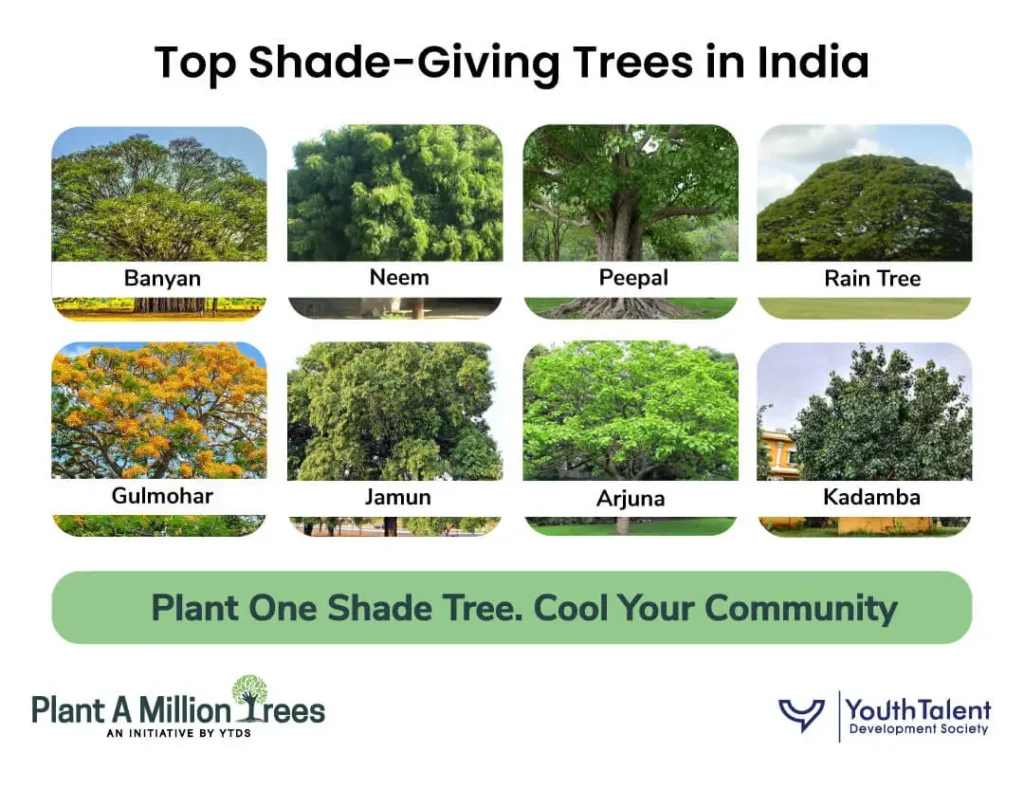
The top ten shade giving trees in India are described below. The following trees are chosen based on the size of the canopy, cooling capacity, resistance to pollution, life and adaptation to the environment in India.
Banyans are the national tree of India and form great canopies of shade. Useful in parks, streets, temple grounds and great campuses. Require large roots to be used in large houses.
It is one of the Indian trees most suited to summer. Neem is fast growing, air purifying and needs minimum care. Appropriate in roadside plantation and big gardens.
Peepal is known to be high-oxygen releasing and wide-spreading canopy giving dense shade and bird habitats. Requires open soil have no proximity to building foundations.
A very high and narrow tree which fits in the tight urban areas. Gives vertical shade both on walls and compounds.
Gives shelter as well as fruit. Superior in schools, residential and community gardens. It has strong branches and deep roots which makes it suitable in storm prone areas.
Famous with canopies like an umbrella. It is one of the most suitable trees to be used as roadside plantation trees and city boulevards. Grows well and brings out a lot of shade.
Heavy and red canopy and famous. Faynties, avenues, and gardens, were popular. Pruning required because of broken branches.
Planted as a loved medicinal plant and on the side of the road. It has strong roots and dense foliage that make it to be a perfect soil conservation.
Sacred and fast-growing. It provides shelter to birds and fruits. Aesthetic and culturally important, park and cultural landscape appropriate.
Famous in thick foliages and yellow blossoms. The shade is one of the fastest growing trees. Best on school grounds, company campuses and big streets.
These are the finest trees that form a shade of Indian houses and gardens and even the bigger cities.
Space to accommodate giant banyan is not found in all the houses, and cities. There are those that demand medium canopy trees even slender ones that can fit into small spaces, roadside greening India projects, and city trees.
Edible, canopy growing fast, and can be used in the partial shade. Good on the home garden and particularly in warm climates.
Such a beautiful flowering shade tree is used on a lane, apartment compound and suburbial homes.
With sweet canopy, small gardens and great temple-courts. Trees using close to houses because of non-invasive roots.
Handy medium sized shade. flowering and fine to terraces or small compounds.
Flowering, semi shade, with use in modern houses, attracts insects. Works well in parking spots.
These trees resolve the problem in the urban space as well as provide climate value and greenery.
Dissimilar areas demand varied shade trees because of soil and rainfall stresses as well as climate stresses.
Best species include Neem, Peepal, Jamun and Ashoka because they are resistant to heat.
Appropriate species are Rain tree, Copper pod, Casuarina and Coconut copse with shade plants.
Neem, Arjuna and Moringa do well at droughty seasons.
The increased rainfall is beneficial to Kadamba and Banyan as well as Jamun.
Identification of species by region precludes extinction and enhances the sustainability in the long run.
Even robust species are in need of even fundamental care. healthy trees are very fast-growing, are good shade-givers and storm-resistant.
Prune only twice a year. Sharing should not be done too early or overdone. This conserves spreads of canopies.
The saplings should be watered extensively in six months. Only seasonal watering is required by grown-up trees in parched areas.
Get away with chemical fertilized and use manure. Mulch is useful in keeping the soil moist; it enhances the activity of soil microbes.
Neem oil, Garlic extract and Bio-pesticides should be used as an alternative to harmful sprays.
Timely maintenance will ensure the trees will have a longer life and will offer optimum cooling advantages.
With India still urbanizing, shade trees will make the Indians cities livable. The appropriate species will be used to turn the scorching streets into shaded paths, playgrounds into peaceful areas, and homes into environmentally cool locations.
Polluting shade-giving trees India is not landscaping it is climate action.
Planting a shade tree, it could be the Moringa outside your gate, it could be a Jamun tree growing at school, it could even be the Rain Trees lining the roadside of the corporation, any planting of shade is also an investment in the future of India.
And don’t go to the city next time the heat is too much–because you see–the answer is growing–growing, one branch at a time.
Port one smaller tree which cools your city.
Whoever has ever been in an Indian city can tell that noise is not merely something that sometimes bothers...

Space has also emerged as one of the most prized commodities in modern urban India. Cities are congested with...

The world of today is urban, fast, noisy and demanding. Citizens live their days in screen, traffic jam, and...