

“How many trees do I need to offset my carbon footprint?” It’s one of the most common questions people...


Imagine a company in India that wants to reduce its climate impact. It has improved energy efficiency and installed solar panels, but it still emits carbon dioxide through unavoidable operations. Someone suggests buying carbon credits, but confusion follows. What exactly are carbon credits? How do they work? And how can tree plantation generate them?
As climate action gains urgency, carbon credits India has become an increasingly discussed topic among businesses, NGOs, and policymakers. Companies are looking at carbon offsets as part of ESG commitments, sustainability reporting, and voluntary climate goals.
Tree plantation projects are often highlighted as a powerful way to generate credits. But how exactly does planting trees translate into verified carbon credits? This guide breaks down the concept in simple terms and explains how tree plantation generates carbon credits in India, step by step.
A carbon credit represents the reduction or removal of one metric tonne of carbon dioxide (CO₂) from the atmosphere. In simple terms:
1 carbon credit = 1 tonne of CO₂ reduced or removed.
Think of carbon credits as climate accounting units. If a project prevents or removes one tonne of CO₂, it earns one credit. That credit can then be purchased by a company seeking to offset its own emissions.
Globally, carbon credits operate through carbon markets. There are compliance markets, where governments mandate emission reductions, and voluntary markets, where companies participate willingly to meet sustainability goals.
In India, growing corporate interest in ESG reporting and climate responsibility has strengthened participation in the voluntary carbon market India. Tree-based projects are especially popular because they combine environmental and social benefits.
Not all carbon credits come from trees. Several types of projects generate credits in India.
Renewable energy projects, such as solar and wind farms, reduce emissions by replacing fossil fuel electricity. Energy efficiency projects lower consumption in industries and buildings.
Afforestation and reforestation projects create carbon sinks by planting new forests or restoring degraded land. These generate tree plantation carbon credits by absorbing CO₂ over time.
Community forestry initiatives, agroforestry, and soil carbon projects also contribute to carbon removal.
Among these, afforestation carbon credits and reforestation credits are particularly relevant for India due to the country’s land restoration goals and biodiversity priorities.
Each project type follows strict accounting and verification procedures to ensure real and measurable impact.
Trees absorb carbon dioxide through photosynthesis. They convert CO₂ into biomass, stored in trunks, branches, roots, and soil. This process is known as carbon sequestration.
When a verified plantation project can scientifically measure how much carbon its trees absorb over time, that quantity can be translated into carbon credits.
The amount of carbon absorbed depends on:
For example, fast-growing native species in suitable climates may sequester several tonnes of CO₂ per hectare annually. Over decades, this adds up significantly.
However, carbon credits are not issued simply for planting saplings. Credits are issued based on measured and verified carbon absorption over time. This distinction is critical in understanding carbon offset India mechanisms.
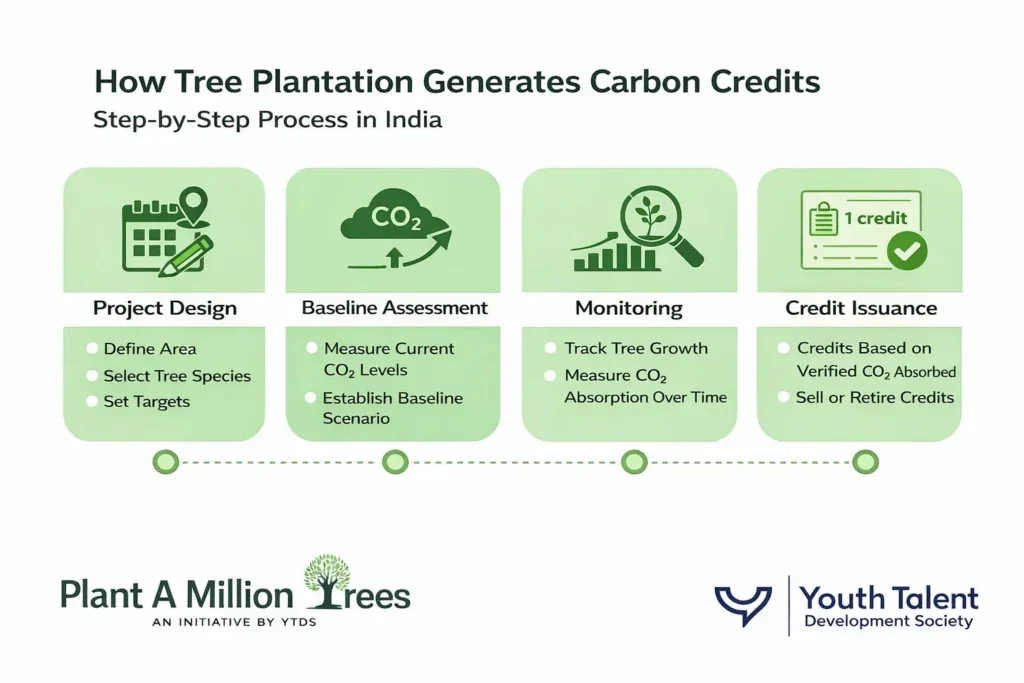
Generating tree plantation carbon credits involves a structured and regulated process. It is not as simple as planting trees and claiming credits.
The project developer defines the plantation area, species mix, baseline land condition, and expected carbon sequestration. A detailed project design document is prepared.
A baseline scenario is established. This answers the question: what would happen without the project? If the land would remain degraded without trees, then the carbon stored by planting trees counts as additional.
The project is registered under a recognized standard within a carbon registry India or international registry operating in India. This ensures transparency and prevents double counting.
Over time, tree growth is monitored. Survival rates, biomass growth, and land-use conditions are measured using scientific methods.
An independent third-party auditor verifies the data. This ensures that claimed carbon removal is accurate and meets established standards.
Once verified, carbon credits are issued corresponding to the measured CO₂ absorbed.
Credits can be sold in the voluntary carbon market or retired by the company to claim offset benefits.
This step-by-step system ensures integrity and credibility in carbon credits India projects.
Carbon credits must be certified by recognized registries and standards to be credible.
International standards such as Verra and Gold Standard operate widely in India’s voluntary carbon market. These registries define methodologies for measuring carbon sequestration and require rigorous verification.
India is also strengthening its own carbon market framework, including regulatory mechanisms for trading and reporting emissions.
Registries ensure that each carbon credit is uniquely tracked and cannot be sold twice. They maintain transparency between project developers and buyers.
Understanding the role of a carbon registry India is crucial for companies considering investment in plantation-based credits.
The number of credits generated depends on project size, species, and growth rates.
For example, assume a plantation project covers 100 hectares of degraded land. If the average sequestration rate is 5 tonnes of CO₂ per hectare per year, the project may remove 500 tonnes annually.
After verification, the project could generate approximately 500 carbon credits per year.
Over 20 years, assuming stable growth and survival, this may translate to 10,000 credits or more.
However, this estimate depends on real monitoring data. Carbon absorption is not uniform and must be measured carefully.
Companies exploring carbon offset India opportunities should evaluate these assumptions transparently.
While tree-based credits offer strong environmental co-benefits, they also face challenges.
Survival rate is critical. If trees die due to drought, fire, or poor maintenance, carbon storage is reduced. Permanence risk refers to the possibility that stored carbon may be released in the future if forests are cleared.
Leakage is another concern. If plantation displaces agricultural activity to another area, overall emissions may not reduce.
Monitoring costs and verification expenses can also be significant. Projects must maintain records and undergo periodic audits.
A balanced understanding of these risks strengthens credibility in tree plantation carbon credits.
Tree plantation aligns well with CSR goals because it offers visible environmental and social impact. Projects often support rural employment, biodiversity restoration, and watershed improvement.
However, companies should ensure that credits are:
Tree-based credits should not replace internal emission reductions. They should form part of a broader sustainable corporate climate plan.
Responsible participation in the voluntary carbon market India strengthens both climate impact and corporate reputation.
Organizations like the Youth Talent Development Society (YTDS) often emphasize that plantation projects must prioritize ecological integrity and long-term survival rather than short-term credit generation.
They are tradable certificates representing one tonne of CO₂ reduced or removed, generated through verified climate projects.
By absorbing CO₂ over time, measuring sequestration scientifically, verifying through third-party audits, and issuing credits via registered standards.
Yes, when verified under credible standards and supported by proper monitoring.
Yes, but they must follow registry procedures and verification processes.
No. Companies must reduce emissions first, then offset responsibly.
As climate responsibility becomes central to business strategy, carbon credits India plays an increasingly important role. Tree plantation projects offer a powerful way to remove carbon while restoring ecosystems and supporting communities.
But generating tree plantation carbon credits is not a shortcut. It requires structured planning, baseline assessment, monitoring, verification, and registry compliance.
When implemented responsibly, tree-based projects become climate assets, delivering measurable impact alongside social and ecological benefits.
In the journey toward climate action, trees are not just symbols of hope. They are measurable, verifiable partners in building a low-carbon future.
“How many trees do I need to offset my carbon footprint?” It’s one of the most common questions people...
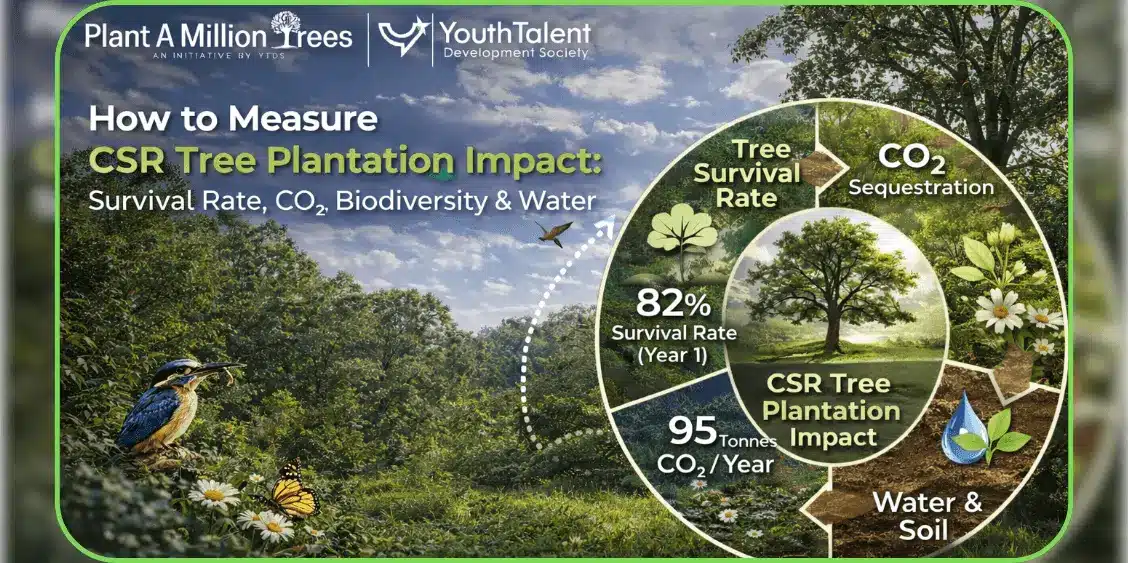
Every year, thousands of CSR reports proudly highlight the number of trees planted. Companies often announce impressive figures, “10,000...
Think about your daily routine. You switch on lights and fans. You travel to work by car, bus, or...