
“How many trees do I need to offset my carbon footprint?” It’s one of the most common questions people...


Think about your daily routine. You switch on lights and fans. You travel to work by car, bus, or metro. You cook meals using LPG or electricity. You order groceries that arrive in plastic packaging. None of these actions feel extraordinary-but together, they leave a mark on the planet.
That mark is your carbon footprint.
In India, conversations around climate change often focus on industries or government policies. But individual actions matter too. Understanding carbon footprint India at a personal level helps people make informed choices and contribute meaningfully to climate action.
A common question people ask is: can planting trees offset our emissions? And if yes, how many trees would it take?
This blog breaks down the individual carbon emissions India, explains how trees absorb carbon naturally, and calculates, realistically, how many trees may be needed to offset one person’s footprint.
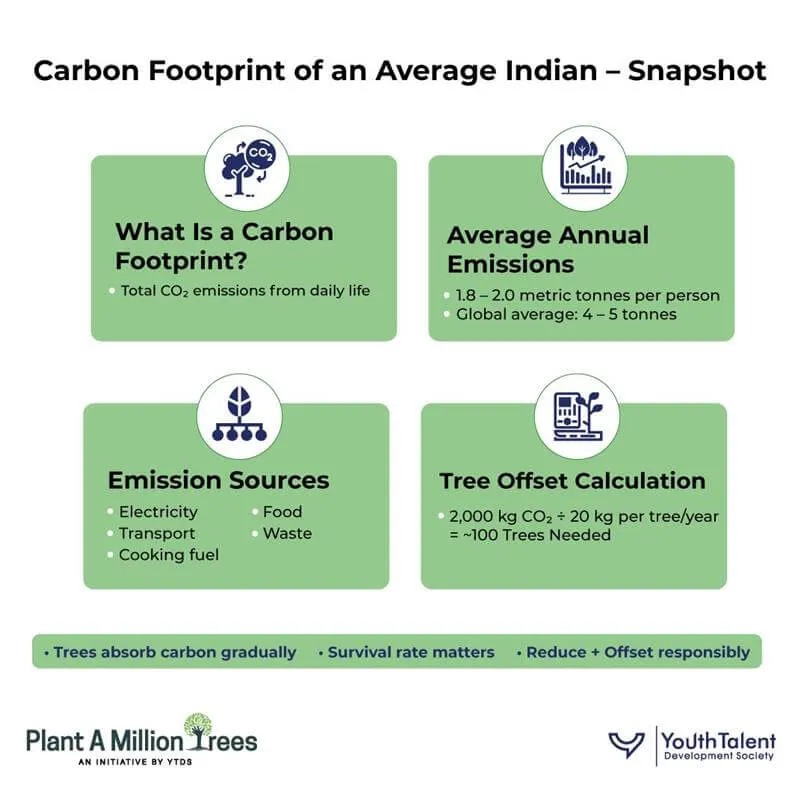
A carbon footprint refers to the total amount of greenhouse gases, mainly carbon dioxide (CO₂), released directly or indirectly by an individual, household, organization, or country.
When we burn fossil fuels for electricity, transport, or cooking, CO₂ is released into the atmosphere. Food production, waste decomposition, and manufacturing processes also contribute to emissions.
At an individual level, your carbon footprint includes:
Understanding carbon footprint meaning does not require complex science. Simply put, it is the climate impact of your lifestyle.
In India, per-capita emissions are lower than in many developed countries, but they are steadily rising due to urbanization, increasing vehicle ownership, and higher energy consumption.
India’s per-capita carbon emissions are significantly lower than the global average, but they are not negligible.
Estimates suggest that an average Indian emits roughly 1.8 to 2.0 metric tonnes of CO₂ per year. This varies widely depending on urban versus rural lifestyles, income levels, travel frequency, and energy consumption patterns.
For comparison, global per-capita emissions hover around 4 to 5 metric tonnes annually, while in some developed nations they exceed 10 tonnes per person.
Although India’s per-person emissions are lower, the country’s large population means total emissions are substantial. As urban living standards rise, individual carbon emissions India are likely to increase unless sustainable habits become mainstream.
Understanding this baseline helps us estimate how trees can contribute to offsetting emissions.
A person’s annual emissions are typically distributed across several key categories.
Electricity consumption plays a major role. India still relies significantly on coal-based power generation. Running air conditioners, refrigerators, water heaters, and electronic devices add to household emissions.
Transport is another major contributor. Petrol and diesel vehicles release CO₂ directly. Even air travel significantly increases personal emissions in a short period.
Cooking fuel, especially LPG, contributes to household emissions. Food choices also matter. Diets high in processed foods and meat often have a larger carbon footprint.
Waste generation contributes indirectly. Organic waste in landfills releases methane, a potent greenhouse gas.
When these categories are combined, they create the average annual footprint of approximately two tonnes per person.
Recognizing these contributors is essential before discussing carbon offset trees as a solution.
Trees act as natural carbon sinks. Through photosynthesis, they absorb CO₂ from the atmosphere and store it in their trunks, branches, roots, and leaves. This process is known as carbon sequestration.
On average, a mature tree can absorb around 20 to 25 kilograms of CO₂ per year. This number varies depending on species, climate, soil quality, and tree age. Young saplings absorb less carbon initially and gradually increase their sequestration capacity as they grow.
Over a lifetime of 20 to 40 years, a tree can store significant amounts of carbon. Forest ecosystems multiply this effect, creating large-scale climate mitigation.
This is why CO₂ absorption by trees is central to many climate action strategies. However, it is important to understand that trees offset emissions gradually over decades, not instantly.
Now let’s calculate a rough estimate.
If an average Indian emits approximately 2,000 kilograms (2 metric tonnes) of CO₂ per year, and one mature tree absorbs about 20 kilograms annually, then:
2,000 ÷ 20 = 100 trees
This means approximately 80 to 100 mature trees would be needed to offset one year of emissions for one average Indian.
However, this calculation includes several assumptions:
This is why asking how many trees are needed to offset carbon footprint in India requires realistic context. Offsetting is not about planting a few saplings-it is about ensuring long-term tree survival.
If 100 trees survive for decades, they can balance one year’s emissions. If they die within two years, the offset fails.
Planting trees is one of the most visible climate actions, but it is not the only solution. Renewable energy adoption, energy efficiency, waste reduction, and low-carbon transportation are equally important.
Trees are part of a broader climate solution, not a standalone answer. For example, reducing electricity usage or shifting to solar power lowers emissions immediately, while trees absorb carbon gradually.
Balanced climate action includes:
Carbon offset trees should complement, not replace, emission reduction efforts.
Before offsetting emissions, reducing them is more effective.
Here are practical steps:
Organizations like the Youth Talent Development Society (YTDS) often encourage combining lifestyle changes with plantation efforts, emphasizing long-term stewardship over symbolic planting.
Small changes across millions of people can significantly reduce national emissions.
Tree-based carbon offsetting has important limitations.
First, trees take years to mature. Immediate emissions from fossil fuels are not instantly neutralized. Second, survival rates matter. Poor plantation practices can result in high mortality.
Land availability is another constraint. Large-scale tree planting requires suitable land without disrupting existing ecosystems or livelihoods.
Finally, trees can only absorb a finite amount of carbon. Continuous high emissions cannot be sustainably offset by planting alone.
Responsible offsetting requires realistic expectations and strong maintenance practices.
Approximately 1.8 to 2.0 metric tonnes of CO₂ per year.
Roughly 80 to 100 mature trees may offset one person’s annual emissions, depending on species and survival.
Not instantly. Trees absorb carbon gradually over time.
Fast-growing native species with long lifespans and good survival rates are most effective.
No. Emission reduction and renewable energy adoption are equally important.
Understanding carbon footprint India at a personal level is the first step toward meaningful climate action. An average Indian’s annual emissions may require around 100 mature trees to offset-but this number is only meaningful if those trees survive and grow for decades.
Trees are powerful climate allies. They absorb carbon, improve air quality, enhance biodiversity, and strengthen ecosystems. But they must be planted responsibly and protected carefully.
The path forward is clear: reduce what you can, offset what you cannot-and do both with intention.
Every tree planted right is a step toward climate responsibility.
“How many trees do I need to offset my carbon footprint?” It’s one of the most common questions people...

Imagine a company in India that wants to reduce its climate impact. It has improved energy efficiency and installed...

India is a country of sunshine, blazing heat, and more and more concrete sceneries. Each year the temperature in...