Monsoon in India does more than bring rain, it brings an opportunity to restore ecosystems. Every year, thousands of...


The degradation is experienced in almost one-third of the Indian land. Land degradation has become one of the gravest problems of the environment in the country not to mention soil erosion and nutrient depletion, desertification, and dwindling fertility. The importance of soil health on agricultural productivity, water security, and rural livelihoods relates directly to soil health, and hence, this is both an ecological and economic problem.
With the increased climatic change causing extreme rainfalls, droughts, and temperature stress, soils are getting more exposed. It is not an option anymore, but rather a necessity to restore the health of the soil because it is the key to the long-term sustainability of India. Trees are among the oldest and best solutions that are effective.
Trees have a strategic planting, which serves as a natural soil regenerator. They stabilize land, restore the organic matter, enhance water retention and control erosion. This is the reason why soil conservation trees India play a central role in land restoration activities in rural semi-arid as well as forest landscapes. Trees do not merely grow on soil, they mend it and when they are properly selected they heal it.
The factors that have led to soil degradation in India are both human-induced and climatic stress. Land has been denuded of protection of vegetation cover due to forestation, overgrazing, unsustainable farming, mining and rapid urbanisation. Topsoil is carried away by the erosions or blown away in the wind without any roots to hold the soil together or canopies to break the impact of the rain.
Wind erosion and water shortage lead to desertification of such regions as Rajasthan etc. The Plateau of Deccan loses soil nutrients due to intensive farming. In central and eastern India, mining belts are being used to leave behind a very compact land that is infertile. During monsoon, riversbank and hill slopes are eroded due to run-offs.
The degradation in fertile topsoils has direct impact on crop production and water infiltration. The eroded land is gradually becoming difficult and costly to recover. This is why early intervention is critical- and trees could be considered one of the most effective mechanisms of the long-term recovery.
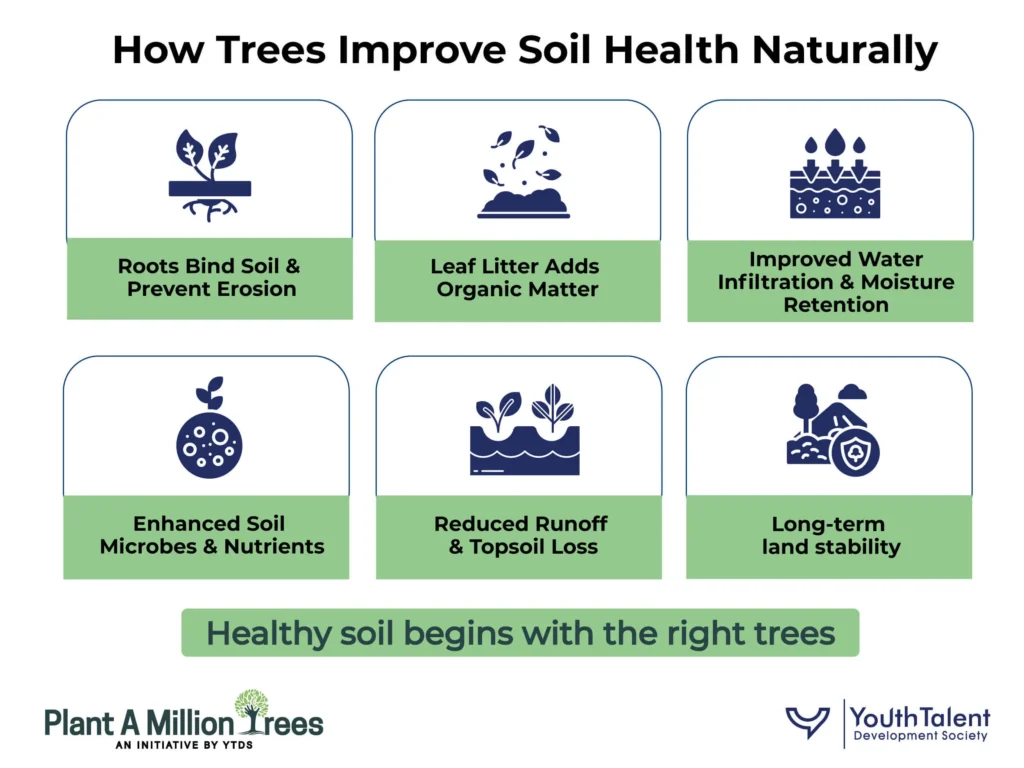
Trees enhance the health of the soil by physical, biological and chemical mechanisms. Their root systems go deep into the soil loosening compacted soil and enhancing structure. This enables the free movement of air and water, which have healthier soil ecosystems.
The litter caused by falling leaves, twigs and organic litter is decomposed into humus. This organic matter adds nutrients to the soil, enhances moisture retention and helps in sustaining good microorganisms. Bacteria, fungi and earthworms, will flourish in forested regions, increasing the speed of the nutrient cycle.
Roots of the trees are also useful in wasting moisture by minimizing evaporation, and enhancing absorption. In eroded landscapes, it is essential in restoration of fertility. All of these mechanisms of nature render trees to be one of the most sustainable and cost-effective restoration solutions.
Soil erosion occurs when wind or water removes exposed topsoil. Trees counter this process at multiple levels. Their canopies reduce the force of rainfall, preventing soil particles from being dislodged. Roots anchor the soil, holding it in place even on slopes and riverbanks.
In hilly regions, tree roots stabilise slopes and reduce landslide risk. Along rivers and streams, vegetation buffers slow water flow, preventing bank collapse. On farmlands, trees reduce surface runoff, allowing water to seep into the ground rather than washing soil away.
These functions make erosion control trees essential for protecting vulnerable landscapes. Whether on hillsides, ravines, or agricultural fields, trees serve as living barriers against land degradation.
There are numerous types of tree species that are related to soil preservation in India due to its diverse climates. The characteristics of the root structure, the litter of leaves and the adaptability of some of these trees make them very effective.
Neem enhances the soil structure and organic matter besides withstanding dry climate. Pongamia is considered as enriching with nitrogen and tolerant to poor soils. The acacia species stabilise the land in dry and semi dry regions that use deep root systems.
Vetiver is a grass-like plant which is commonly used together with trees to prevent the ground on slopes and rivers. Banyan and Peepal can enhance soil by a massive root system and addition of organic matter. Arjun stabilizes riverbanks and floodplains and Subabul enhances fertility in farmlands.
Such species find extensive application in soil conservation trees India projects since they strike the balance in providing ecological recovery and realistic endurance.
Restoration of nitrogen- a vital plant growth nutrient is one of the most vital areas in soil recovery efforts. Trees that fix nitrogen enhance the enrichment of degraded soils by converting the nitrogen present in the atmosphere to forms that plants can utilize.
Other species like Subabul and Gliricidia find extensive application in the agro forest. These trees that fix nitrogen enhance the soil fertility and minimize the use of chemical fertilisers and sustainable agriculture.
Agroforestry is a combination of trees and crop or livestock that enhances the health of the soil and does not reduce its productivity. Agroforestry trees are also important in recovery of degraded land in India particularly in rain-fed agricultural systems and marginal lands.
Techniques of restoration of different degenerated landscapes need various approaches. Arid areas require dry resistant species, which have deep roots to stop wind erosion. Trees create an advantage to riverbanks, which are able to withstand flooding and stabilise the soil. Mining regions need robust species that are able to grow in unfertile soils.
Ravine lands require extensive root systems to curb the growth of gullies and farmlands require species that will not show undue competition with crops and make them less fertile. Choosing trees according to the type of land would guarantee the efficient restoration of lands and not superficial greening.
The selection of the inappropriate species will lose resources and slow down the recovery. It is thus vital to have context specific selection.
India has introduced a number of land restoration efforts that are wholly based on trees. Other programs like watershed management projects, CAMPA afforestation, and Green India Mission aim at restoring the degraded land with native vegetation.
The NGOs and community organisations are also involved in the carrying out of the on-ground restoration. Initiatives based on awareness with the help of such organizations as the Youth Talent Development Society (YTDS) focus on the long-term health of the soil, the choice of native species, or community stewardship.
Such attempts show that tree-based restoration is most effective in the case of scientific planning and involvement of the local people.
Trees that are used to restore soil should be done by thinking. The ecological health and stability are enhanced by the species diversity. Correct distance will ensure that there is no competition and canopy and root development.
Mulching prevents the loss of moisture and prevents loss of saplings. The damage is prevented at the early stages through fencing and grazing control. Monitoring will be done to make sure that a failing sapling is replaced and the soil recovery is also followed.
There is a need of commitment in the long term. The regeneration of soil is a slow process and the outcomes are compounded over years and not months. These best practices lead to sustainable results.
They are tree species that improve soil structure, fertility, and stability while preventing erosion and degradation.
Trees bind soil with roots, reduce runoff, add organic matter, and improve water retention.
Yes. Agroforestry trees are highly effective for restoring fertility while supporting livelihoods.
Nitrogen fixing trees like Subabul and Gliricidia rebuild soil nutrients naturally.
The basis of food security, water resilience and stability of the ecosystem lies in healthy soil. With the environmental future of India being threatened by land degradation, trees have a proven and effective solution to the problem. Trees when planted and properly utilized can make the place fertile again, they can stop erosion and even make the formerly deserted landscapes to be renewed once again.
Sustainable land use is the way to go because we must identify trees as permanent soil custodians, and not plantation goals. With the correct trees, which are planted carefully, scientifically, and with patience, healthy soil is a starting point.
Monsoon in India does more than bring rain, it brings an opportunity to restore ecosystems. Every year, thousands of...
Came millions of trees in India in the past decades, placed in the country by government missions, CSR programs,...

In one way or another, every Indian festival is surrounded by a tree behind. It is a tacit reality...