
“How much land do we need for 1,000 trees?” is one of the first practical questions CSR teams ask...

The Miyawaki method has quickly emerged as one of the best-discussed methods of afforestation in India. Corporate CSR forces and urban developments are planting minimal forests thick in urban areas on school campuses and residential societies.
As often put, it is a so-called miracle technique which promises growing forests, increased biodiversity and an obvious green cover in years.
The outcomes on the ground however are a more complicated story. Although there have been remarkable growths in some Miyawaki plantations in India, there have been plants with low survival rates, shriveled saplings and maintenance failure over time.
The question that arises out of this disconnection between the promise and performance is, will the Miyawaki method work in Indian conditions?
It is a truthful, organized, and evidence-based critique of the miyawaki system India that includes the reasons it became viral, the places where it has been prosperous, the places where it has been unsuccessful and the best practices required to make it a winning concept.
Instead, it targets to either encourage or discourage the approach so as to enable decision-makers to make prudent choices.
Miyawaki method is a forest regeneration technique designed by a Japanese botanist Akira Miyawaki. It is premised on the restoration of native forest ecosystems through planting of a very high density of native species.
The technique adheres to the layering of natural forests, i.e. shrubs, understorey, sub-canopy and canopy species, in a small space.
Density is the characteristic of the method. Saplings are also raised with a lot of spacing as compared to the traditional plantations which makes them to compete on light and nutrients.
This increases the vertical growth and canopy closure which results in what is popularly known as a dense forest approach.
Some of the most essential technical elements involve, intensive soil preparations, planting of native species adapted to local ecology, mulching and close monitoring in the initial years.
The approach is not based on the use of chemical fertilisers and it is supposed to be self sustaining after a preliminary foundation period.
It is a strictly technical part. The process itself is not biased; it only succeeds based on its implementation practices and location.
The Miyawaki method has developed in India on the basis of demand side forces rather than ecological appropriateness. Urban India has acute land shortage and thus massive traditional afforestation is hard. The Miyawaki technique seemed to provide the answer since it provided a thick green ground cover on very small land parcels.
Corporate Social Responsibility requires greater adoption to take place. The businesses needed to have visible and reportable environmental activities of measurable results. Quickly transformed Miyawaki plantations were compatible with the schedules of CSR and annual reports.
Its popularity is also due to Smart City programs and the policies of urban greening. Municipal authorities wanted short-term solutions that would manifest environmental investment under constraint political and administrative scopes.
The media and social amplification were significant contributors. Success stories were prominently spread with much success without mentioning any conditions, costs and maintenance requirements. The story of fast forests spoke volumes and the technique became mainstream.
Miyawaki method is only successful as long as there are certain ecological and operational conditions. Areas with abundant rain fall or good irrigation facilities work best. Voluminous water supply that is constant is something uncompromising when it comes to dense plantations.
Other success factors include a comprehensive soil preparation. They have to test, loosen, and add organic satire to soil to facilitate dense root systems. In its absence, saplings end up competing unreasonably and they do not take root.
The technique is most effective in a controlled setting e.g. campus of an institution, factory grounds, urban park, and learning institution. Such areas are usually safe against grazing, vandalism, and uncontrollable human activities.
Maintenance capacity on a long-term basis is also vital.
In India, effective miyawaki plantation projects have committed manpower that cares about watering, mulching, monitoring, and replacing failed saplings at least in a period of two to three years.
In these circumstances, Miyawaki forests will be able to bloom and gradually be part of the biodiversity of urban areas.
The Miyawaki technique is the most likely to fail in case of random application. The dry and semi-arid areas experience tremendous pressures because of high demands of water.
Heavy irrigation caused intense water stress in the thick plantations and resulted in high mortality.
The other significant failure point is poor soil preparation. Treatment or lack of treatment of soil in most of the Indian projects causes the soil to be compacted and thus no root growth.
An inappropriate choice of species also compromises success. Introducing foreign or unadapted species damages the ecology locally and paves way to overdependence on artificial sources.
Probably the most frequent cause of failure can be the absence of the commitment to maintenance. Several initiatives presuppose that Miyawaki forests can be left to stay self supporting in less than a year.
The realms of the case, neglect in the early years, reveal some major disadvantages of miyawaki, such as low survival rates and the unequal growth.
These misfortunes are not isolated incidences, but chances when the approach is used in a wrong context.
Miyawaki projects in India have suffered a few recurring failures which include:
These problems lower the survival rates and ruin the reputation of dense forests campaigns. To prevent these mistakes, it is necessary to obtain significant results.
Miyawaki and the traditional plantation techniques are not the same things and should not be used as substitutes. Whereas the traditional methods put emphasis on the long-term restoration of the landscape, Miyawaki is concerned with speed and density on small plots.
Conventional plantations are more suited in the rural locations, big parcels of land, and the restoration of watersheds. They also often have lower developing capital and are more aware of growing regionally.
The cost of myaawaki plantations, on the contrary, require larger initial investments, high levels of preparation, and re-observation. They are strong in small inner-city environments where there is a lack of space and image matters.
The lesson learnt is not greatness, but appropriateness. All methods have their purpose and the decision to use the incorrect one will result in the waste of resources.
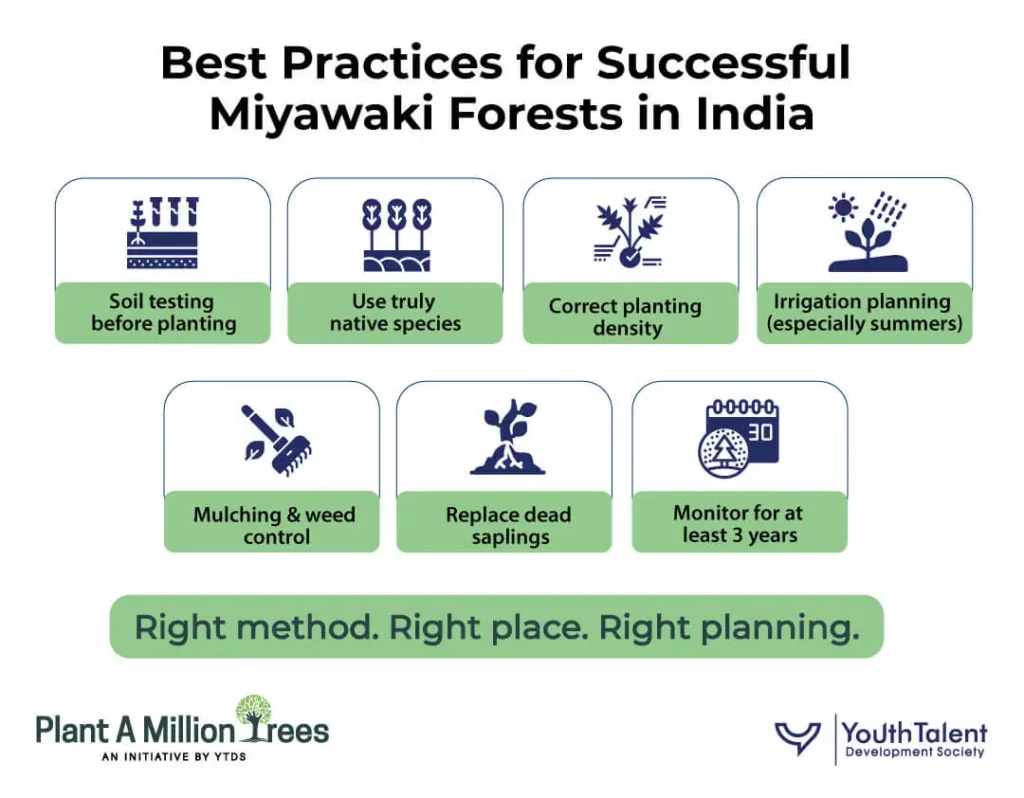
Miyawaki implementation in India needs discipline and exactness in order to be successful.
Pre-plantation testing of the soil should be compulsory. The addition of organic matter is to be done on basis of facts of the actual situation in the soil rather than guesswork. There is a need to choose species that are a real indigenous and are adapted to the local environment.
Planting density needs to be tailored as opposed to it being maximised through blindness. Irrigation schedule should include seasonal variations particularly in the summer seasons.
A follow-up period should last at least three years and has to be monitored with audit of survival and filling gaps where necessary. Accountability and long-term care is enhanced by community involvement.
Other organisations like Youth Talent Development Society (YTDS) have placed education and stewardship as fundamental aspects in which the plantations can become live ecosystems instead of symbolic projects.
The Miyawaki method is appropriate when land is limited, water is available, and long-term maintenance is guaranteed. It works well for urban institutions, campuses, and demonstration projects focused on awareness and biodiversity pockets.
It is not suitable for water-scarce regions, large rural landscapes, or projects without dedicated caretakers. In such cases, traditional or hybrid plantation models deliver better ecological returns.
Choosing Miyawaki should be a strategic decision, not a trend-driven one.
Yes, but only when applied in suitable locations with proper soil preparation, native species, and long-term maintenance.
High water demand, higher initial costs, and dependency on correct execution and monitoring.
No. It complements traditional methods but cannot replace large-scale ecological restoration.
Only those with transparent data, survival audits, and long-term monitoring should be considered credible miyawaki success stories India.
The Miyawaki approach is not something a miracle or a failure. In India, the results of it are solely a matter of context, discipline and ecological knowledge. When properly used, it can make successful urban forests. Being abused, it turns into a costly and a temporary measure.
Sustainable afforestation requires science rather than hype and appropriateness other than speed. The future of the green herbal recovery of India is in the selection of the appropriate procedure at the appropriate location, with or without the headlines, which is inspired by the ecology of the nation.
“How much land do we need for 1,000 trees?” is one of the first practical questions CSR teams ask...
Tree plantation has become an important part of corporate environmental sustainability initiatives in India. Companies are funding plantation drives,...
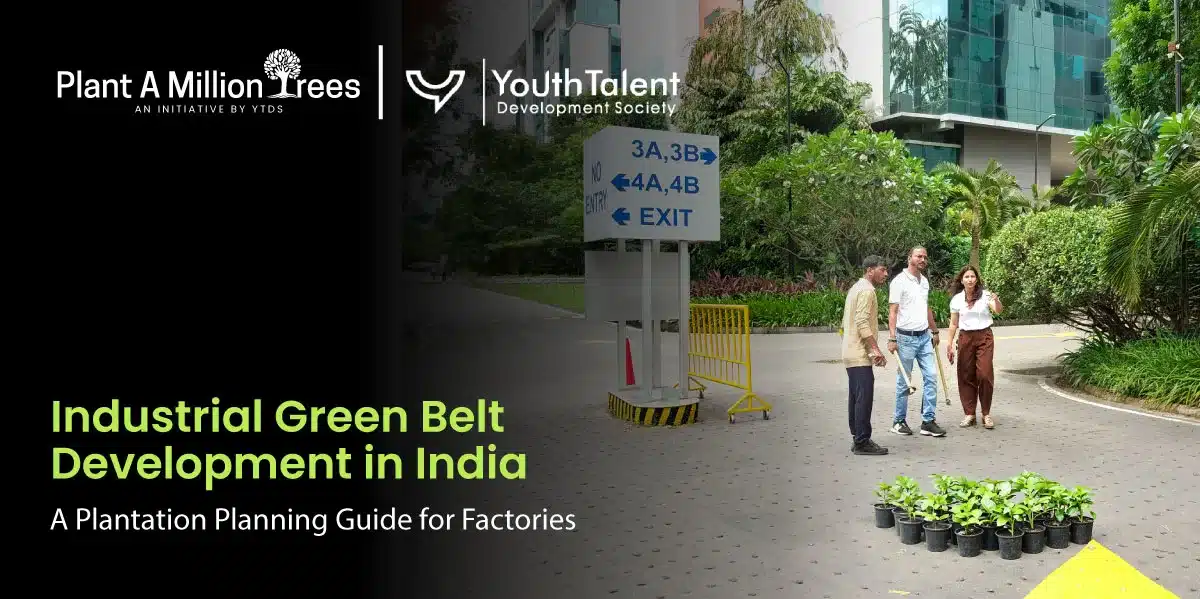
Industrial green spaces are often treated as rows of trees added around a factory boundary. In practice, effective green...