A company wants to take climate action, but the internal discussion quickly becomes confusing. One team suggests organizing a...

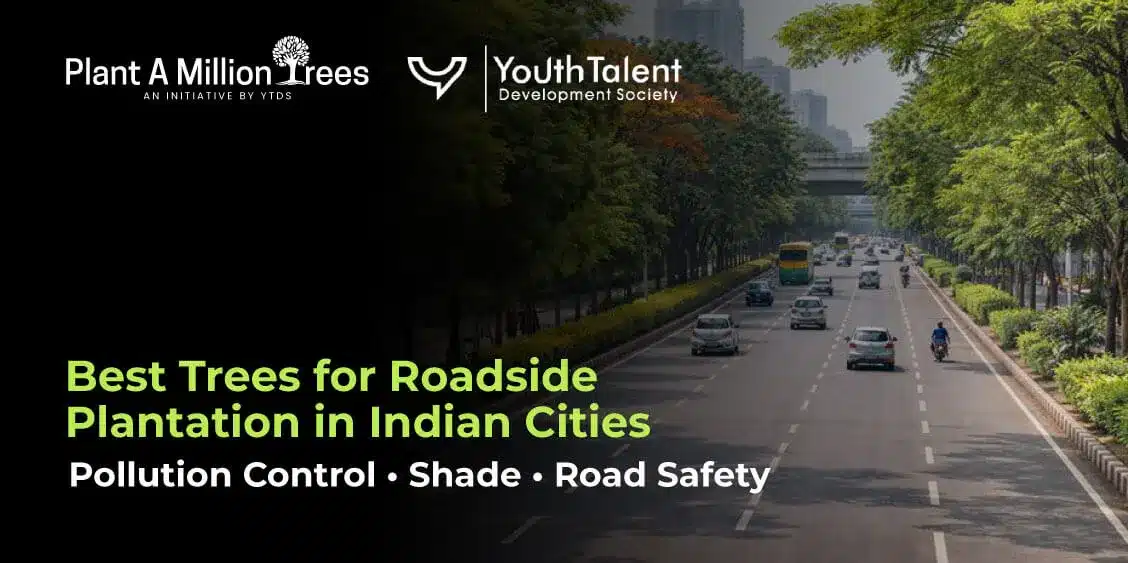
Take a walk on any Indian city road in the rush hour and the problems can be seen within second-the dust in the air as every automobile passes, heat blazing through asphalt, constant honking and people trying to find some kind of shade.
The cities in India are expanding at a high rate yet the road network is not able to cope with the environment conditions. This is where roadside trees are important.
Plantation trees India are not a mere decoration but necessary infrastructures in the city. They not only aid in air pollution mitigation, they also create shade, prevent dust, enhance road safety and they also make concrete intensive landscapes less hostile.
Trees planted correctly at appropriate locations form the first line of defence in protecting traffic pollution and in managing heat in cities in case they are selected and planted in the right places.
But the roadside plantation does not come that easily like planting any tree everywhere. Such adverse factors as poor species selection, lack of planning, and safety control may result in uprooted trees, damaged footpaths, and conflicts in maintenance.
This blog discusses the selection of the best trees to be used in a roadside plantation in Indian cities with high emphasis being given to pollution control, shade and safety.
Successful roadside plantation requires more than selecting pollution-tolerant trees. Site assessment, native species selection, infrastructure safety and long-term maintenance must be planned together. Learn about our urban tree plantation initiatives in Pune and how Plant A Million Trees supports greener, more resilient urban spaces.
Roadside trees actually provide a series of benefits at once and thus they are among the most effective urban greening methods.
They are also pollution control trees that absorb the dangerous gases emitted by vehicles like nitrogen dioxide and the particulates. The dust is trapped by their leaves and this enhances the air quality to commuters, pedestrians and residents who live close to them.
In places where temperatures are extremely high and sunny during the summer day the use of trees has been known to bring about a lot of shade and cooling of the surface temperatures as well as the ambient temperatures.
Trees are also the roadside trees that enhance road safety. Planted avenues obviously increase the visibility, minimize the glare, and keep drivers at a slower pace in a psychological manner.
They serve as a buffer between the traffic and the pedestrian areas in residential and institutional settings.
In every metro city up to the smaller towns (tier 2), the trees on urban roads will serve as the solution to the city heat island effect and the wellbeing of the city in general. Without them, the roads turn into dangerous areas instead of common public routes.
In spite of their significance, roadside plantations usually cannot work because of the practical problems. Space is an issue, often, underground utilities including cables, pipelines, and drains restrict the growth of roots.
The stress of pollution by automobile emissions kills saplings before they grow to maturity.
Damages, inadequate pruning, and absence of post plantation services results in further loss of life. In most instances, specialists select the wrong species in use, i.e. tree species whose roots are invasive, and other species that are weak-wood and thus, dangerous during storms.
These setbacks underscore one important lesson which is that roadside plantation is a technical process and not just a greening undertaking. The choice of trees which do not take into account urban constraints usually results to long term problems but not solutions.
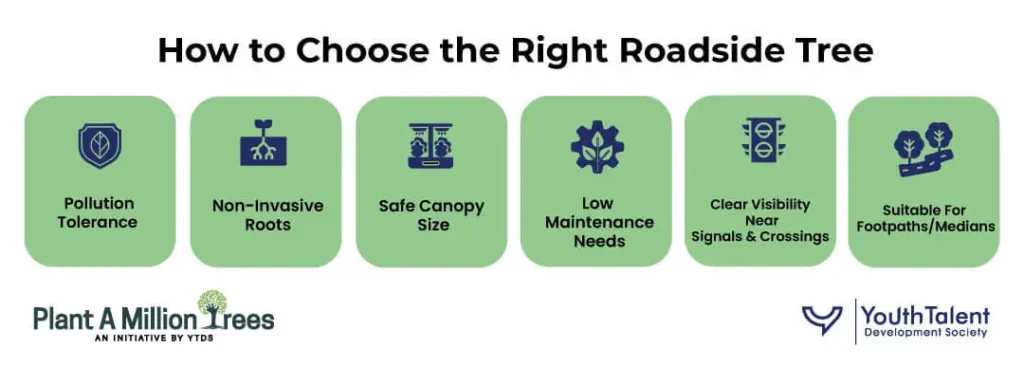
When choosing appropriate roadside trees, it must decide between the ecological benefits and safety as well as infrastructure requirements.
Canopy size is crucial. Trees must not be too big to leave some lighting of the streetlights and traffic signals. Root structure should not be invasive such that it causes damage to the pavements, drains, and roads.
The capacity to withstand pollution is a requirement, because trees and other vegetation found along road sides go through all-time emissions of dust and air.
Always safety and visibility should be able to come first. Signage, intersections, and pedestrian crossing should not be planted in between trees. Even maintenance requirements are an issue–those species which have to be pruned or watered often make the long term costs higher.
The planners of cities and local authorities that put these factors into special consideration make sure that the plantation initiatives along the avenues are successful, rather than debts.
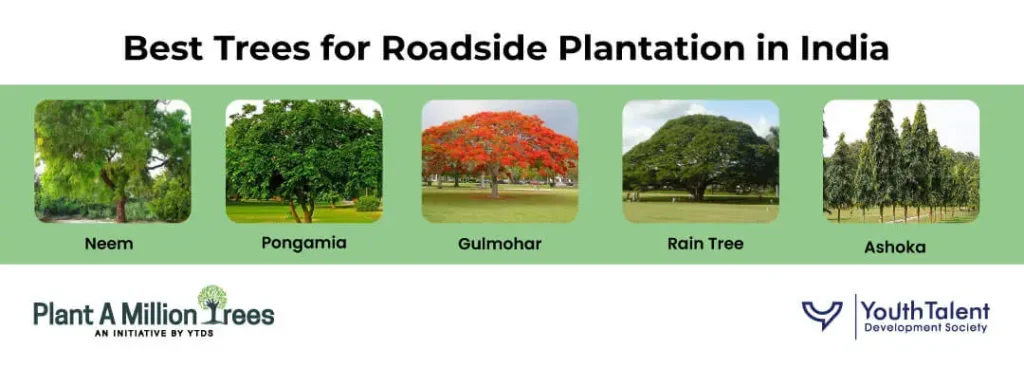
Diversity of climate in India allows a large variety of roadside plantations species, yet only a few species fulfill the requirements of a combination of such criteria as pollution tolerance, shade, and safety.
One of the most common trees that are preferred most in the roadside is the Neem because of its air-cleaning effects and its ability to endure hardship.
The Ashoka trees thrive well in narrow roads due to their straight growth and little root proliferation.
Jamun trees are dense shading and are not very sensitive to pollution.
The pongamia succeeds especially in the harsh roadside environment where its dust containing trees do not require much attention.
Rain Trees provide large canopies in wide roads and medians providing good visual identities and corridors of shade.
Gulmohar also contributes to aesthetic value, but it does not need overcrowding. Bamboo is also a good highway and service road boundary when planted selectively.
These trees are always listed as the best trees used in road side plantation in Indian city since it is sturdy and fits well in the city.
Roadside planting is not possible with all trees. Other species multiply so much without getting a good wood making it more dangerous to fall branches.
Others have root systems that destroy infrastructure or cause too much pollen that results in allergies.
Specific exotic species that have grown rapidly have had adverse negative effects in the long-term, such as groundwater loss and lack of biodiversity. Trees of weak wood are particularly hazardous in stormy regions and in highways characterized by a high rate of traffic.
It is equally important to avoid inappropriate species as well as to use the appropriate ones. Beautiful exclusion also increases safety and decreases maintenance expenses and the level of trust that people have in urban forestry initiatives.
The issue of roadside tree maintenance should be in favour of the public safety. Frequent pruning avoids the hindrance of the branches on the traffic indicateors and signs.
The trees are spaced properly to allow the trees to grow healthy in their canopies and provide clear visibility.
Young saplings are not harmed by tree guards, which ensure that they grow well by mulching and watering. There should be visibility that should be maintained close to intersections and crossings.
Maintenance, which is of the safety-first nature, does not only stop the accidents but also prolongs the life of the roadside plantation making it not a reoccurring cost but a sustainable one.
The maintenance of the trees on the roadsides should have a high priority on safety of people. Hedging is done regularly to ensure that branches do not hinder traffic lights and signage. Between trees there should be sufficient spacing that will have a healthy canopy as well as free views.
Young saplings are also guarded by tree guards to prevent any destruction and watering and proper mulching allows early development to take place. There should always be visibility at the crossings and intersections.
Safety-first maintenance does not only prevent accidents but also lasts longer in roadside plantations, hence it is a sustainable investment as opposed to an investment to be incurred over time.
Roadside plantations require careful assessment of underground utilities, traffic visibility, available planting space, native species, irrigation and long-term maintenance. A successful project must also include survival monitoring and proper documentation.
Plant A Million Trees supports companies and institutions through corporate tree plantation projects that can include site planning, suitable species selection, plantation execution, employee engagement, geo-tagged documentation and ongoing monitoring.
Discuss Your Plantation Requirement
Thoughtful plantation of roadside can be an effective way to change the cities as demonstrated by several Indian cities. The emphasis of native species in Pune that is tolerant to pollution has enhanced the microclimates of the roads.
The avenue plantations proposed in Chandigarh reveal the use of symmetry, space, and selection of species increasing the safety and beauty.
The urban forestry projects in Bengaluru provide an emphasis on community engagement and after-care of the plants. These cities demonstrate that when roadside is scientifically directed, planned and dedicated in the long term it works.
Younger groups like the Youth Talent Development Society (YTDS) have also contributed to creating awareness on the issues of responsible urban plantation, particularly, by involving citizens and educating them.
Neem, Ashoka, Jamun, Pongamia, Rain Tree, and Gulmohar are among the most suitable choices.
They trap dust, absorb pollutants, and reduce exposure to traffic emissions.
Yes, when non-invasive, strong-wood species are chosen and maintained properly.
Yes. Highway plantation using hardy, fast-establishing species improves safety, reduces glare, and controls dust.
There are no optional beautification tools, roadside trees are obligatory requirements of sustainable urban structure. The selection of the appropriate species, advance planning on safety and responsible maintenance of plantation all stabilize the fact that roadside plantation trees India indeed fulfill the promises that they made.
When properly done, roads will become green, cool, safe and healthier to all. It is a very basic principle, but it is effective: right tree, at the right place, doing the right job.
The safer and greener roads can be built today with informed choice of trees.
A company wants to take climate action, but the internal discussion quickly becomes confusing. One team suggests organizing a...

With every year we start with hope. We are making a vow to ourselves to be better health wise,...
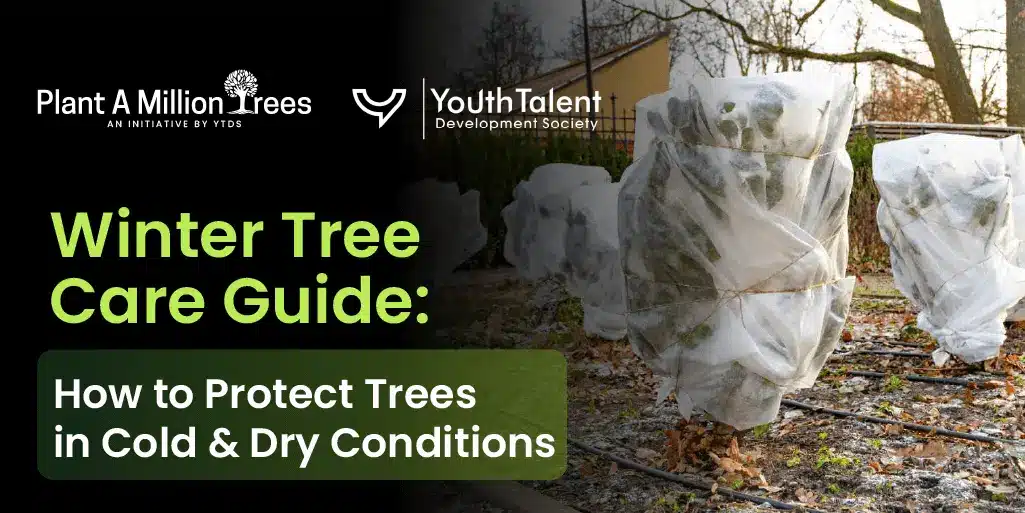
Indian winter does not necessarily have the same effect of Europe or North America where temperatures plunge to the...