
Monsoon in India does more than bring rain, it brings an opportunity to restore ecosystems. Every year, thousands of...


In one way or another, every Indian festival is surrounded by a tree behind. It is a tacit reality that is part of the subcontinent culture.
The worship of the flora is not exactly a rite and an obligation but a religious covenant, as evidenced by the towering canopies of the rainforest down to the very small potted herb resting on a verandah.
The deep-rooted and long-standing connection of trees and Indian festivals marks a rather different world vision in which the nature is not a resource that can be used but rather a divine being that must be venerated.
This innate worship is the foundation of millions of rituals, ceremonies, and festivals that give a cultural and even emotional structure to the relation between the human and the natural world.
Spirituality of Indian culture cannot be separated with ecology of land. This belief system revolves around trees, it is a symbol of life, strength, and time.
Even the most basic act of incorporating a particular leaf or branch in a ritual makes a otherwise ordinary plant a vehicle of the divine, a symbol of good fortune, and an entryway to divine energy.
This is the content of sacred trees India he is the dumb rooted witness of the thousands of years of human tradition and faith, a living testament to the belief that divinity exists in any and every form of creation.
The next few paragraphs discuss how this cultural tree tradition has influenced, on a case-by-case basis, the ethos of India.
To learn more about what trees play in the Indian culture, it is necessary to look out of botany and into theology. Trees are not merely plants, they are perceived to be living gods.
They are the grand mothers of life, they bring shade, sustenance and the air we inhale, and hence are, by default, the symbolic representations of purity, power and long life.
The whole body of belief is imbued with symbolism of a tree, the upwardness of a tree symbolizes the relationship between the heavens and the earth, a cosmic axis where life revolves around.
All the Vedas, Puranas and other folk traditions are full of references to such mythological trees. They can be described as the dwelling of deities, wisdom, and ghosts.
To give an example, the Kalpavriksha, wish-fulfilling tree is one of the central motives that indicate plenty and divine favor. This folklore value of trees is applicable to all aspects of life, it is said that each child is blessed, or shielded, and blessed, and at the end of life when there is a funeral, they are called upon to bring good fortune, safeguard and serenity.
They are accorded the honour of a noble elder, one thing taught by generations. This is the main concept of treating the sacred trees India: they are expressions of the divine feminine power (Shakti) and the masculine principle of creating (Brahma), hence their preservation is not an environmental task but a religious one.
This non-confrontational, religious philosophy has managed to preserve the cultural tree-religions in India over the millennium.
An annual list of Indian festivals is a colorful map of the cultural tree in a country that shows close interconnection of the change of the season and the holiday.
This nature worship which is practiced throughout the year by these traditions, which are tree centered in the Indian festivals.
The Diwali festival of lights involves the important rites of plants. There are toorans (door hangings) in homes made out of Mango leaves.
The Mango tree itself, not to mention the fruit, is believed to be very auspicious and a promise of prosperity and fruitfulness. Its leaves are also used because it is believed to keep evil away and bring Goddess Lakshmi.
Moreover, the tradition of using oil lamps out of doors may imply the usage of plant-based types of wicks and oils which also underline the relationship between the celebration and natural resources. These are the most conspicuous Diwali trees and plants.
The Shami tree ( Prosopis cineraria ) is also worshipped during Dussehra, particularly in Maharashtra and some territory of North India, is the one on which the leaves are exchanged as symbolic gold.
The reason behind the ritual is the mythology of the Pandavas hiding their weapons in Shami tree prior to their year of exile, and giving it the connotation of strength, success, and concealed power. The fact that its leaves have been changed is a recognition of the triumph of the good over the evil.
South India has a festival known as Pongal and Banana leaf and plant are widely used. They worship the Banana tree, which is considered a source of plenty, and also plant it and worship it in threes (mukkala).
The fact that it serves as a provider is illustrated by the fact that it is used as the traditional platters to serve the festive feast with its leaves.
Onam, another celebrated harvest festival in Kerala is a festival that involves making large floral carpets called Pookalam. Although it is technically not a tree ritual, the enormous diversity of the used flowers and plants as the festival ritual trees are plants collected in a local environment, which again confirms the reliance and appreciation of the community on its local ecosystem.
Tulsi Vivah is a good example of a ritual that is all about trees and in which the sacred Tulsi plant (Holy Basil) is ceremonially married off to Lord Vishnu. It is a ceremony that spells the end of the monsoon and the start of the wedding season.
Most importantly, as a representation of the Goddess Lakshmi, the Tulsi is the focus of the festival, which symbolizes purity and medical effects, supporting the notion of plants as spiritual and physical medicine.
These trees and plants unique to the festivals are vital in the identity as well as the implementation of the festivals, which further solidifies the notion that trees and Indian festivals are inseparable.
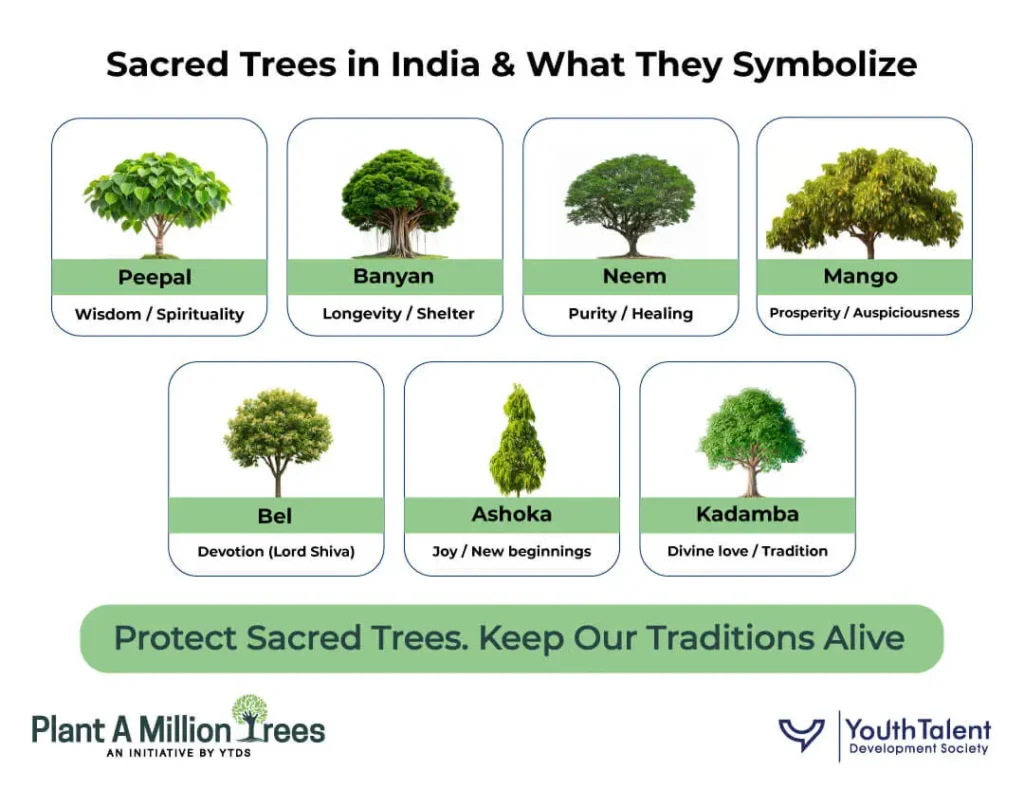
India has a rich and diverse pantheon of sacred trees, and the trees have their own myths, meaning, and practices. They are the breathing monuments of the Indian faith, which they give to the physical expression of ancient wisdom and symbolism of the tree.
Some of them are especially notable due to their omnipresence and profound spiritual meaning. This part discusses the sacred trees of the Indian culture and festivals with special attention to the most holy ones.
The Bodhi tree or the Peepal tree is probably the most respected tree in India. The Peepal significance is enormous as it is based on Hindu and Buddhist cultures. Hindus believe that it is the home of the Trimurti – Brahma, Vishnu and Shiva with Brahma being the root, Vishnu in the trunk and Shiva in the leaves.
Women circle the Peepal tree and tie threads around the tree and this is a common ritual that is believed to bring a long and healthy life to their husbands and family. Even when there is no wind, its incessant rustling is thought to be the sound of the gods.
The tree, in Buddhism is a universal symbol of wisdom, reflexion and spiritual awakening and Siddhartha Gautama achieved enlightenment on the tree.
The Banyan tree is easily identified by its hanging roots, which have been known to branch downwards to make new trunks, and hence the tree is able to cover expansive spaces.
This peculiar development course offers it the supreme symbol of long life, immortality, and endless extension. It has a hugely big canopy that gives it shelter and shades hence its worship as the tree of life.
The core of the festival of Vat Purnima is the Banyan meaning and is the one that married women offering prayers to make the husbands stay longer and healthy just like the tree. It is regarded as the seat of meditation of Lord Shiva which makes it even more sacred.
Neem is hailed in terms of its medicinal value and use in the purification of Neem. It is regarded as an incarnation of the Goddess Sitala who is the Goddess of smallpox and other illnesses and is commonly planted outside homes to clean the air and keep off diseases.
Its leaves and twigs are a part of all spring festivals, and they are eaten or used in baths to clean up the body and mind. The reason why Neem has such a bitter taste is its capacity to fight negativity and disease which is the power of nature.
Lord Shiva is especially attached to the Bel tree especially its trifoliate leaves. The trilaminar leaf is a representation of the three eyes of Shiva or Trimurti.
Providing Bel leaves to the Shiva Linga is regarded as one of the most auspicious worships, particularly during such festivals as Maha Shivaratri. The Bel is also deemed to be a divine gift and its fruit is used in the rituals to achieve prosperity and spiritual merit.
The Mango tree has a wide cultural importance beyond being used in Diwali. The flowers of it are connected with the spring coming and are even connected to the God of Love, Kamadeva.
The fact that it has a fruitful ability to yield is a strong symbol of fertility, abundance and prosperity of mango because of its prolific fruit-bearing capacity.
Its wood is commonly applied during religious fire ceremonies (havan), which means that it is pure and can serve as a transition between the world of matter and the world of spirit.
These are the holy trees that are used during the Indian culture and festivals, not the props, but their critical characters of Indian spirituality.
Worship of trees is not uniform in India; it is manifested in different and distinctive ways in various states, and it leads to interesting regional sacred trees India and practices. This local phrase is important in the realization of the extent of the cultural tree practices.
Kerala is known to have what is known as the tree of life, the Kalpavriksha (coconut tree) that is revered to give everything like oil, water, food and shelter.
It is central either in the economy or the culture, so its worship is a day to day activity. Some of the very old shrines of the temples of Tamil Nadu are characterised by a Sthala Vriksham (Temple Tree), a particular tree that is holy to the temple.
This tree is as revered as the idol, and symbolizes the primordial energy of the location. The Neem-Tulsi image is so widespread in the Deccan country that there are frequently two of them in the court of the temples or in the centre of the village, to signify the union of the divine masculine and feminine forces.
Sacred Groves (Devrai/Kavu) is a common idea in Maharashtra and the North-East. They are forested areas that are dedicated to a local god, and which are safeguarded by the community and not at all interfered with by man.
They are ancestral and living models of conservation, in which the forest is the temple, and all communities in the forest are sacred. In the Northeast, the focus of the traditions is often on the maintenance of the forest, and their tribal celebrations are linked to the well-being of the local nature.
The Bodhi trees (as descended offspring of the original Peepal) are also common in Buddhist temples, as the custom of worshipping the tree of enlightenment was continued.
Even the diversity of these practices, with the temple tree rituals of the South and the community sacred groves of the West, shows the geographical seriousness of Indian devotion to nature.
The ritualistic forms of nature in festivals India are actually a clever conservation system of the ancient conservation practices. The sacredness of the tree automatically prevents cutting of the trees and it is a crucial ecological advantage.
The festivals, which commonly follow the agricultural rhythm and transitions between seasons, covertly promote the continuity of the culture by prescribing the time of planting, rest, or harvest, as well as guaranteeing an ecological balance.
Such is the symbolic significance of trees in ceremonies that the usage of a particular branch or fruit towards a festival guarantees the well-being and reproduction of said species.
As an example, the utility of Mango leaves or Bel leaves in a given season ensures that the trees are treasured and preserved hence safeguarding the biodiversity in the past. The festivals were therefore, tacit environmental laws.
This green Indian culture was the primitive way of sustainable living. By marking a forest as a sacred grove, a community was establishing a micro-ecosystem, a survival pool of its own flora and fauna rather than a series of extinct species, which were under pressure from the environment.
Festivals are not only religious holidays, but they are archaic instruments of managing the community, of being mindful of the season, and, best of all, keeping in mind that the natural world, whether it is the giant banyan or the blade of grass, must be treated with respect and left to survive.
The old knowledge of the cultural trees of India provides a strong, practical way of going in an age where climate change and environmental degradation is the main driver of the world around us.
The issue is that it is necessary to turn the passive reverence into the active preservation to promote sustainable ritual activities and use eco-friendly festivals India.
The concept of Gifting a Green Legacy should be incorporated in celebrations in order to change it into one of the most effective. Rather than simply materialistic transactions, one can be able to encourage individuals to plant a tree on a festival a Banyan on Vat Purnima, a Mango sapling during Diwali, or a Peepal during the birth of their child.
This makes a short-lived celebration permanent contribution to the planet. As an illustration, Diwali may be turned into a Diwali of green with a special emphasis on biodegradable earthen lamps, making fewer firecrackers and planting Diwali trees as flowering shrubs as opposed to the consumption that is purely symbolic.
The transition has been facilitated by organizations such as in Youth Talent Development Society (YTDS) which are on the ground reinforcing the value of Bringing Back India: Green Traditions.
Their suggestion is the use of environmentally friendly festivals Indiaby through holding community planting drives along with the traditional festivals, so that the young people can learn to have more joy in celebrating, not through the environment, but by taking care of it.
The movement also links contemporary environmental science with the ancient ecological wisdom, and demonstrates that the ancient reverence is the most powerful kind of modern sustainability. We respect the religion of our ancestors but protect the future by making a conscious decision in favor of sustainability.
The trip to the festivals in India illustrates an indisputable truth, implying that Nature is the main temple and the most divine of the gods are trees.
The tree and Indian festivals relationship is holistic philosophy which has maintained so much of biodiversity and has also given rise to a culture where religion and ecology are inseparable.
The tradition of wisdom is an Indian heritage of the wisdom of the planting of the Banyan tree, the healing of the Neem, and the great, expansive embrace of a single tree.
It is a reminder of the fact that our spiritual, cultural and physical well being is inseparable with the well being of the green canopy that surrounds us.
When we celebrate our festivals, we need to renew this old relationship with making a conscious decision to save and preserve the very same trees that have been with us since time immemorial to give us our culture, our spirituality and our identity.
We should be motivated by the wisdom of our traditions to be the keepers of the green legacy that we have been given.
Monsoon in India does more than bring rain, it brings an opportunity to restore ecosystems. Every year, thousands of...

The degradation is experienced in almost one-third of the Indian land. Land degradation has become one of the gravest...
Came millions of trees in India in the past decades, placed in the country by government missions, CSR programs,...