
A company wants to take climate action, but the internal discussion quickly becomes confusing. One team suggests organizing a...


Indian winter does not necessarily have the same effect of Europe or North America where temperatures plunge to the point of freezing, but nonetheless there are challenges of Indian winter such as low temperatures, bone-chilling winds, soil drying out, frost in northern parts of India and a slowed-down biological process.
This is the time of vulnerability of trees, more so young saplings, which need special consideration. Home garden, community green patch, or maintain plantation drives, regardless of whether it is in organizations such as the Youth Talent Development Societ y (YTDS), knowledge of winter tree care practices in India is worthwhile in tree health and life.
This book of tips covers the ways to secure trees during winter season in India, the importance of taking care of them seasonally, stressors found during winter, how to water and mulch trees, pruning, and specifics of how to take care of trees in various regions.
At the conclusion, you will have an easily understandable practical strategic way half of the season, of how to maintain your trees to prevent injuries to your saplings until spring arrives.
The winter has its own impact on Indian landscapes in different areas, different places have suffered cold waves and frost in North India, dry winds in the West, freezing spells in Himalayas and cold nights and low humidity in part of South India. Whatever the area, trees experience seasonal stress due to:
All these stresses may be able to make saplings weak and vulnerable to attacks by pests or even to breakage of branches or even worse die off. That is why protect trees in winter procedures are important.
And snow also dehydrates the soil significantly. Although during colder weather evaporation is reduced, absence of rainfalls and powerful dry winds cycle water out of the upper layer of the soil.
Saplings, still young, having shallow roots, are the worst. Correct watering, mulching, pruning sparingly, and protection methods combined made the basis of the effective guidelines of winter tree care India.
Winter-specific problems may be neglected, and the health of the trees will decline in a very short time. The following are some of the most prevalent issues:
Frost in states such as Punjab, Haryana, Uttarakhand, Himachal Pradesh and Rajasthan is a usual occurrence in serious winter period. Frost rests upon leaves and young stems destroying plant tissues. Leaf burn is manifested in the form of brown or black spots that lead to the early fall of leaves.
Winter winds lower humidity and remove moisture on the soil. This, in turn, can lead to the suffering of even very robust native species. The problem of dehydration is one of the least considered in the situation of maintaining the trees seasonally, as most people have the erroneous idea that a tree should not be watered in winter.
The cold soil does not allow the absorption of nutrients. The response of roots is slow thus interfering with the general sapling vigor.
Uneven contracting of the bark of the trees can occur at extreme night-time cooling, particularly in young ornamental trees. This will result in cracks exposing the inner tissues to infection.
During the winter period, water scarcity occurs in Northwest India, small areas of Gujarat and in interiors of Maharashtra. Plants planted in monsoons find it difficult to survive unless they are well nurtured.
The knowledge of these winter tree issues that India employs would enable you to anticipate and establish a micro space that your saplings would would feel safe.

Although over watering is bad in cold months, total neglect is worse still. Watering during winter is aimed at ensuring constant soil water content- not to wet the soil. The effective practices are as follows:
Deep watering promotes downward growth in the root of the trees, which have slightly higher temperatures of the soil. This improves the stability and retention of moisture.
In watering in the morning, the moisture does not stand overnight as the water is applied before the weather changes to cooler conditions making chance of creating frostiness unlikely.
Soil is cold and wet and roots suffocated. Watering Before watering check the soil with your fingers (press the soil 1-2 inches deep). In case it is wet, take one day more.
Even though evaporation in winter is sluggish, there may be indoor regions and open regions where the loss of moisture may be accelerated. Quite regularly check on soil conditions in such climates.
In the case of sapling clusters, drip irrigation is frequently employed in organizations such as Youth Talent Development Society (YTDS) because it does not consume a lot of water, but offers an even flow of moisture.
Trees have been recommended to be mulched as a form of soil temperature maintenance, moisture, weeding and frost protection. The winter mulching is the equivalent of insulation–the stress of the sudden changes in the temperature is minimized.
Mulching plays a large role in the prevention of frost damages and stabilization of the microenvironment that is required to be able to survive winter.
It is crucial to prune out to get new growth, healthiness and shape but the winter needed a lighter hand. Sap flow is slowed down and hard pruning may subject the plant to undue stress.
Non-governmental organizations that participate in community forestry like YTDS focus on instructing volunteers in the basics of pruning. The right pruning techniques assist in the strengthening of the trees during spring and prevention of the damage caused by the winter periods.
A significant threat of winter is the wind chill. Powerful winds decrease the air temperature and depilitate the leaves, hastening drying.
Conservation of saplings in open spaces -farmlands, community plots, school grounds, and government plantations, can be achieved by simple measures.
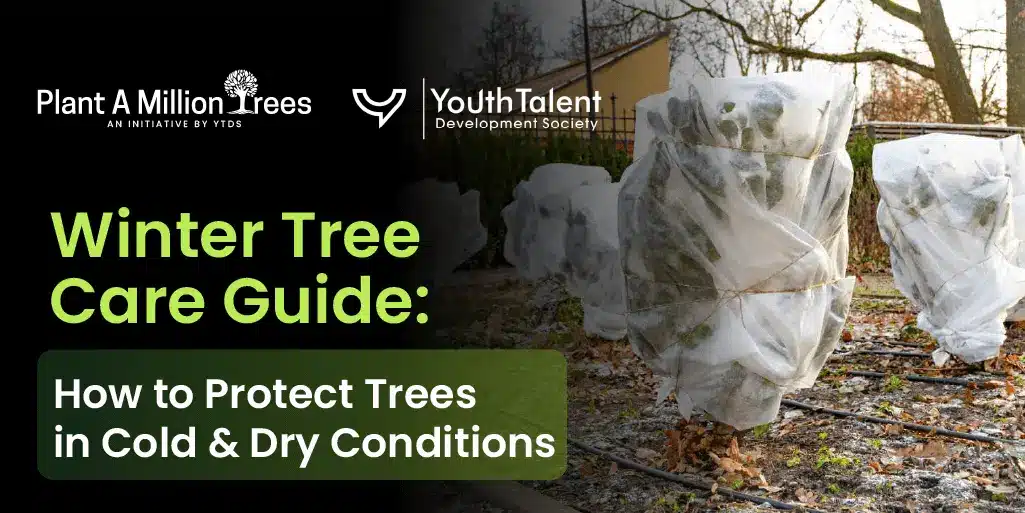
Winding trees, more so saplings with clothes which breathe well, offers protection against frost. Frost protection sheets sold commercially, burlap, and jute cloth are usually used.
Piling up straw mats, bamboo foliages or temporaries on saplings helps to keep wind at bay.
Plastic or bamboo trees cover animals as well as extreme winds.
The greater the layers of mulch, the warmer is the soil.
Cold and its resultant stem cracking can be saved by wrapping cloth or coir around the trunk in strips or failure to do so.
These are low-cost and basic techniques that lie at the heart of protect trees in winter exercises by communities, non-governmental organizations and plantation initiatives.
The diversity of the climate in India implies the particular winter tree care practices in each area.
Regional customization of care will be effective in terms of winter tree care India programs which will be responsive to local climatic realities.
While excessive watering is harmful in cold months, complete neglect is even worse. The goal of watering in winter is to maintain stable soil moisture—not to saturate the ground. Here are effective practices:
Such organizations as Youth Talent Development Society (YTDS) and other environment protection agencies focus on community-based winter protection models. Key learnings include:
These techniques establish ownership that is sustainable over the long term and enhance survival of saplings whilst they grow beyond the period.
Yes. Although the rate of evaporation is lower, wind and dry conditions make soil dry. Winter watering should be done with control so as to avoid dehydration.
The benefits of mulching include soil insulation, moisture retention, maintenance of root health and prevention of frost penetration and soil fertility.
Little pruning should be used. Extreme pruning subjects internal tissues to cold winds. Only available dead or frost-damaged branches have to be removed.
Plastic should be avoided because it is airtight, entraps water, and rot. Use burlap, jute or breathable frost cloth instead.
Organisations such as YTDS focus on mulching, systematic supervision, frost sheets, and the youth stewardship programmes to sustain the survival of saplings.
Winter may sound silent, but it is a very important period of keeping trees healthy. Once we know the impacts of cold winds, low humidity, frost, and slow growth, we will be able to make the conscious efforts to protect saplings against environmental stress.
The key thing is that whether you are a home gardener, school volunteer or a CSR participant or even part of an NGO such as the Youth Talent Development Society (YTDS), having the right strategies on winter tree care in India makes sure that the trees not only survive but also grow.
The four fundamental components of the protection of trees during winter season in India include deep watering, tree mulching, moderate pruning and physical protection.
These measures need uniformity over complication. Several hours of seasonal attention would save the time spent in the plantation drives and bring saplings to maturity.
There are no seasons more in need of us than winter. Keep them safe till spring and they will bloom in their beauty.
A company wants to take climate action, but the internal discussion quickly becomes confusing. One team suggests organizing a...

It is a conversation that has been made in every housing society. Why year after year are things growing...

Take a walk on any Indian city road in the rush hour and the problems can be seen within...