Tree plantation becomes far more valuable when it is connected to measurable sustainability goals rather than treated as a...

Most plantation failures are not visible on day one, they are discovered months later.
A tree plantation drive may begin with enthusiasm, planning, and community participation. Saplings are planted, reports are generated, and the project is often considered “complete.” But real success does not depend on planting day,it depends on what happens after.
Six months is a critical checkpoint. By this time, saplings have either established themselves or started showing signs of stress. Ignoring this phase means missing the opportunity to correct issues early.
This is where tree plantation audit India becomes essential.
A structured audit helps evaluate survival, growth, site conditions, and maintenance practices. It transforms plantation from a one-time activity into a measurable, outcome-driven process.
If you are wondering how to audit tree plantation site after 6 months in India, this guide provides a simple, practical checklist to assess real impact and improve survival outcomes.
The first six months after plantation are crucial for sapling survival. This period typically includes initial root establishment, adaptation to soil conditions, and exposure to environmental stress.
During this phase, several challenges may arise, insufficient watering, pest attacks, soil compaction, or damage from grazing animals. If these issues are not identified early, they can lead to significant losses.
A post plantation review at six months allows teams to:
Waiting longer can reduce the chances of recovery. Early intervention improves outcomes significantly.
In practical terms, a six-month audit acts as a health check for the plantation.
A tree plantation audit is a structured evaluation of a plantation site to assess its performance and condition.
It goes beyond counting trees. A proper audit examines survival, health, growth, soil conditions, irrigation, protection measures, and maintenance practices.
Think of it as a comprehensive inspection process that answers key questions:
In the context of plantation inspection India, audits help verify whether a project is delivering real environmental impact.
They also provide data for reporting, decision-making, and future planning.
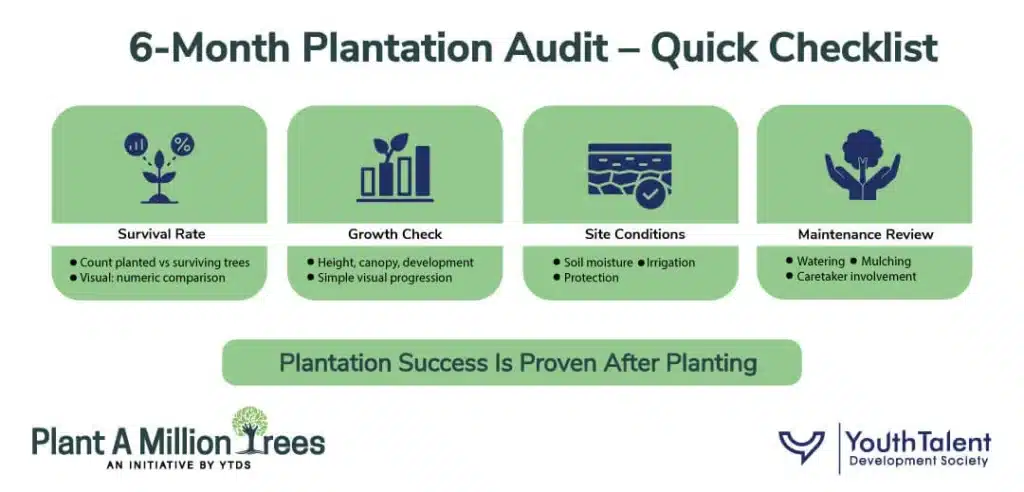
The first and most important step in a survival audit trees process is checking how many saplings have survived.
Start by counting the total number of saplings originally planted. Then count the number of saplings still alive after six months.
The survival rate is calculated as:
(Number of surviving trees ÷ Number of trees planted) × 100
For example, if 1,000 saplings were planted and 700 are still alive, the survival rate is 70%.
A survival rate above 70% is generally considered acceptable, while well-maintained projects can achieve 80–90%.
During the sapling survival check, also note the condition of surviving trees. Some may be alive but weak, which indicates potential future losses.
This metric provides the foundation for evaluating plantation success.
Survival alone is not enough. Trees must be healthy to grow and contribute to environmental impact.
Health assessment involves simple visual observations that anyone can perform without technical expertise.
Look for leaf color. Healthy trees usually have green, vibrant leaves, while yellowing or browning may indicate stress or nutrient deficiency.
Check for signs of pests or disease. Holes in leaves, sticky residue, or unusual spots may signal infestation.
Observe overall structure. Weak stems, drooping branches, or stunted growth may indicate poor conditions.
These indicators form the basis of plantation inspection India and help identify early warning signs.
Healthy trees are more likely to survive long-term, making this step critical in the audit process.
Growth is another important indicator of plantation success.
After six months, saplings should show visible progress. This can be measured through simple indicators such as height, canopy development, and stem thickness.
Compare current height with initial planting height to assess growth rate. Even modest growth indicates that the tree is adapting well.
Check canopy spread. New leaves and branches suggest healthy development.
Avoid overly technical measurements. Basic observations are sufficient for most audits.
Tracking growth helps differentiate between trees that are merely surviving and those that are thriving.
Even the healthiest saplings depend on supportive site conditions.
During the audit, assess soil moisture levels. Extremely dry soil may indicate inadequate watering, while waterlogged conditions can harm roots.
Check irrigation systems. Ensure that water is reaching all parts of the plantation.
Inspect protection measures. Tree guards, fencing, or barriers should be intact and effective.
Look for signs of human or animal interference. Grazing, trampling, or vandalism can damage saplings.
These observations form a critical part of the plantation monitoring checklist and help identify environmental constraints.
Maintenance is the backbone of plantation success.
During the audit, review watering schedules. Are trees being watered regularly, especially during dry periods?
Check for mulching around saplings. Mulch helps retain moisture and improve soil health.
Inspect pruning practices. Removing dead or damaged branches supports healthy growth.
Evaluate caretaker involvement. Whether it is a community group, NGO, or contractor, active engagement is essential.
This step highlights the importance of post plantation care India and ensures that ongoing efforts are aligned with project goals.
A structured audit checklist CSR helps ensure consistency and completeness during inspections.
Following this checklist ensures that audits are systematic and actionable.
Six-month audits often reveal recurring challenges.
Low survival rates due to poor site preparation or species mismatch.
Pest infestations affecting young saplings.
Water stress caused by irregular irrigation.
Soil degradation or compaction limiting root growth.
Damage from grazing animals or human activity.
Identifying these issues early allows teams to take corrective action and prevent further losses.
An audit is only useful if it leads to action.
For low survival areas, consider replanting with more suitable species.
Improve irrigation systems to ensure consistent water supply.
Address pest issues using organic or appropriate control methods.
Upgrade protection measures to prevent damage.
Enhance soil quality with compost or organic matter.
These steps help improve survival rates and strengthen plantation outcomes.
Continuous improvement is key to long-term success.
Community involvement plays a vital role in plantation success.
Local participation ensures regular monitoring, watering, and protection. It also builds ownership and accountability.
Organizations such as the Youth Talent Development Society (YTDS) often emphasize post-plantation audits and monitoring as critical components of successful plantation programs.
When communities and organizations work together, plantations become sustainable ecosystems rather than short-term projects.
Because it helps identify early issues and improve survival rates before it is too late.
Survival rate, tree health, growth, site conditions, and maintenance practices.
(Number of surviving trees ÷ number planted) × 100.
Yes, basic audits can be done using simple visual indicators.
Corrective actions are taken to improve plantation outcomes.
Plantation success is not proven on planting day, it is proven in audits.
A six-month tree plantation audit India provides the insights needed to measure real impact, identify challenges, and improve outcomes.
By following a structured plantation monitoring checklist, organizations can ensure that their efforts translate into long-term environmental benefits.
The takeaway is simple:
Plantation success is proven in audits, not on day one.
Tree plantation becomes far more valuable when it is connected to measurable sustainability goals rather than treated as a...

Tree plantation has become one of the most visible CSR initiatives undertaken by companies across India. Every monsoon, organizations...

A successful CSR tree plantation project begins long before the first sapling is planted, it begins with choosing the...